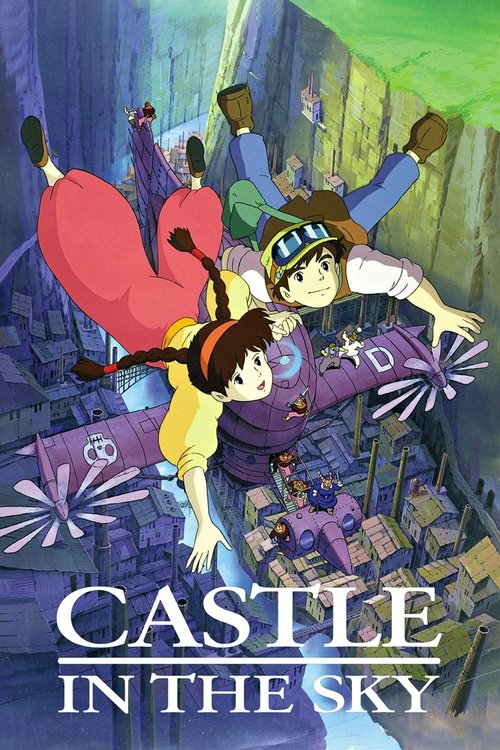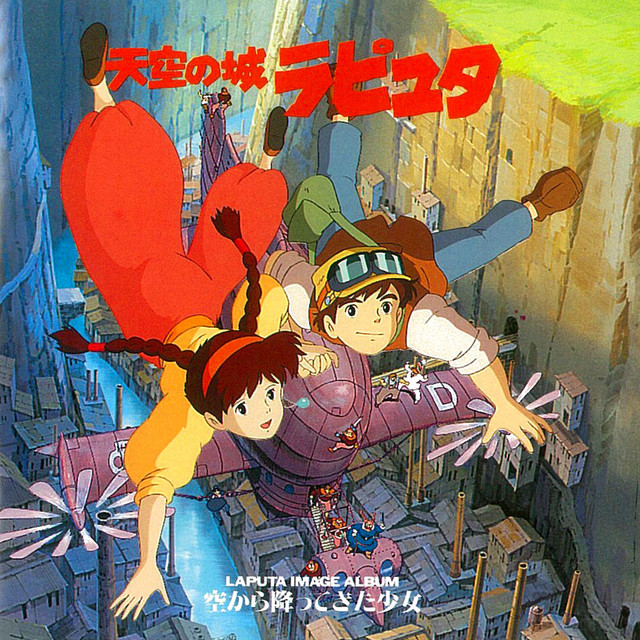
Album: 天空の城ラピュタ イメージアルバム ~空から降ってきた少女~
When Joe Hisaishi sat down at his piano at 11:30 PM one fateful evening in 1986, he had no idea he was about to compose what would become one of Studio Ghibli’s most beloved themes. The melody that emerged in just twenty minutes would later be known as “Kimi wo Nosete” (Carrying You), but its journey began with “Hikoishi” (The Flying Stone), a piece that captures the very essence of Hayao Miyazaki’s vision for Castle in the Sky.
The pressure Hisaishi felt during the creation of this image album was immense. Having reconnected with Miyazaki and Isao Takahata after their successful collaboration on Nausicaä, he carried the weight of expectation. “I absolutely had to create something wonderful,” he reflected, describing the silent pressure that haunted him daily during recording sessions at Wonder Station and Nikkatsu Studio Center.
This pressure stemmed from a profound responsibility. The conceptual framework provided by Miyazaki and Takahata was nothing less than “what adults must leave for children now.” It was a mission that required Hisaishi to dig deep into his understanding of childhood wonder, adventure, and the delicate balance between dreams and reality.
“Hikoishi” embodies this philosophy through its gentle, ascending melodic lines that seem to float like the mystical stone itself. The piece unfolds in a major key with a tempo that suggests both weightlessness and forward momentum, perfectly capturing the duality of the flying stone as both a source of incredible power and childlike wonder. Hisaishi’s instrumentation choices reflect his deliberate shift toward acoustic simplicity, a stark contrast to his previous work on “Arion,” which had been heavy with sound samples.
Miyazaki’s conceptual notes for the “Castle of Time” spoke of “shining cloud peaks beyond, yearning, lost paradise, darkness containing both wicked and beautiful things, mystery.” These images found their musical translation in Hisaishi’s composition, where major and minor tonalities interweave like light and shadow, creating an emotional landscape that children could instinctively understand while adults recognized its deeper complexities.
The creative process was far from smooth. Hisaishi made a radical decision early on to center the entire score around acoustic sounds, abandoning the electronic textures that had defined much of his previous film work. This choice aligned perfectly with his core philosophy for Laputa’s music: to create melodies that conveyed love, dreams, and adventure while warming children’s hearts through clear, honest musical storytelling.
When Hisaishi handed over that midnight melody, he expected it to be just another piece in the collection. Instead, Miyazaki immediately recognized its potential as the main theme, completely restructuring the musical architecture of the film. “Everything got turned upside down,” Hisaishi recalled, highlighting how spontaneous creativity often produces the most powerful results.
The final polishing of the image album took place at London’s prestigious Air Studio, where mixing engineers Steve Jackson and Masayoshi Ohkawa helped bring Hisaishi’s vision to life. This international collaboration resulted in what Hisaishi described as music that was “bright and lively,” qualities that “Hikoishi” exemplifies through its crystalline textures and buoyant rhythmic feel.
Miyazaki’s lyrics added another layer of meaning to the musical foundation Hisaishi had created. The composer noted how phrases like “that horizon” immediately placed the listener’s gaze skyward, while unconventional word choices such as “many lights” possessed a poetic quality that professional lyricists rarely achieve. This partnership between Miyazaki’s visual poetry and Hisaishi’s melodic storytelling created something greater than either could have accomplished alone.
“Hikoishi” represents more than just background music for an animated sequence; it embodies a philosophy about the relationship between technology and nature, between adult responsibility and childhood innocence. The flying stone itself becomes a metaphor for music’s power to lift us above earthly concerns while keeping us grounded in human emotion.
Listening to “Hikoishi” today, we hear the sound of a composer finding his voice under pressure, creating acoustic beauty from conceptual complexity. Every phrase carries the weight of that midnight inspiration, transformed through careful craftsmanship into something that continues to move listeners across generations. In those twenty minutes at 11:30 PM, Hisaishi didn’t just write a melody; he captured the essence of flight itself, both literal and metaphorical, creating a musical flying stone that continues to carry us toward our own distant horizons.
- 天空の城ラピュタRead Review
- ハトと少年Read Review
- 鉱夫Read Review
- 飛行石Now Playing
- ドーラRead Review
- シータとパズーRead Review
- 大樹Read Review
- フラップターRead Review
- 竜の穴Read Review
- ティディスの要塞Read Review
- シータとパズーRead Review
- 失われた楽園Read Review