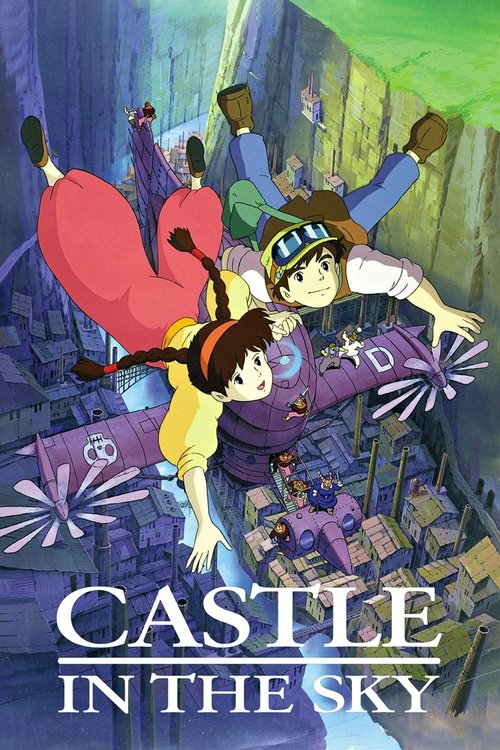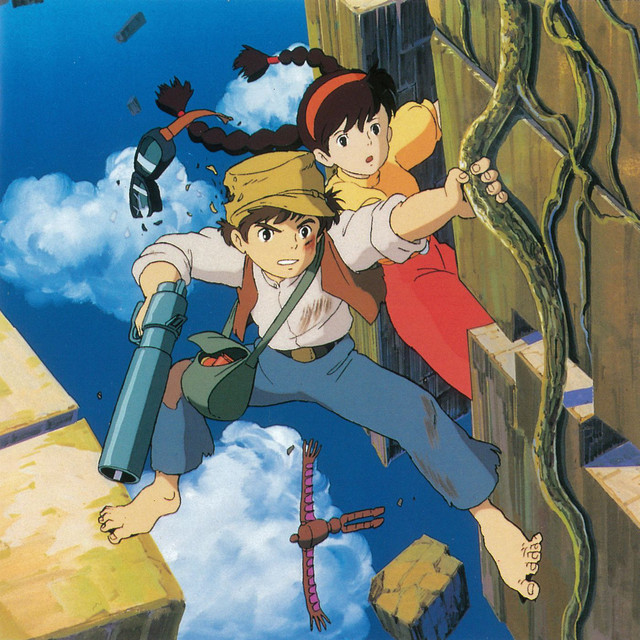
Album: 天空の城ラピュタ サウンドトラック ~飛行石の謎~
In a cramped coffee shop near Studio Ghibli in June 1986, three men huddled over rough film cuts and sketchy musical ideas that would soon become one of animation’s most beloved soundtracks. Joe Hisaishi, Hayao Miyazaki, and Isao Takahata were deep in discussion about the music for Castle in the Sky, but this wasn’t your typical film scoring session. Hisaishi had made a radical decision: every note would be synchronized to match the animated movement on screen, frame by frame.
“Morning in Slug Valley” exemplifies this meticulous approach perfectly. The track, which accompanies one of the film’s quieter moments, showcases Hisaishi’s commitment to what he called “complete unity between visual movement and musical flow.” Unlike traditional film scoring where music provides emotional backdrop, Hisaishi demanded that each musical phrase correspond precisely to the animation’s rhythm and pacing.
The technical process was revolutionary for its time. Working with a Fairlight III sampler at Wonder Station, Hisaishi would study rush film footage, timing each visual cue down to the second. He’d input this data into the sampler to create basic rhythm tracks that would serve as the foundation for the full orchestral arrangements. This method meant that when the 50-piece orchestra gathered at Nikkatsu Studio on July 8th, every musician was essentially performing to a digital metronome calibrated to Miyazaki’s animation.
“Morning in Slug Valley” reflects another crucial aspect of Hisaishi’s philosophy for this project: acoustic simplicity over electronic complexity. After his work on “Arion,” which featured extensive sound sampling, Hisaishi deliberately chose to center Laputa’s score around traditional acoustic instruments. The morning valley piece features gentle woodwinds and strings in a pastoral F major, with a tempo that mirrors the unhurried pace of dawn breaking over the countryside.
This compositional approach stemmed from Miyazaki’s initial concept notes, which Hisaishi received during the early planning stages. The director had written about “the castle of time” and “lost paradise,” describing imagery of “shining cloud peaks beyond, yearning, darkness containing both evil and beautiful things, mystery.” These poetic fragments became Hisaishi’s creative compass, pushing him toward music that could capture both wonder and melancholy.
The irony is that while Hisaishi was crafting intricate pieces like “Morning in Slug Valley” with surgical precision, the film’s main theme “Carrying You” came to him in a burst of spontaneous creativity. Written in just twenty minutes around 11:30 PM, it wasn’t intended as a main theme at all. When Miyazaki heard it and declared “Let’s make this the main theme,” Hisaishi felt everything had been “completely turned upside down.” Yet this contrast between calculated precision and intuitive inspiration perfectly captures the dual nature of his Laputa score.
Hisaishi’s basic concept for the entire soundtrack was deceptively simple: create melodies that would let children feel warmth in their hearts while experiencing love, dreams, and adventure. “Morning in Slug Valley” achieves this through its unhurried pace and major key harmonies, but the technical execution required extraordinary discipline. Every crescendo, every instrumental entrance, every dynamic shift had been pre-planned to match specific moments in the animation sequence.
The recording schedule was equally precise. After the June 23rd coffee shop meeting, Hisaishi had just over two weeks to complete everything. He began rhythm programming on June 24th, recorded the full orchestra on July 8th, and finished the final mix-down by July 12th. This compressed timeline meant there was no room for second-guessing or extensive revisions.
What makes “Morning in Slug Valley” particularly effective is how it balances Hisaishi’s technical precision with organic musical expression. The piece feels natural and breathing despite being constructed to match predetermined visual cues. The gentle interplay between solo flute and string ensemble creates a sense of pastoral peace that perfectly complements the valley’s serene atmosphere in the film.
This approach influenced an entire generation of anime composers who began to see film music not just as emotional support but as integral narrative element. Hisaishi’s insistence on frame-accurate synchronization raised the bar for how seriously animated films could take their musical components.
Looking back, “Morning in Slug Valley” represents both the culmination of traditional orchestral film scoring and the beginning of a new digital precision age. Hisaishi managed to honor the romantic tradition of symphonic cinema while embracing cutting-edge technology, creating music that sounds timeless despite being created through revolutionary methods. The result is a soundtrack where technical innovation serves purely musical ends, producing pieces that work as standalone compositions while fulfilling their precise dramatic functions within Miyazaki’s animated world.
- 空から降ってきた少女Read Review
- スラッグ溪谷の朝Now Playing
- 愉快なケンカ(~追跡)Read Review
- ゴンドアの思い出Read Review
- 失意のパズーRead Review
- ロボット兵(復活~救出)Read Review
- 合唱 君をのせてRead Review
- シータの決意Read Review
- タイガーモス号にてRead Review
- 破滅への予兆Read Review
- 月光の雲海Read Review
- 天空の城ラピュタRead Review
- ラピュタの崩壊Read Review
- 君をのせてRead Review