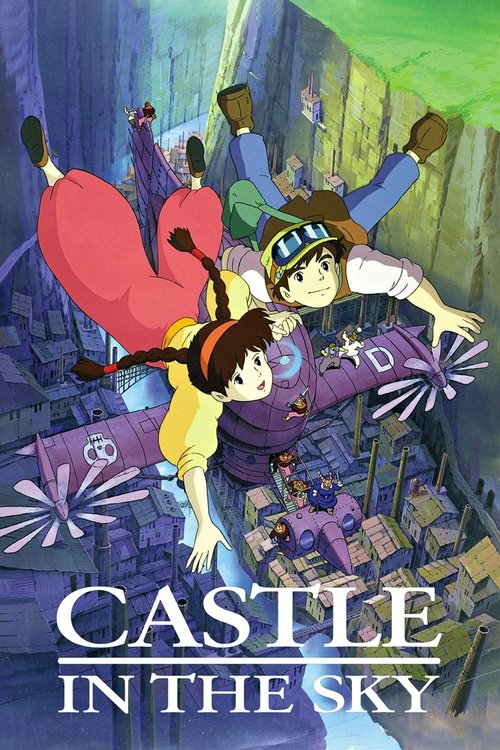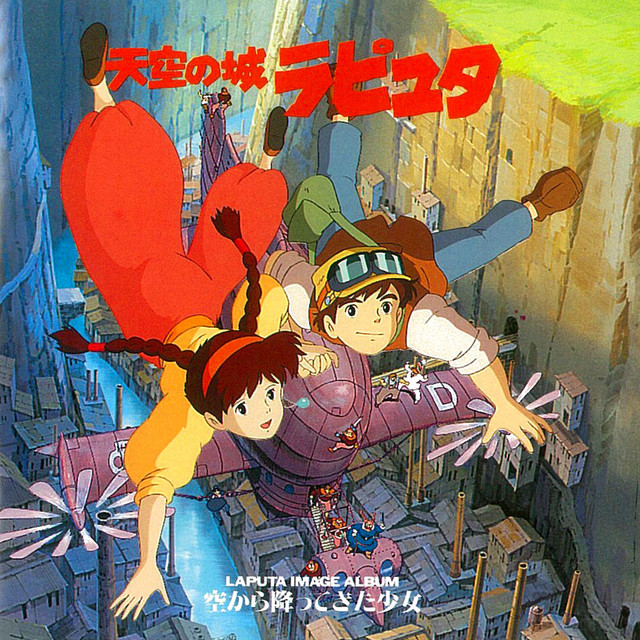
Album: 天空の城ラピュタ イメージアルバム ~空から降ってきた少女~
What happens when a composer faces the impossible task of capturing humanity’s most precious gift to children through music? For Joe Hisaishi in 1986, this philosophical challenge became the driving force behind one of Studio Ghibli’s most beloved soundtracks, particularly embodied in the haunting piece “Ushinawareta Rakuen” (Lost Paradise) from Castle in the Sky’s image album.
The weight of expectation pressed heavily on Hisaishi’s shoulders as he entered the studio that March. Fresh from his successful collaboration on Nausicaa, he found himself reunited with directors Hayao Miyazaki and Isao Takahata, but this time with a profound mandate: create music that answered the question “What must adults leave for children today?” This wasn’t merely about composing a film score; it was about distilling hope itself into sound.
“Lost Paradise” emerged from this pressure cooker of artistic responsibility as perhaps the most emotionally complex piece on the image album. While Castle in the Sky is often remembered for its soaring adventure themes, this particular composition delves into something more melancholic—a reflection on what we lose as we grow up, and what we desperately hope to preserve for the next generation.
Hisaishi’s approach to the entire project marked a deliberate shift from his previous work. Where his score for Arion had been dense with sonic samples and electronic textures, Castle in the Sky demanded something fundamentally different. He stripped back to acoustic instruments, centering the music around what he called “melody that can be properly heard.” This philosophy manifests beautifully in “Lost Paradise,” where a simple piano melody in a minor key carries the emotional weight, supported by subtle string arrangements that seem to float like clouds.
The technical precision behind this apparent simplicity was revolutionary for Japanese cinema. Hisaishi pioneered the use of computer-assisted timing, synchronizing music to film with 0.1-second accuracy—a level of detail previously unheard of in the industry. While “Lost Paradise” appears on the image album rather than the film itself, it benefited from this same meticulous approach to emotional timing. Each phrase seems perfectly calibrated to match the rise and fall of memory, the bittersweet recognition of innocence lost.
Miyazaki’s creative notes to Hisaishi during this period reveal the poetic thinking behind the music. His description of flight—”swarming like flies, fleeing like flies, returning like flies”—captures something essential about childhood’s relationship to dreams. “Lost Paradise” embodies this same contradictory motion: reaching toward something beautiful while simultaneously mourning its absence.
The recording process itself became a journey of discovery. Sessions took place at Wonder Station and Nikkatsu Studio Center in Japan, but Hisaishi insisted on completing the final mix at London’s legendary Air Studios. Working with engineers Steve Jackson and Masayoshi Ohkawa, he transformed these intimate compositions into what he described as “bright and lively” pieces, even when dealing with themes of loss.
This paradox—finding brightness within sadness—defines “Lost Paradise” perfectly. The piece operates in a gentle 4/4 time signature with a tempo that suggests both a lullaby and a funeral march, creating space for reflection without overwhelming the listener. Hisaishi’s orchestration choices are telling: the prominence of woodwinds suggests the breath of life, while sustained strings provide a cushion of memory.
What makes this composition particularly powerful is how it functions as both a standalone piece and part of the larger Castle in the Sky universe. On the image album, it serves as emotional counterpoint to the more adventurous themes, reminding us that every great journey involves leaving something behind. The title itself—Lost Paradise—suggests both Eden and childhood, those perfect states we can never truly return to but must somehow honor.
Hisaishi later reflected that the daily pressure of creating “something wonderful” during the recording sessions was almost overwhelming. Yet this pressure produced music of extraordinary emotional honesty. “Lost Paradise” doesn’t try to comfort us with false promises that everything will be okay. Instead, it acknowledges loss while affirming that beauty can emerge from that acknowledgment.
The London mixing sessions proved crucial to achieving this delicate balance. Air Studios, with its reputation for clarity and warmth, allowed Hisaishi to find the perfect sonic environment for these fragile emotions. The final version of “Lost Paradise” achieves something remarkable: it sounds both intimate and expansive, personal yet universal.
Listening to “Lost Paradise” today, more than three decades after its creation, the piece feels prophetic. Hisaishi’s question about what adults must preserve for children resonates even more urgently in our current moment. The composition suggests that perhaps what we must leave behind isn’t just clean air and water, but the capacity for wonder itself—the ability to find beauty in impermanence, hope in loss, and paradise in the very act of remembering what we’ve left behind.
- 天空の城ラピュタRead Review
- ハトと少年Read Review
- 鉱夫Read Review
- 飛行石Read Review
- ドーラRead Review
- シータとパズーRead Review
- 大樹Read Review
- フラップターRead Review
- 竜の穴Read Review
- ティディスの要塞Read Review
- シータとパズーRead Review
- 失われた楽園Now Playing