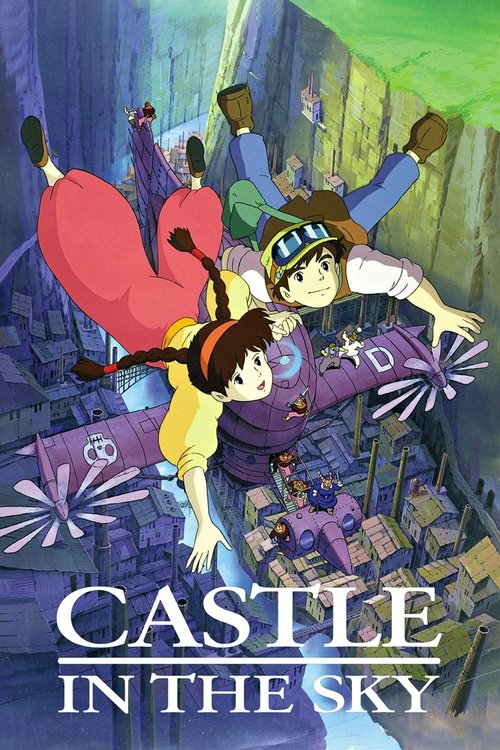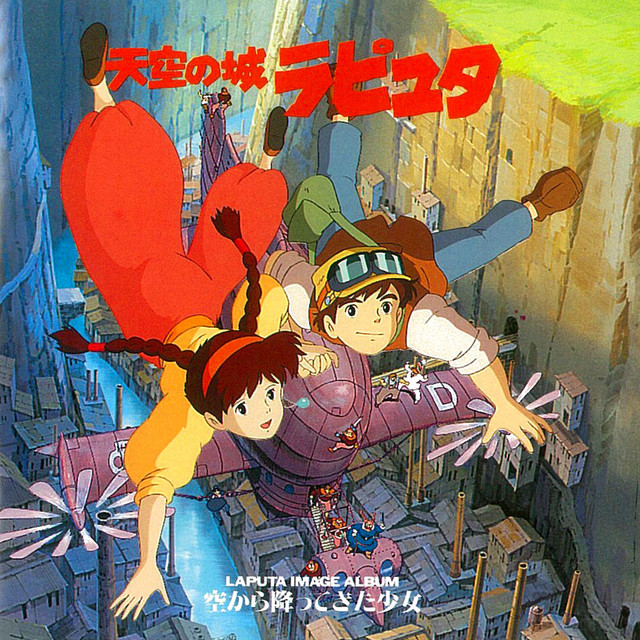
Album: 天空の城ラピュタ イメージアルバム ~空から降ってきた少女~
In the spring of 1986, composer Joe Hisaishi found himself under extraordinary pressure. Having reunited with directors Hayao Miyazaki and Isao Takahata after their successful collaboration on Nausicaä, he was tasked with creating music that would answer a profound question: “What must adults leave for children today?” The result of this creative challenge would become one of Studio Ghibli’s most beloved soundtracks, with “Sheeta and Pazu” serving as a perfect embodiment of Hisaishi’s musical philosophy.
The track appears on the image album “Castle in the Sky Image Album ~ The Girl Who Fell from Heaven,” a collection that employed an unprecedented two-stage composition process. Rather than scoring directly to finished animation, Hisaishi first created this standalone musical interpretation of Miyazaki’s story concepts. This approach allowed both composer and director to enter subsequent discussions with shared musical vocabulary already established in their minds.
“Probably no one else is doing anything like this,” Hisaishi reflected on this innovative method. The strategy proved invaluable during production meetings, where conversations could reach remarkably specific levels: “In this scene, we’ll use that theme.” For “Sheeta and Pazu,” this meant the emotional core of the protagonists’ relationship was musically defined before their animated counterparts even existed.
The composition itself reflects Hisaishi’s deliberate shift toward acoustic simplicity. While his previous work on “Arion” had featured extensive sampling and electronic textures, “Castle in the Sky” represented a conscious return to organic instrumentation. “Sheeta and Pazu” exemplifies this approach through its gentle piano foundation in D major, supported by warm strings and subtle woodwind flourishes. The melody moves with the unhurried pace of childhood friendship, building gradually rather than demanding immediate attention.
This restraint wasn’t accidental. Hisaishi’s fundamental concept for the entire project centered on creating melodies that would “properly convey love, dreams, and adventure” while ensuring “children’s hearts would feel warm when listening.” Every note of “Sheeta and Pazu” serves this mission, from its opening phrases that suggest wonder and discovery to its tender harmonies that speak to innocent connection.
The pressure Hisaishi felt during those March 1986 recording sessions at Wonder Station and Nikkatsu Studio Center was immense. “Every day during recording, I felt the silent pressure that I absolutely had to create something wonderful,” he later admitted. This tension between creative freedom and responsibility permeates “Sheeta and Pazu,” where playful melodic elements dance alongside more serious harmonic undercurrents, reflecting both the joy and weight of the story’s themes.
The final polishing phase took place at London’s Air Studio, where mixing engineers Steve Jackson and Masayoshi Ohkawa helped realize Hisaishi’s vision. Under their guidance, “Sheeta and Pazu” emerged with what the composer described as a “bright and lively” quality that perfectly captured the essence of aerial adventure and young love. The London sessions added a subtle but crucial spaciousness to the recording, as if the music itself had learned to fly.
What makes “Sheeta and Pazu” particularly compelling is how it embodies the broader philosophical framework that guided the entire project. Miyazaki’s character notes reveal deep thinking about life’s essential drives – passion and pride, love and hunger, the urgent imperative to live fully in the present moment. While these notes specifically addressed the pirate captain Dola, their spirit infuses every track, including this gentle portrait of two children whose friendship transcends their vastly different origins.
The track’s structure mirrors the relationship it depicts: two distinct melodic voices that begin separately, interweave through the middle section, and ultimately harmonize without losing their individual characteristics. Hisaishi achieves this through careful voice leading and complementary rhythmic patterns that suggest both independence and interdependence.
Listening to “Sheeta and Pazu” today, more than three decades after its creation, reveals the lasting wisdom of Hisaishi’s approach. By prioritizing melodic clarity over technical complexity, emotional honesty over superficial excitement, he created music that speaks directly to that timeless question about what adults must preserve for future generations. The answer, it seems, lies not in grand gestures but in simple truths: friendship matters, wonder sustains us, and sometimes the most profound adventures begin with a single act of kindness.
In “Sheeta and Pazu,” Hisaishi offers exactly what he promised – music that warms the heart while honoring the intelligence and emotional depth of its young listeners. It stands as proof that the most effective film music often works not by overwhelming the audience, but by creating space for their own feelings to take flight.
- 天空の城ラピュタRead Review
- ハトと少年Read Review
- 鉱夫Read Review
- 飛行石Read Review
- ドーラRead Review
- シータとパズーRead Review
- 大樹Read Review
- フラップターRead Review
- 竜の穴Read Review
- ティディスの要塞Read Review
- シータとパズーNow Playing
- 失われた楽園Read Review