
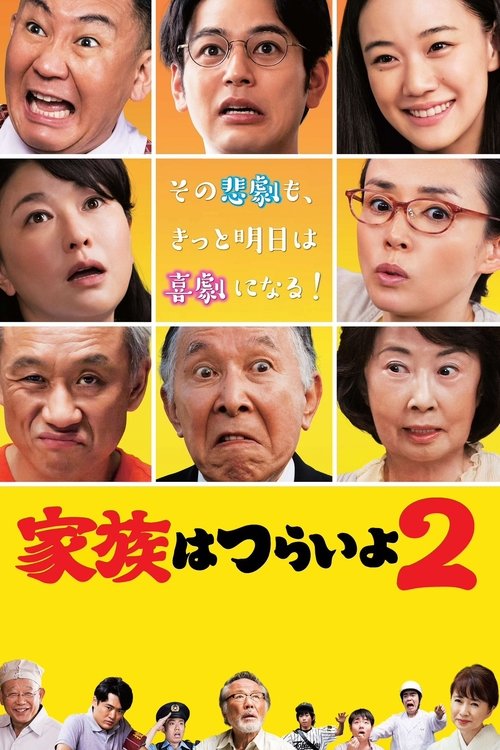
What a Wonderful Family! 2, released in 2017 and directed by the legendary Yoji Yamada, represents the continuation of one of Japanese cinema’s most beloved comedic franchises. Following the events of the original film where patriarch Shuzo’s wife Tomoe proposed divorce as a birthday surprise, this sequel finds the Hirata family navigating fresh complications. When the aging Shuzo decides to drive his old schoolmate after a drinking session—against his family’s well-founded concerns—a chain of events unfolds that transforms their household into a tempestuous landscape of chaos, laughter, and ultimately, deeper understanding. What distinguishes this installment is its thematic embrace of mortality itself, adding philosophical weight to the family’s comedic misadventures and creating a more introspective portrait of aging and familial bonds.
The film achieved considerable success both critically and commercially, resonating particularly strongly with Japanese audiences who have grown fond of the Hirata family across multiple instalments. Yamada’s continued direction ensures the film maintains the franchise’s trademark warmth and humour while allowing space for genuine emotional reflection. European audiences, increasingly appreciative of Japanese cinema’s nuanced approach to family dynamics and ageing, found themselves drawn to the film’s refusal to sentimentalise its characters while remaining fundamentally compassionate toward their struggles.
Central to the film’s emotional resonance is Joe Hisaishi’s masterfully crafted score, which balances comedic lightness with underlying melancholy. Hisaishi, renowned for his collaborations with Hayao Miyazaki and his sophisticated understanding of film music’s psychological dimensions, brings remarkable subtlety to this project. The composer’s approach recognises that family comedies require music that operates on multiple registers simultaneously—supporting the humour without undermining it, while simultaneously establishing emotional authenticity.
The score features Hisaishi’s characteristic melodic sensibility, with themes that evoke both warmth and gentle wistfulness. Rather than deploying obvious musical cues for comedic moments, the composer demonstrates restraint, allowing the humour to breathe independently while the orchestration subtly reinforces the emotional stakes beneath the surface action. This sophisticated approach reflects his understanding that true comedy often depends upon emotional grounding; when audiences trust that characters’ feelings matter, laughter becomes more meaningful.
Throughout the film, Hisaishi employs string arrangements of considerable delicacy, creating a sonic texture that mirrors the fragility and resilience of aging relationships. The music acknowledges the family’s vulnerability—particularly Shuzo’s precarious position as an elder fighting irrelevance—while never descending into maudlin sentimentality. Instead, the composer finds beauty in ordinariness, celebrating the mundane moments that constitute family life.
The film’s thematic engagement with mortality receives particularly sensitive treatment from Hisaishi’s compositional voice. Where a lesser composer might have introduced heavy, dramatic elements, Hisaishi maintains an approach that feels natural and unforced. The music accepts death as part of life’s fabric rather than treating it as extraordinary, mirroring Yamada’s own humanistic perspective. This creates a profound emotional landscape where laughter and sadness coexist, where family dysfunction becomes simultaneously funny and touching.
Hisaishi’s score for What a Wonderful Family! 2 exemplifies how film music can enrich comedy while deepening dramatic resonance. His composition proves that sophisticated orchestration and genuine emotional intelligence need not conflict with entertainment value; indeed, they enhance it immeasurably.