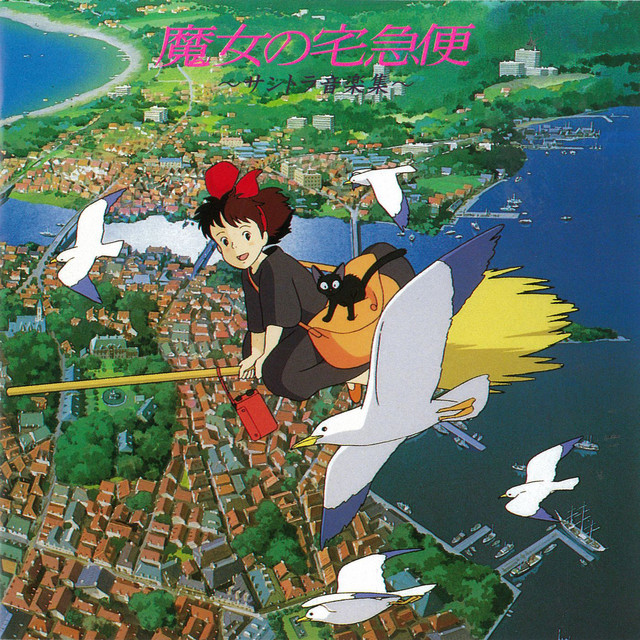
Album: 魔女の宅急便 サントラ音楽集
Picture this: Joe Hisaishi, fresh off a plane from New York, walks into a meeting room with Studio Ghibli executives. The next day, he’s already in the recording studio. Two days later, he’s conducting a full orchestra for what would become one of anime’s most beloved soundtracks. This wasn’t just any project—this was “Kiki’s Delivery Service,” and the clock was ticking toward a nationwide release just weeks away.
Among the treasures born from this impossibly tight schedule was “Soratobu Takkyubin” (The Flying Delivery Service), a piece that perfectly captures the essence of a young witch learning to navigate both the skies and her own growing independence. But the story behind this enchanting waltz reveals far more than just musical notes—it unveils Hisaishi’s philosophy of breathing life into animation through sound.
When Hisaishi set out to score Kiki’s adventures, he made a conscious decision that would define the entire soundtrack’s character. “I wanted to reduce the use of synthesizers and get closer to live, organic sounds,” he explained. This wasn’t just an aesthetic choice—it was philosophical. For a story about a girl learning to fly using nothing but her own power and determination, artificial electronic sounds simply wouldn’t do.
Instead, Hisaishi turned to Europe for inspiration, crafting what he called “European ethnic dance-style” pieces. The influence is unmistakable in “Soratobu Takkyubin,” where the lilting three-quarter time signature immediately evokes images of Mediterranean festivals and village celebrations. But this wasn’t mere musical tourism—Hisaishi was searching for instruments that could literally breathe life into his compositions.
The choice of instrumentation tells its own story. Dulcimers—ancient predecessors to the piano—provide an earthy, folkloric foundation. Accordions wheeze and sigh like the wind itself, while guitars add warmth reminiscent of sun-drenched European courtyards. These weren’t random selections from a world music catalog; each instrument was chosen for its ability to channel what Hisaishi saw as the essence of Kiki’s journey: the power of breath, of wind, of life force itself.
“Breath equals wind” became an unofficial motto for the soundtrack. Ocarinas whistle like gentle breezes, wooden flutes dance like autumn leaves, and brass instruments swell like powerful updrafts. In “Soratobu Takkyubin,” you can hear this philosophy in action as woodwinds carry the melody like invisible currents supporting Kiki’s flight. The music doesn’t just accompany her journey—it becomes the very air beneath her broomstick.
But perhaps the most revealing aspect of Hisaishi’s approach came from an unexpected source: director Isao Takahata’s guidance about when not to use music. “Don’t put music in the painful or sad parts,” Takahata advised. Instead, they would save the main waltz theme—the very melody that drives “Soratobu Takkyubin”—for moments when “Kiki’s feelings gradually expand.” This restraint, this understanding that silence can be as powerful as sound, shaped how the flying theme would be deployed throughout the film.
The result is a piece that functions almost like a musical barometer of Kiki’s emotional state. When we hear those familiar waltz rhythms, we know something important is happening—not dramatic tension or conflict, but growth, expansion, the quiet joy of discovery. The melody rises and falls like a young witch testing her wings, sometimes confident and soaring, sometimes tentative and searching.
Working under such extreme time pressure—with composition, arrangement, and recording all compressed into mere weeks—might have produced a rushed, compromised result. Instead, it seemed to focus Hisaishi’s creative energy into something pure and essential. There was no time for overthinking, no opportunity for endless revisions. The music had to capture the story’s heart immediately and completely.
“Soratobu Takkyubin” embodies this urgency-born clarity. Built in a comfortable waltz tempo that feels both grounded and airborne, the piece weaves together acoustic guitars, gentle percussion, and those crucial wind instruments into something that sounds effortless despite its complex emotional undertones. The melody line itself seems to float, never quite landing heavily on any single note, perfectly mirroring Kiki’s own relationship with gravity.
This approach—trusting organic instruments, embracing European folk traditions, and understanding the power of musical restraint—would influence not just this soundtrack but Hisaishi’s entire career. In “Soratobu Takkyubin,” we hear more than just background music for an animated film. We hear a composer’s philosophy made audible: that the most powerful magic comes not from artificial enhancement but from breathing real life into every note.
Perhaps that’s why this piece continues to enchant listeners decades later. Like Kiki herself, it achieves something extraordinary through the simplest means—a melody that captures the pure joy of flight, grounded in traditions as old as the folk dances that inspired it, yet somehow timeless enough to carry us away on wings of song.
- 晴れた日に…Read Review
- 旅立ち
- 海の見える街Read Review
- 空とぶ宅急便Now Playing
- パン屋の手伝いRead Review
- 仕事はじめRead Review
- 身代わりジジRead Review
- ジェフRead Review
- 大忙しのキキRead Review
- パーティーに間に合わないRead Review
- オソノさんのたのみ事…Read Review
- プロペラ自転車Read Review
- とべない!Read Review
- 傷心のキキRead Review
- ウルスラの小屋へRead Review
- 神秘なる絵Read Review
- 暴飛行の自由の冒険号Read Review
- おじいさんのデッキブラシRead Review
- デッキブラシでランデブーRead Review