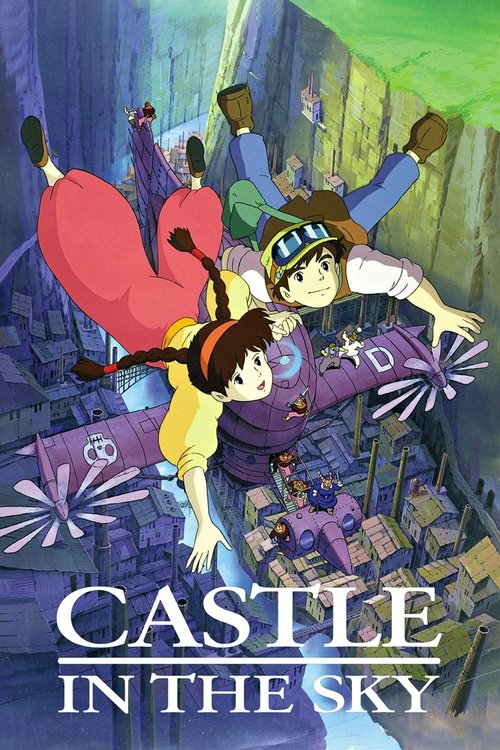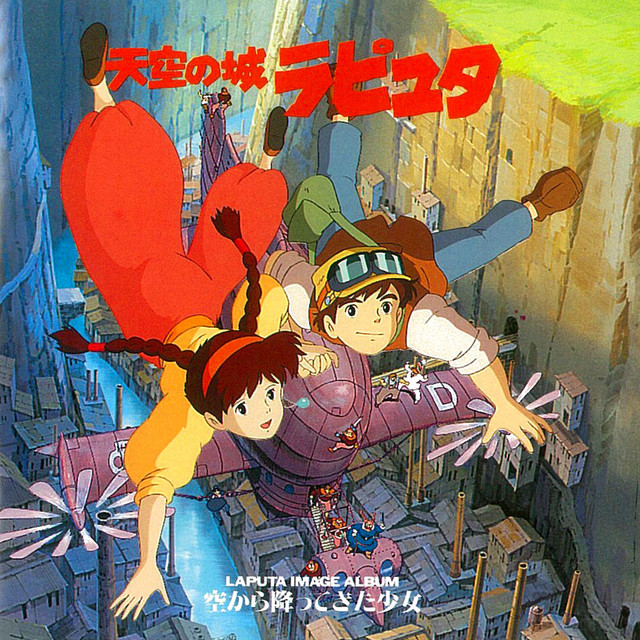
Album: 天空の城ラピュタ イメージアルバム ~空から降ってきた少女~
In the spring of 1986, composer Joe Hisaishi found himself in a London recording studio, putting the finishing touches on what would become one of Studio Ghibli’s most beloved musical collections. “Hato to Shounen” (The Dove and the Boy) from the Laputa image album represents more than just another film score track—it embodies the intersection of childhood wonder, environmental consciousness, and the weight of artistic legacy that defined this pivotal moment in animation history.
The track opens with a gentle acoustic guitar melody in D major, its simple fingerpicking pattern establishing an intimate, almost folk-like atmosphere. This deliberate choice of acoustic instrumentation wasn’t accidental. Fresh from his work on “Arion,” where he had experimented extensively with sampling technology, Hisaishi made a conscious decision to strip back the complexity for Laputa. He wanted to create music that children could connect with on an emotional level, something that would warm their hearts rather than overwhelm their senses.
“Hato to Shounen” perfectly encapsulates this philosophy. The melody, carried by flute and strings over that fingerpicked guitar foundation, feels both ancient and timeless. It’s the kind of tune a shepherd might whistle on a hillside, or a child might hum while watching clouds drift across the sky. Yet beneath its apparent simplicity lies sophisticated orchestration that gradually builds from solo instruments to a fuller ensemble, mirroring the journey from individual discovery to collective adventure that defines Miyazaki’s storytelling.
The pressure Hisaishi felt during this period was immense. Having reconnected with directors Hayao Miyazaki and Isao Takahata after the success of “Nausicaä,” he knew that expectations were sky-high. Each morning in the recording studio brought what he later described as “silent pressure”—the knowledge that he absolutely had to create something extraordinary. This wasn’t just about composing film music; it was about answering a deeper question that Miyazaki and Takahata had posed: “What must adults leave for children today?”
This philosophical foundation permeates every note of “Hato to Shounen.” The piece doesn’t just accompany images of a boy and his dove; it speaks to the relationship between humanity and nature, between innocence and responsibility. When Miyazaki handed Hisaishi his conceptual notes for the track, he wrote of “vast expanses,” “the tree of life,” “distant time,” and “sunlight.” The composer’s response was to create music that feels both grounded and ethereal, rooted in acoustic reality yet capable of soaring.
The production process itself was groundbreaking for Japanese cinema. Recording at Wonder Station and Nikkatsu Studio Center with an orchestra of nearly 50 musicians—so large they barely fit in the studio—Hisaishi was working with unprecedented resources. The budget was three times the normal amount, justified partly by the decision to make Laputa the first Miyazaki film recorded in four-channel Dolby stereo. Hisaishi was adamant that this particular story demanded that level of sonic sophistication.
The final mixing sessions at London’s Air Studios with engineers Steve Jackson and Masayoshi Ohkawa proved transformative. Hisaishi later reflected that this final stage made each piece “bright and lively.” In “Hato to Shounen,” you can hear this vibrancy in the way the acoustic elements breathe together, how the flute’s melodic line dances above the guitar without ever losing its earthy connection.
What makes this track particularly special is how it serves as a musical bridge between different worlds. Like the dove in Miyazaki’s story that connects earth and sky, the music connects the pastoral and the magical, the personal and the universal. The Fairlight II and III synthesizers that Hisaishi employed are used sparingly here, adding atmospheric textures rather than dominating the sonic landscape. This restraint speaks to his artistic maturity and his understanding that sometimes the most powerful statement comes from knowing what not to include.
Listening to “Hato to Shounen” today, decades after its creation, the piece feels like a musical time capsule of a specific moment when Japanese animation was discovering its unique voice. It carries within it the optimism of creators who believed deeply in the power of storytelling to shape young minds, the technical ambition of artists pushing the boundaries of their medium, and the timeless human desire to find magic in the everyday world.
The track stands as proof that Hisaishi’s greatest achievement wasn’t just creating beautiful melodies, but crafting musical experiences that honor both the complexity of adult emotions and the pure wonder of childhood perception. In just over three minutes, “Hato to Shounen” accomplishes what the best film music always aspires to: it doesn’t just accompany a story, it becomes part of the story itself.
- 天空の城ラピュタRead Review
- ハトと少年Now Playing
- 鉱夫Read Review
- 飛行石Read Review
- ドーラRead Review
- シータとパズーRead Review
- 大樹Read Review
- フラップターRead Review
- 竜の穴Read Review
- ティディスの要塞Read Review
- シータとパズーRead Review
- 失われた楽園Read Review