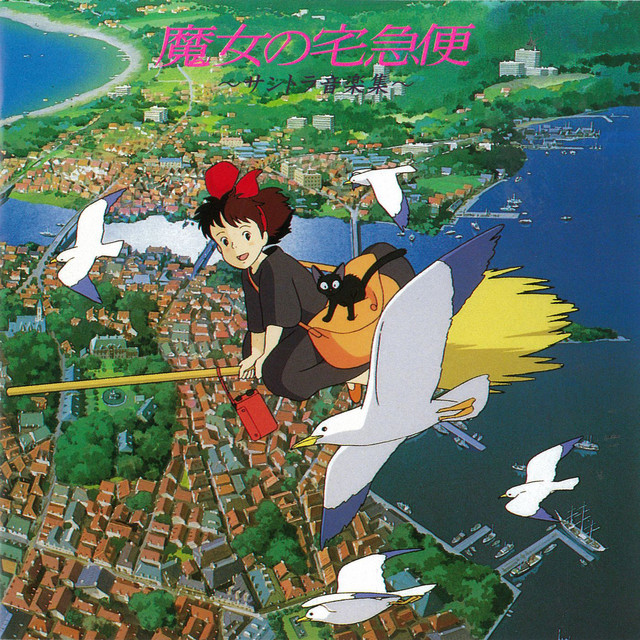
Album: 魔女の宅急便 サントラ音楽集
Picture this: you’re composing for a young witch’s adventure, and suddenly you find yourself channeling the chaotic energy of Tom and Jerry cartoons. This unlikely collision of influences shaped one of Joe Hisaishi’s most playful compositions, “Migawari Jiji” (Substitute Jiji), from the Kiki’s Delivery Service soundtrack.
During rehearsals for his 2019 World Dream Orchestra performance, Hisaishi revealed the unexpected inspiration behind this spirited track. Drawing from early 20th-century American Dixieland jazz, he crafted a honky-tonk piano piece that captures the mischievous spirit of classic animation music. The choice seems almost contradictory for a Studio Ghibli film set in a European coastal town, yet it perfectly embodies the transformative magic that occurs when Jiji, Kiki’s black cat companion, must play a different role.
The creative process behind this track illuminates Hisaishi’s broader philosophy for the entire Kiki’s Delivery Service score. Unlike his previous works that heavily featured synthesizers, this soundtrack marked a deliberate shift toward organic, acoustic instrumentation. “This time I significantly reduced the use of synthesizer-based compositions,” Hisaishi explained. “Since the content became more realistic, I moved closer to live sounds overall.”
This commitment to authenticity extended beyond mere technical choices. For Kiki’s European setting, Hisaishi immersed himself in the continent’s musical traditions, incorporating Greek-influenced dulcimer, guitar, and accordion. The dulcimer, a folk instrument that served as a predecessor to the modern piano, adds an earthy, medieval quality that grounds the fantasy in historical musical reality.
The decision to emphasize three-quarter time signatures throughout the album creates a dance-like quality that perfectly matches the coastal European atmosphere. These waltz-time compositions suggest the leisurely rhythm of seaside life, where time moves differently than in bustling cities. “Migawari Jiji” stands out within this framework, its syncopated jazz rhythms providing a delightful contrast to the prevailing triple meter that characterizes most of the score.
Perhaps most significantly, Hisaishi’s instrumentation choices reflect a deeper philosophical connection to the film’s themes. Throughout the score, he emphasizes wind instruments—ocarina, accordion, and various woodwinds—that require breath to produce sound. This isn’t mere coincidence. The composer understood that breath equals wind, and wind represents multiple layers of meaning in Kiki’s story: the literal wind that carries her through the sky, the atmospheric essence of Koriko town, and the very life force that drives the young witch forward.
“Migawari Jiji” participates in this wind-instrument philosophy while adding its own percussive piano voice. The honky-tonk piano style, with its slightly detuned, bar-room character, creates an intimate, lived-in sound that contrasts beautifully with the ethereal wind textures surrounding it. This juxtaposition mirrors Jiji’s own character—grounded and practical, yet magical and transformative.
The creation timeline for this soundtrack reads like a thriller. Hisaishi found himself caught between his New York recording commitments and Studio Ghibli’s demanding schedule. After returning to Japan in June, he had mere weeks to complete additional compositions and arrangements before the full orchestra recording in early July. The film’s July 29th nationwide release left no room for perfectionism—only inspired spontaneity.
This pressure-cooker environment likely contributed to the fresh, immediate quality that “Migawari Jiji” possesses. There’s an improvisational feel to the track that suggests Hisaishi trusted his instincts, allowing the Dixieland jazz influence to flow naturally into the composition without overthinking its integration into the larger European-themed score.
The genius of “Migawari Jiji” lies in its ability to serve multiple narrative functions simultaneously. As Jiji transforms into a stuffed toy substitute, the music captures both the humor of the situation and the underlying tension. The playful jazz elements evoke laughter, while the underlying harmonic progressions maintain connection to the film’s emotional core.
Listening to this track today, decades after its creation, reveals how Hisaishi’s willingness to embrace unexpected influences enriched his compositional palette. By refusing to limit himself to obvious European musical references, he created something uniquely hybrid—authentically American jazz serving a Japanese animated film about a European witch.
This cross-cultural musical pollination exemplifies Hisaishi’s broader artistic philosophy: drawing inspiration from wherever it naturally flows, regardless of geographical or stylistic boundaries. “Migawari Jiji” stands as proof that the most memorable film music often emerges from the composer’s willingness to follow unlikely creative pathways, even when—or especially when—they lead toward the unexpected intersection of jazz clubs and magical adventures.
- 晴れた日に…Read Review
- 旅立ち
- 海の見える街Read Review
- 空とぶ宅急便Read Review
- パン屋の手伝いRead Review
- 仕事はじめRead Review
- 身代わりジジNow Playing
- ジェフRead Review
- 大忙しのキキRead Review
- パーティーに間に合わないRead Review
- オソノさんのたのみ事…Read Review
- プロペラ自転車Read Review
- とべない!Read Review
- 傷心のキキRead Review
- ウルスラの小屋へRead Review
- 神秘なる絵Read Review
- 暴飛行の自由の冒険号Read Review
- おじいさんのデッキブラシRead Review
- デッキブラシでランデブーRead Review