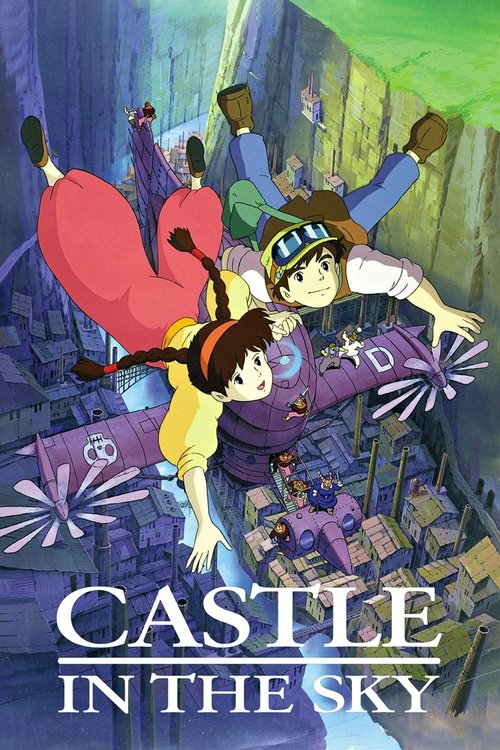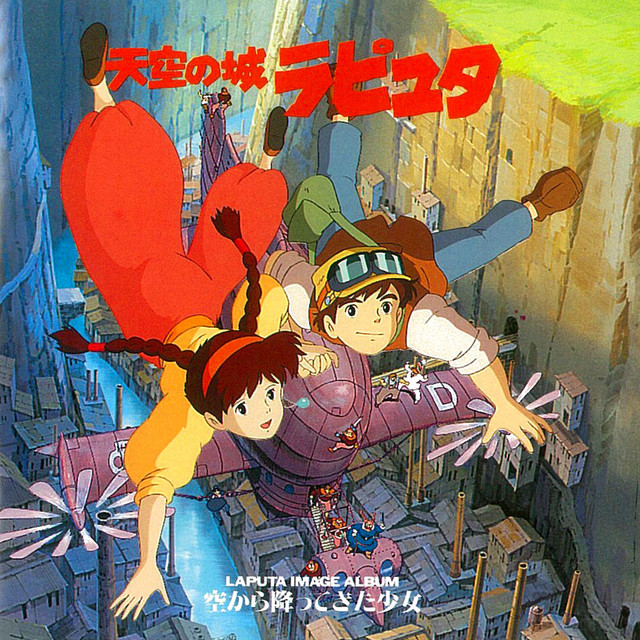
Album: 天空の城ラピュタ イメージアルバム ~空から降ってきた少女~
What happens when creative pressure meets pure inspiration? Joe Hisaishi discovered the answer during those intense recording sessions for Castle in the Sky’s image album in March 1986, where every day brought both exhilaration and anxiety in equal measure.
The composer found himself caught between two powerful forces: the joy of reuniting with Hayao Miyazaki and Isao Takahata after their successful collaboration on Nausicaä, and the crushing weight of expectation. “I absolutely had to create something wonderful,” Hisaishi recalled of those recording sessions at Wonder Station and Nikkatsu Studio Center. This unspoken pressure haunted him daily, yet it also pushed him toward some of his most enduring work.
Among the tracks emerging from these sessions was “Tatsu no Ana” (Dragon’s Den), a piece that perfectly embodies Miyazaki’s cryptic notes about “the castle of time” – that lost paradise beyond shining cloud peaks, containing both mysterious darkness and pure beauty. The song captures this duality through its careful balance of major and minor tonalities, shifting between hope and uncertainty like sunlight filtering through storm clouds.
Hisaishi had deliberately chosen a different musical path for Laputa than his previous film work. Where Arion had been dense with sound samples and complex arrangements, Castle in the Sky would strip back to acoustic simplicity. This wasn’t just an aesthetic choice – it reflected the deeper philosophy behind the project. Miyazaki and Takahata had presented him with a profound challenge: “What must adults leave for children today?” The music needed to speak directly to young hearts while carrying the weight of adult wisdom.
“Dragon’s Den” exemplifies this approach beautifully. Built around a haunting melody in D minor that gradually opens into brighter major passages, the track relies on acoustic piano, strings, and subtle woodwinds rather than electronic flourishes. The tempo remains deliberately unhurried, allowing each melodic phrase to breathe and develop organically. This restraint serves the emotional narrative – like approaching an ancient, mysterious place with both caution and wonder.
The creative process behind these tracks reveals Hisaishi’s remarkable intuitive abilities. The famous story of “Kimi wo Nosete” (Carrying You) – written in just twenty minutes around 11:30 PM and unexpectedly chosen as the main theme – demonstrates how inspiration can strike when the conscious mind steps aside. Similarly, “Dragon’s Den” feels like it emerged from that same wellspring of spontaneous creativity, where technical skill meets pure musical instinct.
Hisaishi’s commitment to melody as the heart of everything drove these compositions. He wanted children to feel warmth when listening, to experience love, dreams, and adventure through carefully crafted musical lines. “Dragon’s Den” achieves this through its memorable central theme – a melody that suggests both ancient mystery and childlike wonder, perfectly matching Miyazaki’s vision of a lost paradise that contains both darkness and light.
The final polish came during those crucial sessions at London’s Air Studio, where mix engineers Steve Jackson and Masayoshi Ohkawa helped transform the recordings. Hisaishi noted how this finishing process made each song “bright and vivid” – and you can hear this clarity in “Dragon’s Den,” where every instrumental voice sits perfectly in the mix, creating space for both intimate moments and sweeping orchestral passages.
This attention to sonic detail reflects Hisaishi’s broader philosophy about film music. Rather than overwhelming the listener with complex arrangements, he trusted in the power of simple, honest musical expression. “Dragon’s Den” never feels overproduced or cluttered; instead, it invites listeners into its mysterious world through gentle persuasion rather than force.
The track also demonstrates how Hisaishi absorbed Miyazaki’s poetic sensibilities into his musical language. Just as the director’s lyrics for “Carrying You” contained phrases like “those distant lights” that no professional lyricist would write, “Dragon’s Den” contains musical phrases that feel uniquely honest – slightly awkward in their beauty, touching in their directness.
Listening to “Dragon’s Den” today, nearly four decades later, reveals how successfully Hisaishi met that daunting challenge. The music carries both the weight of adult responsibility and the lightness of childhood dreams. It speaks to something universal about lost paradises and mysterious places, while remaining grounded in the specific acoustic world Hisaishi created for Castle in the Sky.
Those pressure-filled recording sessions in 1986 ultimately produced something remarkable: music that fulfills its creators’ ambitious goals while never feeling burdened by them. “Dragon’s Den” stands as proof that true inspiration can emerge from the tension between technical mastery and emotional honesty, between adult wisdom and childlike wonder.
- 天空の城ラピュタRead Review
- ハトと少年Read Review
- 鉱夫Read Review
- 飛行石Read Review
- ドーラRead Review
- シータとパズーRead Review
- 大樹Read Review
- フラップターRead Review
- 竜の穴Now Playing
- ティディスの要塞Read Review
- シータとパズーRead Review
- 失われた楽園Read Review