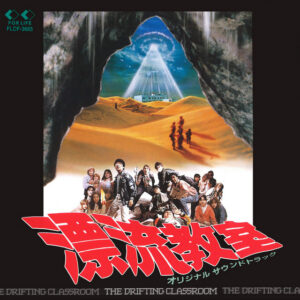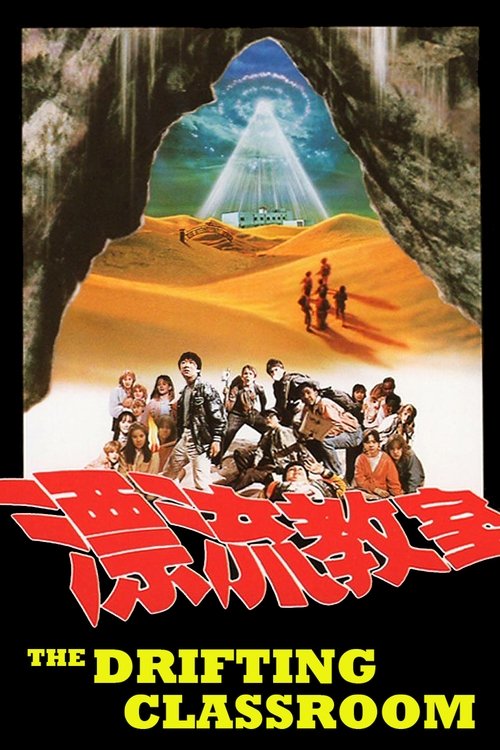
Nobuhiko Obayashi’s 1987 film ‘The Drifting Classroom’ presents one of Japanese cinema’s most unsettling premises: an entire international school, complete with students and staff, is mysteriously transported to a barren, hostile desert landscape. As the story progresses, the trapped students face not only the physical threats of their apocalyptic environment but also the psychological unraveling that comes with isolation and desperation. The film becomes a haunting exploration of survival, fear, and the collapse of civilized order, all set against an otherworldly backdrop that defies logical explanation.
Upon its release, ‘The Drifting Classroom’ garnered significant attention within Japanese cinema circles and among international horror and science fiction enthusiasts. The film’s ambitious concept and Obayashi’s distinctive directorial vision earned it recognition as a cult classic, particularly among viewers drawn to speculative fiction and psychological horror. While it may not have achieved mainstream blockbuster status, the film secured its place in the memories of those who experienced its deeply unsettling atmosphere. European audiences, in particular, would come to appreciate Obayashi’s willingness to embrace ambiguity and existential dread rather than providing easy answers.
Central to the film’s effectiveness is Joe Hisaishi’s remarkable musical composition. Hisaishi, already establishing himself as one of Japan’s most innovative film composers, crafted a score that transforms the visual nightmare into an immersive sonic experience. Rather than employing conventional orchestral approaches, Hisaishi constructed a soundscape that mirrors the film’s sense of displacement and unease. His compositional strategy relies heavily on dissonance, unconventional instrumentation, and the strategic use of silence to heighten tension.
The score’s thematic material reflects the psychological journey of the trapped students. Early motifs carry an unsettling quality—neither fully ominous nor comforting—that captures the initial confusion and dawning horror of their situation. As the narrative progresses and desperation mounts, Hisaishi’s arrangements become increasingly fragmented and discordant, musically representing the students’ deteriorating mental states. The composer employs sparse, haunting melodies that seem to echo across the empty desert, amplifying the film’s sense of isolation.
What distinguishes Hisaishi’s approach is his integration of electronic elements alongside organic instrumentation. This fusion creates an otherworldly quality that perfectly complements the inexplicable nature of the school’s transportation. The music rarely settles into traditional harmonic structures, instead creating an atmosphere of perpetual unease. String sections sustain unsettling pitches while wind instruments cut through with sharp, piercing phrases that punctuate moments of horror and revelation.
The relationship between Hisaishi’s score and Obayashi’s visuals demonstrates a masterful collaboration. Where the cinematography presents the vast, sterile desert landscape, the music provides emotional depth and psychological texture. During moments of relative calm, the score retreats, allowing viewers to absorb the visual information; during scenes of crisis and violence, it surges forward with aggressive energy. This dynamic interplay ensures that neither the image nor the sound overwhelms the other.
Hisaishi’s work on ‘The Drifting Classroom’ showcases his extraordinary ability to enhance narrative complexity through music. The score transcends typical film accompaniment to become an essential storytelling element, elevating the film’s exploration of survival and existential terror into a fully realized artistic statement. For European fans of Hisaishi’s work, this film represents a crucial example of his versatility and depth as a composer.