
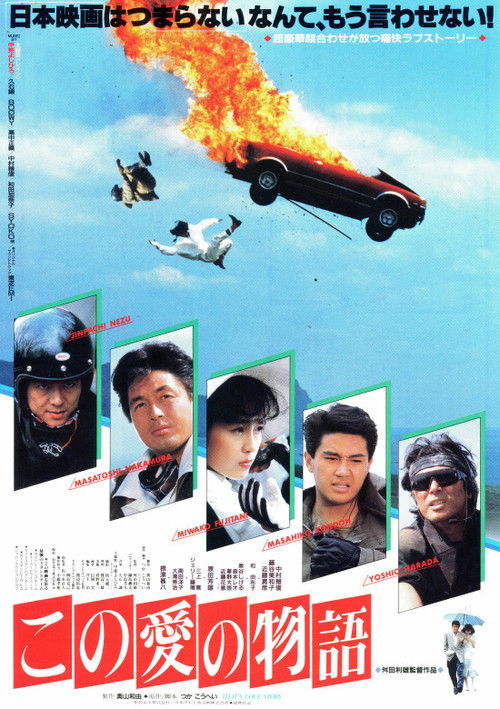
Toshio Masuda’s 1987 film ‘This Story of Love’ offers a unique cinematic exploration of the lives and relationships of stunt performers—individuals who exist in the shadows of cinema, risking their bodies to create the illusions audiences cherish. The film weaves together multiple narratives centered on these unsung professionals, examining how danger, dedication, and human connection intersect within their demanding world. Rather than focusing on the spectacular action sequences stunt work entails, Masuda directs our attention inward, to the intimate emotional landscapes his characters inhabit. It is precisely within these quieter moments that Joe Hisaishi’s extraordinary score finds its deepest resonance.
Upon its release, ‘This Story of Love’ received considerable appreciation within Japanese cinema circles, though it remained somewhat obscure internationally during its initial theatrical run. However, the film has gradually gained recognition among devotees of thoughtful character-driven cinema and, crucially, among those who appreciate Hisaishi’s evolving compositional voice. The film’s gentle humanitarianism and focus on overlooked professions resonated with critics who valued its empathetic approach to storytelling, and the soundtrack became recognized as a masterwork that elevates the narrative substantially.
Hisaishi’s contribution to ‘This Story of Love’ represents a watershed moment in his career—a score that demonstrates his remarkable ability to translate human vulnerability into sound. The composer approaches the material with characteristic sensitivity, crafting melodies that feel both intimate and universal. His orchestral writing avoids melodrama despite the emotional weight of the narrative; instead, he employs a restrained elegance that allows viewers to project their own feelings onto the screen. The primary thematic material centers around gently unfolding melodic lines that suggest yearning and quiet resilience, qualities essential to understanding the stunt performers’ existences.
One of Hisaishi’s most striking compositional choices involves his use of solo instrumentation—particularly strings and piano—to underscore moments of personal reflection. These passages create a profound intimacy, making the audience feel as though privy to characters’ most private thoughts. The orchestrations gradually build throughout certain sequences, layering instrumental voices to suggest emotional accumulation and psychological complexity. Hisaishi’s harmonic language, while remaining fundamentally tonal, incorporates subtle chromaticism that conveys uncertainty and the precarious nature of his characters’ professions.
The score’s relationship to the visual narrative is particularly sophisticated. Rather than simply accompanying scenes, Hisaishi’s music actively interprets the psychological subtext beneath everyday interactions. During sequences where stunt performers discuss their work and relationships, the score comments silently but eloquently on the courage required to maintain both professional commitment and personal connections. The music acknowledges the contradiction inherent in their situation: they dedicate themselves to creating fictional spectacle while their own lives demand authenticity and emotional honesty.
Furthermore, Hisaishi employs leitmotifs associated with different characters, allowing the score to chart emotional journeys across the film’s duration. These recurring themes transform subtly, reflecting character development and changing circumstances. The composer’s orchestral palette remains sophisticated throughout, utilizing unconventional instrumental combinations that surprise without distracting from the narrative focus.
‘This Story of Love’ stands as testament to Joe Hisaishi’s capacity to create profoundly moving music that respects both story and audience intelligence. For European admirers of his work, this film and its exceptional score represent an essential, often-overlooked chapter in understanding his artistic development and his deep commitment to emotional truthfulness in film composition.