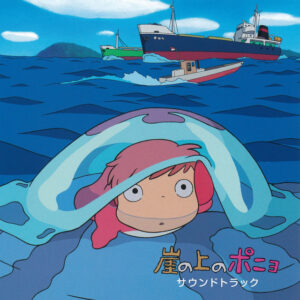
Hayao Miyazaki’s 2008 film Ponyo tells the delightful story of an unlikely friendship between Sosuke, a young boy living in a clifftop house overlooking the sea, and Ponyo, a magical goldfish with an extraordinary desire to become human. When Sosuke rescues the curious and energetic creature from the ocean, he sets in motion a series of whimsical and chaotic events that challenge the boundaries between the human and natural worlds. Meanwhile, Ponyo’s father, a powerful sorcerer, works tirelessly to reclaim his daughter and restore her to her rightful place beneath the waves. The film beautifully captures themes of love, transformation, and acceptance through its stunning hand-drawn animation and imaginative storytelling.
Upon its release, Ponyo became a remarkable commercial and critical success, particularly resonating with audiences across Europe who embraced its childlike wonder and emotional depth. The film’s box office performance secured its place as one of Studio Ghibli’s most beloved works, while critics praised Miyazaki’s direction and the film’s distinctive visual style. The story’s universal themes of connection and belonging transcended cultural boundaries, making it accessible to viewers worldwide and cementing its status as a modern animated classic.
Yet perhaps the most crucial element in Ponyo’s success lies in Joe Hisaishi’s extraordinary musical score, which serves as the emotional heartbeat of the entire film. Hisaishi’s approach to composing for Ponyo demonstrates his masterful understanding of how music can elevate animation beyond mere visual spectacle into genuine artistic expression. The score employs a sophisticated blend of orchestral arrangements, incorporating both traditional and contemporary instruments to create soundscapes that perfectly complement Miyazaki’s aquatic world.
The film’s central theme, which recurs throughout the narrative, is immediately memorable and deeply affecting. Hisaishi crafted a melodic line that captures both the innocence of childhood friendship and the magical nature of Ponyo herself. The theme grows and evolves alongside the story, transforming from a simple, delicate phrase into a grand orchestral statement that underscores the film’s most emotionally resonant moments. This musical progression mirrors the characters’ own development, with the score serving as an auditory reflection of their emotional journey.
Hisaishi’s compositional approach in Ponyo reveals his gift for creating music that feels intrinsically connected to the visuals. When Ponyo causes domestic chaos, the music becomes playful and energetic, with quirky instrumental combinations that enhance the comedic elements without overwhelming the animation. Conversely, during quieter scenes—such as moments between Sosuke and his mother or tender exchanges between the boy and the magical fish—Hisaishi employs minimalist arrangements featuring solo piano or sparse string sections that allow the emotional weight of Miyazaki’s character animation to shine through unimpeded.
The underwater sequences showcase Hisaishi’s particular brilliance, as he crafts ethereal, flowing passages that evoke both the beauty and mystery of the ocean. These musical interludes employ sweeping string movements and delicate woodwind textures that seem to ripple and undulate like water itself. The composer’s use of silence and space within these passages proves equally important, creating breathing room that prevents the score from becoming overwrought.
Ultimately, Joe Hisaishi’s score for Ponyo represents a pinnacle of film music composition, demonstrating how perfectly calibrated orchestration can transform an animated film into a complete sensory experience. For European fans of Miyazaki and Hisaishi alike, Ponyo stands as a testament to their collaborative genius and remains an essential listen for anyone seeking to understand the profound relationship between music and visual storytelling in animation.