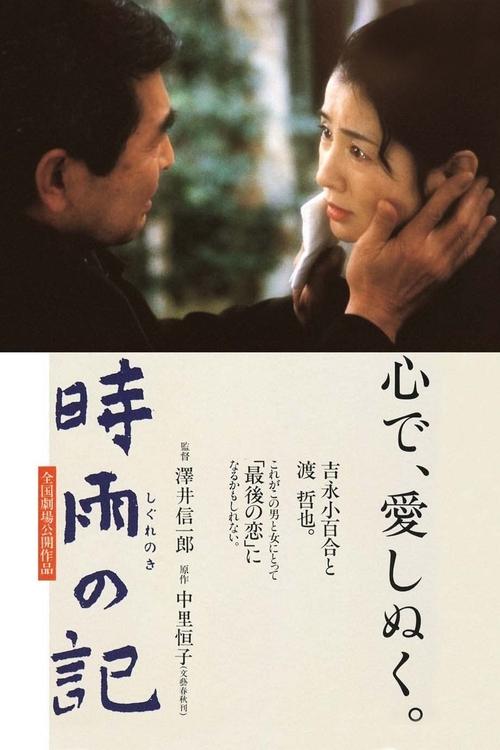
Shinichiro Sawai’s 1998 film ‘Diary of Early Winter Shower’ tells a poignant story of rekindled love and unfulfilled promises spanning two decades. The narrative follows Kounosuke Mibu and Tae Horikawa, whose passionate but innocent affair was discovered twenty years prior, forcing them to part ways. When Tae receives news of Kounosuke’s stroke, she makes the difficult decision to visit him at Shiguretei, the retreat they had once dreamed of building together. Their encounter, bittersweet and charged with unresolved emotion, forms the emotional core of this intimate drama. Though their love was never consummated beyond a kiss, the weight of lost time and abandoned dreams hangs heavily over their reunion, and the film explores what might have been with delicate restraint.
Upon its release, ‘Diary of Early Winter Shower’ found particular resonance with Japanese audiences who appreciated its mature treatment of longing and regret. The film’s quiet, understated approach to romance struck a chord with critics and viewers seeking cinema that valued emotional subtlety over dramatic spectacle. While it did not achieve widespread international distribution, the film has maintained a devoted following among discerning cinema enthusiasts, particularly those drawn to character-driven narratives and sophisticated melodramas. Its influence can be seen in the growing appreciation for Japanese films that explore the interior lives of middle-aged protagonists—a demographic often overlooked in mainstream cinema.
It is, however, Joe Hisaishi’s sublime musical composition that elevates this delicate film into something truly transcendent. The maestro’s score for ‘Diary of Early Winter Shower’ represents a pinnacle of his approach to film music: intimate, restrained, and profoundly humanistic. Rather than overwhelm the narrative with orchestral grandeur, Hisaishi crafts a soundscape that mirrors the internal emotional landscapes of his characters. The score employs sparse instrumentation, with piano, strings, and subtle woodwind flourishes creating an atmosphere of gentle melancholy that perfectly captures the bittersweet nature of rekindled love.
Hisaishi’s compositional approach demonstrates remarkable sensitivity to the film’s thematic preoccupations. The recurring musical motifs—gentle, almost wistful—seem to embody the characters’ unspoken emotions and the weight of decades spent apart. The piano work particularly stands out, functioning almost as a character itself, expressing what the dialogue cannot. Where conversation becomes inadequate to convey the depth of feeling between these two people, Hisaishi’s music steps in seamlessly, translating longing into sound.
The score’s relationship to the visual narrative is exceptionally well-calibrated. During moments of quiet conversation in Shiguretei’s refined spaces, the music provides emotional scaffolding without intruding upon the precious silence between the characters. During scenes of separation and departure, Hisaishi’s compositions swell with poignancy, acknowledging the tragedy of a love that arrived too late. The autumn and early winter imagery of the film finds perfect musical reflection in the score’s cool, crystalline textures and melancholic harmonies.
What makes Hisaishi’s work here particularly remarkable is his ability to suggest hope and profound sadness simultaneously. The music never becomes cynical or despairing; instead, it honors the beauty of human connection, however brief or incomplete. For European audiences unfamiliar with Hisaishi’s more whimsical works, ‘Diary of Early Winter Shower’ offers an exceptional introduction to his profound emotional intelligence and compositional mastery, revealing why he remains one of cinema’s greatest contemporary composers.