
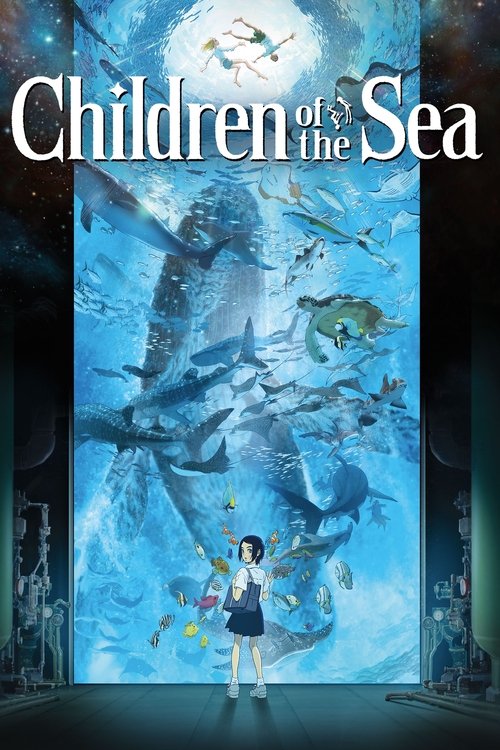
Ayumu Watanabe’s 2019 animated film “Children of the Sea” presents a visually stunning and narratively enigmatic exploration of humanity’s connection to the natural world. The story follows Ruka, a girl estranged from her separated parents, who discovers a profound kinship with two mysterious boys, Umi and Sora, raised by dugongs in the ocean. When these brothers arrive at her father’s aquarium, Ruka begins to uncover her own latent supernatural abilities linked to the sea. As inexplicable phenomena escalate—creatures appearing in impossible locations, animals vanishing from aquariums worldwide—Ruka finds herself drawn into an investigation that challenges her understanding of reality itself. The film’s dreamlike narrative deliberately obscures definitive answers, inviting audiences into a meditative experience rather than a conventional plot-driven journey.
Upon its release, “Children of the Sea” received acclaim from animation enthusiasts and critics who appreciated its artistic ambition and thematic depth, though its unconventional storytelling meant it remained somewhat niche compared to mainstream anime productions. European audiences in particular responded to the film’s philosophical undertones and visual poetry, recognizing it as a work that transcends typical genre boundaries. The film garnered recognition at international animation festivals and established itself as a cult classic among those seeking thoughtful, visually innovative cinema.
The true revelation of “Children of the Sea,” however, lies in Joe Hisaishi’s extraordinary musical score—a composition that elevates the entire experience into something transcendent. Hisaishi, celebrated for his collaborations with Hayao Miyazaki and Studio Ghibli, brings his signature compositional mastery to create a soundscape that functions as much as a narrative element as the visuals themselves. The score operates on multiple registers simultaneously: it establishes emotional tone, amplifies the film’s mystical atmosphere, and creates sonic representations of the ocean’s vast consciousness.
Hisaishi’s approach employs a fascinating blend of orchestral grandeur and minimalist restraint. Rather than overwhelming scenes with constant musical presence, the composer strategically deploys silence and sparse instrumentation to create space for contemplation. When music does emerge, it often features flowing, wave-like melodic structures that literally sonically mirror the ocean’s movements. Strings dominate the palette, creating rippling textures that evoke water’s fluidity, while subtle synthesizers introduce otherworldly dimensions that reinforce the supernatural elements of the narrative.
The central theme embodies childlike wonder and spiritual awakening, its simple yet profound melody recurring throughout the film in various transformations. This thematic flexibility allows Hisaishi to chart Ruka’s emotional and spiritual journey without explicit explanation. As she discovers her connection to the ocean, the theme evolves—becoming more confident, more complex, ultimately merging with larger orchestral movements that suggest her individual identity integrating with something vast and eternal.
Particularly masterful is how Hisaishi uses the score to visualize the invisible. During sequences depicting the boys’ aquatic nature or supernatural events, the music doesn’t attempt literal representation but rather creates emotional and spiritual correlatives. Shimmering, crystalline passages suggest otherworldly perception, while deeper, resonant tones evoke the ocean’s unfathomable depths and ancient wisdom. The composer understands that mystery cannot be explained musically—only suggested, implied, and felt.
The climactic sequences showcase Hisaishi at his most transcendent, crafting music that feels simultaneously personal and cosmic, intimate and overwhelming. These moments demonstrate why he remains one cinema’s greatest living composers—his ability to express the inexpressible through pure musical language makes “Children of the Sea” not merely a film with music, but a true audiovisual synthesis where both elements are inseparable.