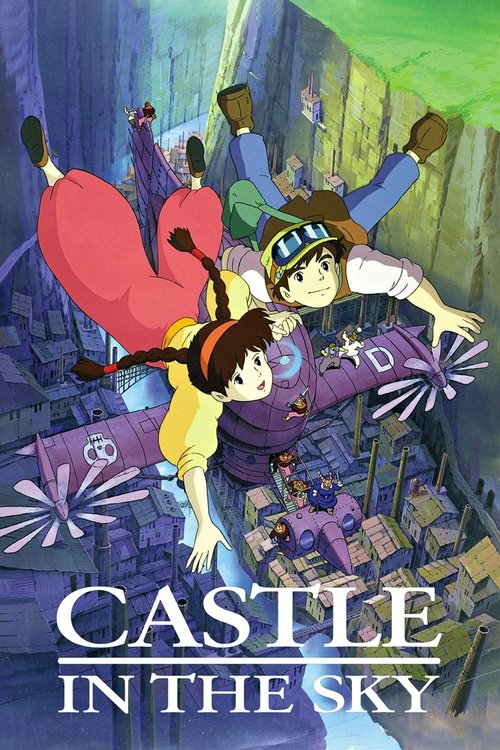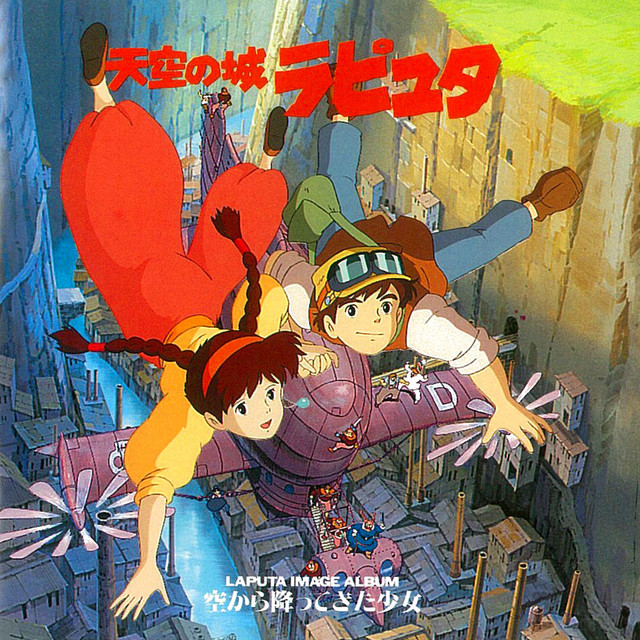
Album: 天空の城ラピュタ イメージアルバム ~空から降ってきた少女~
The year 1986 marked a pivotal moment in Japanese animation history, but perhaps more quietly, it also witnessed one of Joe Hisaishi’s most introspective creative journeys. Working on the image album for Hayao Miyazaki’s “Castle in the Sky” (Tenkuu no Shiro Laputa), Hisaishi found himself grappling with both artistic pressure and profound responsibility – a combination that would ultimately birth some of his most beloved compositions.
Among the tracks that emerged from this intense creative period, the titular piece “Castle in the Sky” stands as a perfect embodiment of Hisaishi’s evolving musical philosophy. Unlike his previous work on “Arion,” which had been dense with complex sound samples and layered arrangements, this new composition embraced something radically different: simplicity.
The shift wasn’t arbitrary. Hisaishi had made a conscious decision from the project’s inception to center the score around acoustic instruments and clear, memorable melodies. “Castle in the Sky” exemplifies this approach beautifully, built around a gentle piano melody in a major key that seems to float effortlessly, much like the mythical floating city it represents. The piece moves at a contemplative tempo, allowing each note to breathe and resonate with the kind of warmth that Hisaishi specifically wanted children to feel when listening.
But behind this apparent simplicity lay enormous pressure. Reuniting with Miyazaki and producer Isao Takahata after their successful collaboration on “Nausicaa,” Hisaishi felt the weight of expectation daily during recording sessions. The joy of working with these visionary filmmakers again was tempered by an unspoken demand for excellence that, as Hisaishi later reflected, “assaulted him every day” during production.
The conceptual framework provided by Miyazaki and Takahata only intensified this pressure. Their central question – “What must adults leave for children now?” – demanded music that could carry profound emotional and philosophical weight while remaining accessible to young listeners. For “Castle in the Sky,” this meant crafting a piece that could simultaneously evoke wonder at technological marvels and nostalgia for simpler times.
Miyazaki’s detailed notes to Hisaishi reveal the depth of their collaborative vision. One particularly evocative description painted a scene of a boy alone on a rooftop overlooking the sleeping world, with only pigeons for company as morning mist clears and a trumpet melody announces the beginning of adventure. This imagery directly influenced the orchestration of “Castle in the Sky,” where brass instruments emerge gradually from the piano foundation, suggesting that same sense of dawn breaking and possibilities unfolding.
The creation process itself proved as complex as the emotions the music needed to convey. Recording took place at Wonder Station and Nikkatsu Studio Center, but Hisaishi knew the true magic would happen during the final mixing stage. He made the bold decision to travel to London’s Air Studios for the concluding work, collaborating with mixing engineers Steve Jackson and Masayoshi Ohkawa.
This international finishing touch proved crucial. Under the careful guidance of these engineers, “Castle in the Sky” and the other album tracks achieved what Hisaishi described as becoming “bright and lively.” The London sessions added a particular clarity and spaciousness to the recording that perfectly matched the vast, sky-bound themes of the story.
Interestingly, Hisaishi’s image album work often differed from what eventually appeared in the completed films. While “Castle in the Sky” remained relatively unchanged from album to screen, other pieces like the Flaptter theme underwent significant transformation. The original album version captured the whimsical, pattering flight of the ornithopter aircraft, but when Miyazaki’s final edit revealed that most Flaptter scenes involved danger and crisis, the music had to be reconceived entirely.
This flexibility speaks to Hisaishi’s understanding that image albums serve a unique purpose – they’re not merely demo versions of film scores, but complete musical statements in their own right. “Castle in the Sky” works beautifully in both contexts: as a standalone piece evoking wonder and possibility, and as accompaniment to the visual poetry of Miyazaki’s floating city.
The enduring appeal of “Castle in the Sky” lies in how successfully Hisaishi achieved his stated goals. The piece does indeed “warm the heart” of listeners, young and old alike. Its melody is immediately memorable yet sophisticated enough to reward repeated listening. Most importantly, it carries that essential message about what adults must leave for children – not just entertainment, but genuine hope and wonder about the world’s possibilities.
In March 1986, as Hisaishi completed work on this image album, he couldn’t have known he was creating music that would continue inspiring listeners decades later. “Castle in the Sky” remains a perfect crystallization of his belief that the most profound musical statements often come through the simplest means – a lesson as valuable today as it was nearly forty years ago.
- 天空の城ラピュタNow Playing
- ハトと少年Read Review
- 鉱夫Read Review
- 飛行石Read Review
- ドーラRead Review
- シータとパズーRead Review
- 大樹Read Review
- フラップターRead Review
- 竜の穴Read Review
- ティディスの要塞Read Review
- シータとパズーRead Review
- 失われた楽園Read Review