
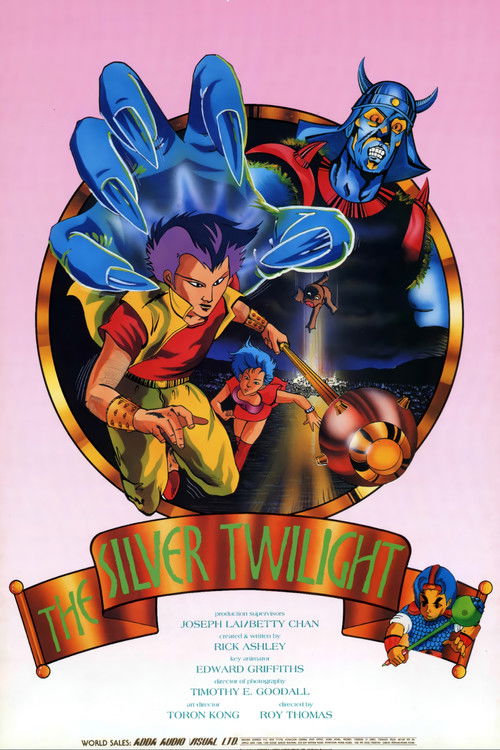
Park Seung-cheol’s ‘The Silver Twilight’ (1990) stands as a fascinating entry in the director’s body of work, representing a remake of his own 1979 film and drawing from the Korean animated tradition of “도깨비 방망이” (Goblin Bat). The film follows an imaginative premise: when the King of Monsters learns that rebel monsters are kidnapping innocent humans, he dispatches his own son into the human world armed with a magical staff. There, the young prince encounters a group of human rebels and an unlikely animal companion—a bear—as they work together to thwart the villains’ nefarious plans. This cross-cultural blend of Korean animation and international adventure storytelling created an intriguing vehicle for musical interpretation.
Despite its unique premise and creative ambitions, ‘The Silver Twilight’ remained relatively obscure outside Asian markets during its theatrical run, though it has garnered increased appreciation among animation enthusiasts and Joe Hisaishi devotees in recent decades. The film’s reception was modest upon release, yet it has aged remarkably well, with contemporary viewers praising its imaginative world-building and charming character dynamics. The Hong Kong English dub, while occasionally quirky in its localization choices, introduced the film to broader English-speaking audiences and contributed to its cult status among international fans.
Yet it is Joe Hisaishi’s luminous score that truly elevates ‘The Silver Twilight’ into the realm of minor masterpiece. Hisaishi, already renowned for his collaborations with Hayao Miyazaki and his distinctive compositional voice, approached this Korean production with the same meticulous care and imaginative fervor he brought to his most celebrated works. The soundtrack weaves together Eastern and Western orchestral traditions, creating a sonic palette perfectly suited to the film’s hybrid cultural aesthetic.
The central theme of the film—a sweeping, adventurous melody introduced in the opening sequence—establishes the narrative’s tone of earnest heroism tempered with whimsy. Hisaishi employs traditional orchestral instruments alongside subtle electronic elements, creating a sound that feels both timeless and contemporary. This compositional choice mirrors the film’s own blending of ancient magic (the titular goblin bat) with modern sensibilities. The main theme’s recurring appearances throughout the score serve as an emotional anchor, reminding listeners of the fundamental goodness and determination driving the young prince’s quest.
What distinguishes Hisaishi’s work on ‘The Silver Twilight’ is his sensitive approach to underscoring the film’s emotional beats. During moments of danger and confrontation, his orchestration becomes more aggressive, with pounding timpani and urgent string arrangements propelling the action forward. Conversely, quieter scenes—particularly those exploring the unlikely friendship between the prince and his human companions—are accompanied by gentle, almost impressionistic arrangements that emphasize intimate character development over spectacle.
The bear character, potentially a source of comic relief, receives its own leitmotif from Hisaishi: a charming, slightly bumbling theme that humanizes the creature while maintaining its animalistic qualities. This demonstrates Hisaishi’s genius for musical characterization, where even minor characters receive thematic consideration.
Perhaps most impressively, Hisaishi’s score never overwhelms the narrative’s inherent charm. Instead, it functions as a sympathetic partner to the animation and storytelling, enhancing rather than dominating. For European fans discovering this hidden gem, Hisaishi’s contribution represents an exceptional example of his versatility and his ability to create magic across cultural and linguistic boundaries.