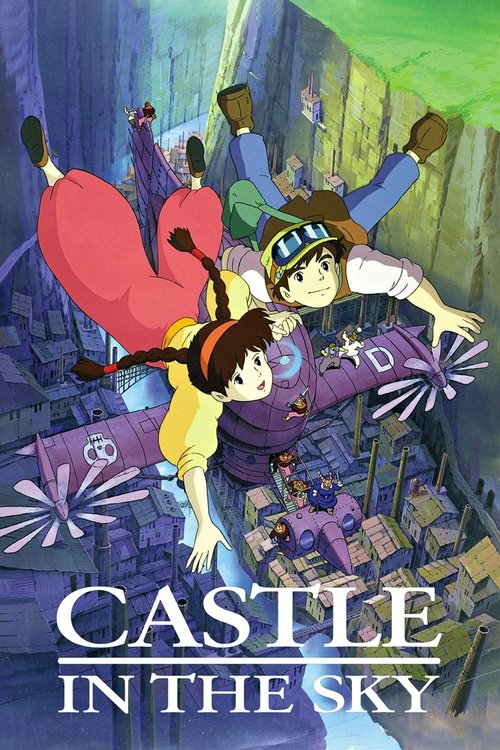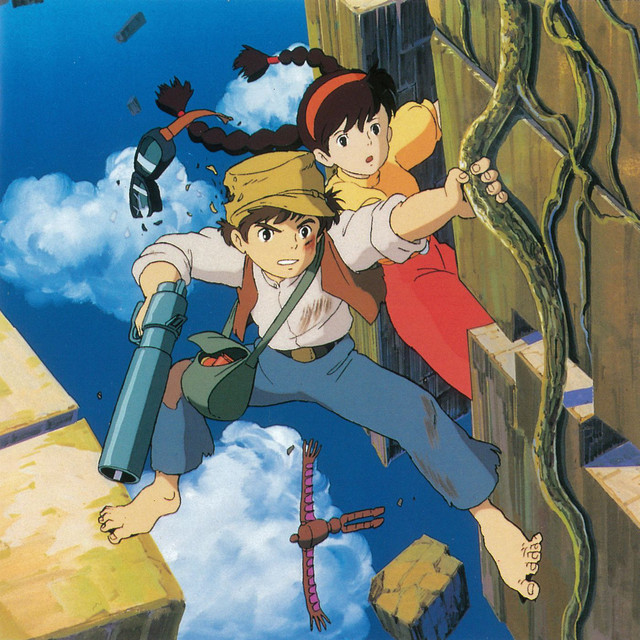
Album: 天空の城ラピュタ サウンドトラック ~飛行石の謎~
In the world of film scoring, few collaborations have been as fruitful as that between composer Joe Hisaishi and director Hayao Miyazaki. Yet even the most harmonious partnerships face moments of creative turbulence, and for Hisaishi, one particular piece from Castle in the Sky became his most challenging musical puzzle.
“Moonlight Over the Sea of Clouds” (Gekkou no Unkai) stands as perhaps the most technically demanding composition Hisaishi created for the 1986 animated masterpiece. The track accompanies one of the film’s most emotionally complex sequences: Pazu and Sheeta’s discovery of the floating castle’s interior, their walk through its haunted corridors, and their solemn moment before ancient graves beneath a towering tree.
What makes this particular piece fascinating isn’t its musical complexity alone, but rather the creative miscommunication that nearly derailed its creation. Hisaishi, working from incomplete rush footage that lacked color grading and final polish, initially composed what he describes as a “grand and mysterious” orchestral piece. The music was technically brilliant, featuring sweeping string arrangements and majestic brass sections that captured the awe-inspiring nature of the ancient civilization.
However, when Miyazaki reviewed the composition against the finished visuals, a crucial disconnect became apparent. The scene demanded something entirely different: a minor-key composition filled with melancholy and introspective sadness. The visual poetry of two children confronting the remnants of a lost world required musical restraint rather than grandeur.
This creative tension reveals something profound about Hisaishi’s working process during the Castle in the Sky production. Unlike many film composers who work primarily from written descriptions or rough cuts, Hisaishi had committed to an unprecedented level of synchronization between music and image. He meticulously analyzed rush film footage, timing every visual beat to the exact second using a Fairlight III synthesizer to create rhythmic foundations that would perfectly match Miyazaki’s animation.
The recording schedule for the soundtrack was remarkably compressed, running from June to July 1986. After comprehensive discussions between Hisaishi, Miyazaki, and producer Isao Takahata at a coffee shop near Studio Ghibli on June 23rd, the composer began building his electronic foundations at Wonder Station. By July 8th, nearly fifty orchestra members gathered at Nikkatsu Studio to record the acoustic elements, with the entire project completed by July 12th.
This tight timeline made the “Moonlight Over the Sea of Clouds” revision particularly stressful. Hisaishi had to completely reconceptualize the piece’s emotional core while maintaining his commitment to precise visual synchronization. The final version features a haunting string melody in D minor, supported by subtle woodwind textures and restrained brass, creating an atmosphere of reverent sadness that perfectly captures the children’s emotional journey.
The experience taught Hisaishi valuable lessons about the collaborative nature of film scoring. Despite his preference for acoustic instruments and melodic clarity—principles he established early in the project as a reaction against the sample-heavy approach he’d used for the film Arion—successful film music requires constant dialogue between composer and director.
Interestingly, this challenging experience contrasts sharply with Hisaishi’s creation of the film’s main theme, “Carrying You” (Kimi wo Nosete). That beloved melody came to him in just twenty minutes around 11:30 PM, initially conceived as incidental music rather than a central theme. When Miyazaki heard it and immediately declared it the film’s musical heart, Hisaishi realized his entire compositional approach would need restructuring.
The composer later reflected on Miyazaki’s lyrical sensibilities, particularly praising lines like “beyond that horizon” and “countless lights,” which he felt demonstrated an amateur’s authentic emotion that professional lyricists might struggle to capture. This appreciation for unpolished authenticity perhaps explains why “Moonlight Over the Sea of Clouds” works so effectively in its final form—it abandons compositional showmanship for genuine emotional truth.
For contemporary film music enthusiasts, “Moonlight Over the Sea of Clouds” serves as a compelling case study in creative problem-solving. The piece demonstrates how technical proficiency must sometimes yield to emotional necessity, and how the most memorable film music often emerges from collaborative friction rather than seamless agreement.
Hisaishi’s willingness to completely reimagine his composition, despite the time pressure and technical challenges, ultimately produced one of Castle in the Sky’s most moving musical moments. The track reminds us that in film scoring, the greatest triumph often lies not in creating beautiful music, but in creating the right music for each specific moment of storytelling.
- 空から降ってきた少女Read Review
- スラッグ溪谷の朝Read Review
- 愉快なケンカ(~追跡)Read Review
- ゴンドアの思い出Read Review
- 失意のパズーRead Review
- ロボット兵(復活~救出)Read Review
- 合唱 君をのせてRead Review
- シータの決意Read Review
- タイガーモス号にてRead Review
- 破滅への予兆Read Review
- 月光の雲海Now Playing
- 天空の城ラピュタRead Review
- ラピュタの崩壊Read Review
- 君をのせてRead Review