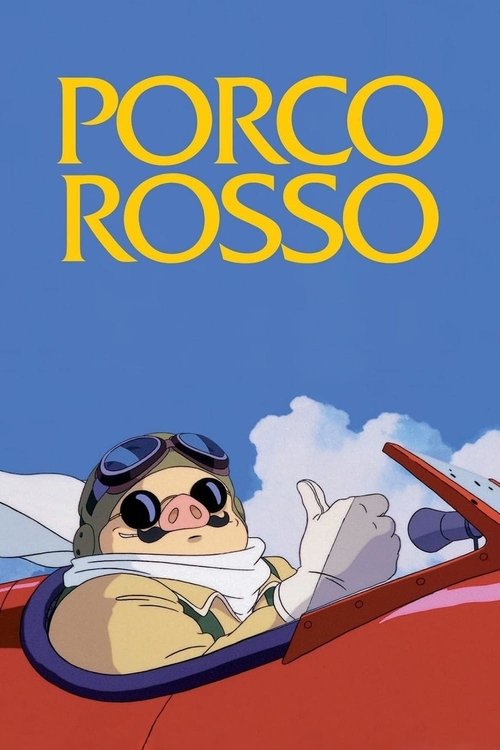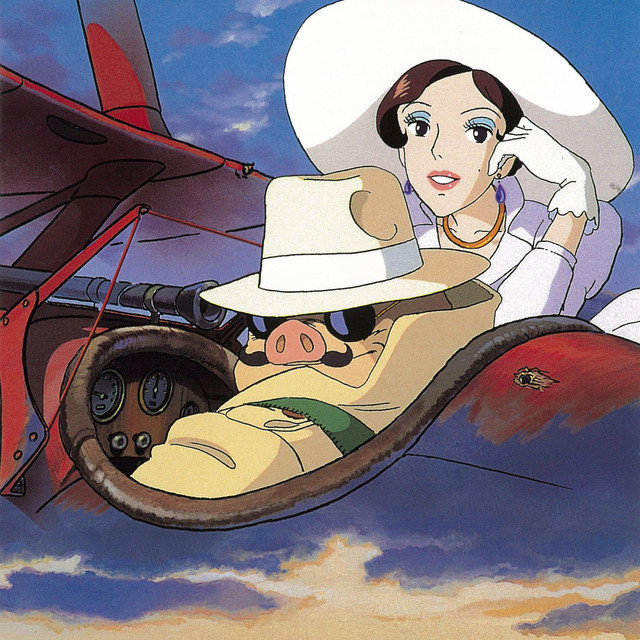
Album: 紅の豚 サウンドトラック
Sometimes the universe conspires to create art. In 1992, as Joe Hisaishi was deep into composing what would become “Toki wo Koete” (Seeking for Distant Days) for Hayao Miyazaki’s “Porco Rosso,” he discovered something extraordinary. The 1920s jazz aesthetic he’d been exploring for his personal album “My Lost City” – inspired by F. Scott Fitzgerald’s evocative prose – perfectly aligned with Miyazaki’s chosen setting for the film. “As artists living in the same era, I felt something deeply fateful about this coincidence,” Hisaishi would later reflect.
This serendipitous moment would prove crucial to understanding one of cinema’s most emotionally complex musical themes. “Toki wo Koete” emerges not as mere background music, but as a bridge between two artistic souls grappling with nostalgia, loss, and the weight of memory. The composition serves multiple narrative functions – it’s the jazz standard that flows from the piano in Gina’s hotel bar, the romantic theme that binds Marco and Gina’s complicated relationship, and perhaps most significantly, the musical embodiment of Miyazaki’s deeply personal vision.
The choice to center the theme around jazz piano wasn’t arbitrary. The 1920s represented the height of the Jazz Age, when speakeasies and hotel bars resonated with improvisational melodies that spoke to a generation caught between war’s devastation and modernity’s promise. Hisaishi’s decision to voice Marco and Gina’s relationship through this musical language provided both historical authenticity and emotional resonance. The piano becomes Gina herself – sophisticated, melancholic, eternally waiting.
Musically, “Toki wo Koete” unfolds in a contemplative B-flat major, its moderate tempo allowing space for the kind of reflective pauses that mirror the characters’ unspoken longing. The melody moves with the sophisticated harmonic language of period jazz, yet Hisaishi infuses it with his characteristic ability to find the universal within the specific. Listen carefully to how the left-hand accompaniment maintains steady, gentle syncopation while the right hand explores increasingly complex emotional territory – a perfect musical metaphor for characters whose surface composure masks deeper turbulence.
But creating this musical intimacy proved challenging for Hisaishi. Miyazaki had handed him six poems as creative guidance – “The Flying Boat Rider’s Tango,” “Ascent,” “Twilight Adriatic Sea,” “Night Flight,” “Secret Garden,” and “Merry-go-round” – cryptic verses that served as emotional roadmaps rather than literal descriptions. More significantly, Miyazaki’s specific request was unusual: “Please write an embarrassing song. Build it up.” Producer Toshio Suzuki recalls how this direction initially puzzled Hisaishi, but ultimately proved essential to capturing the film’s vulnerable heart.
Hisaishi later admitted his initial misstep: “This was a film where Miyazaki’s personal feelings emerged strongly, and I should have pulled back much more. Instead, I found myself pushing toward an action-adventure style at times. I still regret this.” This confession reveals the delicate balance required when scoring deeply personal stories. The composer’s role wasn’t to amplify or dramatize, but to create space for quieter emotions to breathe.
“Toki wo Koete” succeeds precisely because it embraces this restraint. When it first appears in the film, drifting from Gina’s piano in the hotel’s atmospheric lounge, it doesn’t announce itself dramatically. Instead, it seeps into the scene like memory itself – gradual, inevitable, tinged with both sweetness and sorrow. The jazz setting provides perfect cover for emotions too complex for direct expression.
This approach reflects Hisaishi’s broader musical philosophy during this period. Working simultaneously on “My Lost City” had immersed him in the aesthetic of an era when popular music carried profound emotional weight without sacrificing accessibility. The 1920s jazz masters understood that the most powerful emotions often required the gentlest touch. Hisaishi channels this wisdom, creating a theme that functions as both period-appropriate source music and psychological underscore.
The synchronicity between Hisaishi’s personal artistic exploration and Miyazaki’s storytelling needs suggests something deeper about creative collaboration. When artists share temporal and emotional wavelengths, their separate visions can enhance rather than compete. “Toki wo Koete” exists because two creators were simultaneously drawn to the same historical moment for profoundly personal reasons – Hisaishi through Fitzgerald’s literary romanticism, Miyazaki through his own complex relationship with masculinity, aging, and regret.
Listening to “Toki wo Koete” today, decades after its creation, reveals layers that extend beyond its original cinematic context. The piece captures something essential about how memory works – not as precise recall, but as emotional impression, filtered through time’s gentle distortion. Like the best jazz standards, it invites repeated listening, each encounter revealing new subtleties in its seemingly simple structure.
Perhaps most remarkably, this music fulfills Miyazaki’s paradoxical request for something both “embarrassing” and emotionally elevating. The embarrassment comes from the raw honesty of middle-aged longing; the elevation from Hisaishi’s refusal to judge or sentimentalize these feelings. In “Toki wo Koete,” vulnerability becomes strength, and the search for distant days transforms from mere nostalgia into profound acceptance of time’s passage.
- 時代の風-人が人でいられた時-Read Review
- MAMMAIUTORead Review
- Addio!Read Review
- 帰らざる日々Read Review
- セピア色の写真Read Review
- セリビア行進曲Read Review
- Flying boatmenRead Review
- Doom-雲の罠-Read Review
- Porco e BellaRead Review
- Fio-SeventeenRead Review
- ピッコロの女たちRead Review
- FriendRead Review
- Partner shipRead Review
- アドリアの海へRead Review
- 遠き時代を求めてNow Playing
- 荒野の一目惚れRead Review
- 夏の終わりにRead Review
- 失われた魂-LOST SPIRIT-Read Review
- Dog fightRead Review
- Porco e Bella-Ending-Read Review