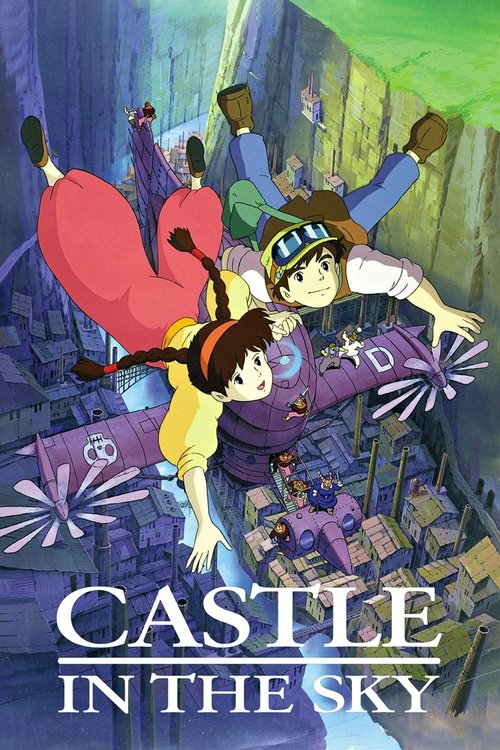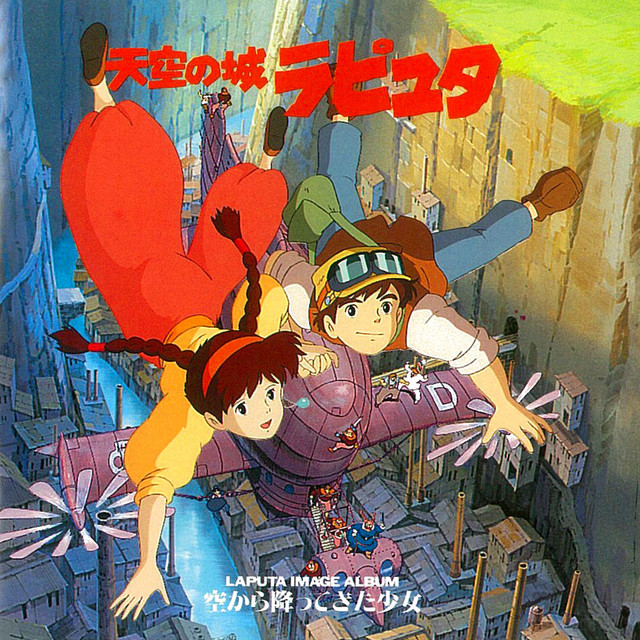
Album: 天空の城ラピュタ イメージアルバム ~空から降ってきた少女~
In March 1986, Joe Hisaishi found himself wrestling with an impossible task. Sitting at his keyboard, he had to capture something ineffable – the feeling of two children meeting at the edge of the world, suspended between earth and sky. The result would become “Sheeta and Pazu,” one of the most emotionally resonant pieces from the Castle in the Sky image album, but the journey to create it was anything but simple.
The pressure was enormous. Having reconnected with directors Hayao Miyazaki and Isao Takahata after their successful collaboration on Nausicaä, Hisaishi felt the weight of expectations. “I absolutely had to create something wonderful,” he later reflected, describing how this unspoken pressure haunted him daily during recording sessions at Wonder Station and Nikkatsu Studio Center.
But pressure can forge diamonds, and Miyazaki’s creative brief provided the spark Hisaishi needed. The director handed him a simple yet evocative note: “On a rooftop overlooking the entire world. People are still sleeping. Now only the boy and the pigeons exist in the world. The morning sun clears the mist, and a departure song begins to flow from the boy’s trumpet.”
This image – of solitude, hope, and the quiet magic of dawn – became the emotional DNA of “Sheeta and Pazu.” Hisaishi understood that he wasn’t just scoring a scene; he was crafting a musical representation of what adults must leave for children. The overarching concept that Miyazaki and Takahata shared with him was profound: “What must adults leave for children right now?”
Musically, Hisaishi made a deliberate choice to strip away complexity. After the sample-heavy approach of his previous work on Arion, he committed to acoustic instruments and clear, memorable melodies. “Sheeta and Pazu” exemplifies this philosophy perfectly – built around a gentle, flowing melody in a warm major key that feels like sunlight breaking through clouds. The instrumentation centers on piano and strings, with subtle woodwind touches that echo Pazu’s trumpet from Miyazaki’s vision.
The piece unfolds like a conversation between two souls discovering each other. The main theme, carried initially by solo piano, represents the tentative first meeting – careful, wondering, full of possibility. As strings join the melody, the music swells with the growing connection between the characters. It’s music that speaks directly to the heart without pretension, embodying Hisaishi’s core belief that children should hear something that warms their hearts.
What makes “Sheeta and Pazu” particularly fascinating is how it existed in two worlds simultaneously. While crafting the image album, Hisaishi couldn’t know exactly how the final film would unfold. He was working from concepts and emotions rather than completed scenes. This creative freedom allowed him to explore the pure essence of the characters’ relationship without the constraints of specific dramatic moments.
The final polishing of the track took place in London’s Air Studios, where Hisaishi worked with mix engineers Steve Jackson and Masayoshi Ohkawa. This international collaboration added a sonic richness that Hisaishi described as making each song “bright and vibrant.” The London sessions gave “Sheeta and Pazu” a crystalline clarity that allows every emotional nuance to shine through.
Listening to the piece today, one can hear Hisaishi’s entire musical philosophy distilled into five minutes. There’s the accessibility that comes from his belief in melody – no listener needs musical training to feel the tenderness and hope woven into every phrase. There’s the acoustic warmth that he chose specifically to contrast with more synthetic approaches. And there’s something deeper: a sense of innocence that never feels naive, a complexity that never overshadows emotion.
“Sheeta and Pazu” also represents Hisaishi’s understanding of childhood as a state of endless possibility. The music doesn’t patronize young listeners or simplify complex emotions. Instead, it treats children as capable of experiencing profound feelings – love, wonder, the bittersweet nature of growing up. This respect for the emotional sophistication of young people runs through all of Hisaishi’s work with Studio Ghibli.
The track serves as a bridge between the image album’s pure musical storytelling and the film score’s dramatic requirements. While some pieces would change significantly between album and movie – the Flaptter theme, for instance, proved too cheerful for the aircraft’s dangerous scenes in the finished film – “Sheeta and Pazu” captured something so essential about the characters that it translated perfectly across both mediums.
In the end, “Sheeta and Pazu” stands as more than just a beautiful piece of film music. It’s Hisaishi’s answer to Miyazaki and Takahata’s fundamental question about what adults owe children. Through melody, harmony, and careful orchestration, he offers something precious: the musical equivalent of that morning rooftop moment, when the world belongs to dreamers and anything seems possible.
- 天空の城ラピュタRead Review
- ハトと少年Read Review
- 鉱夫Read Review
- 飛行石Read Review
- ドーラRead Review
- シータとパズーNow Playing
- 大樹Read Review
- フラップターRead Review
- 竜の穴Read Review
- ティディスの要塞Read Review
- シータとパズーRead Review
- 失われた楽園Read Review