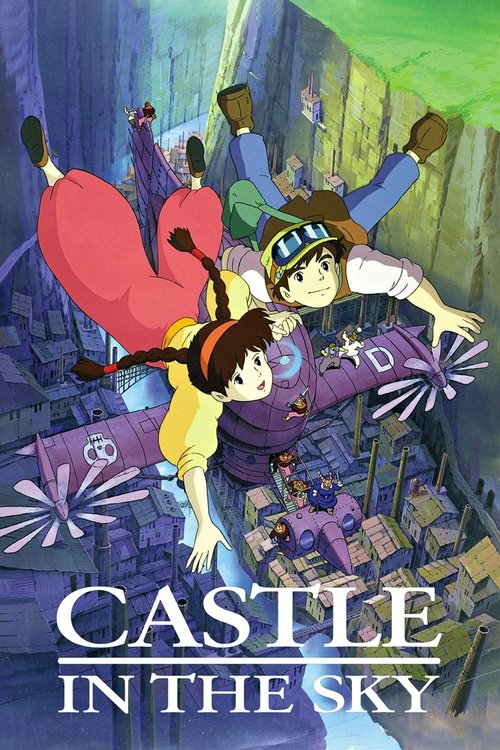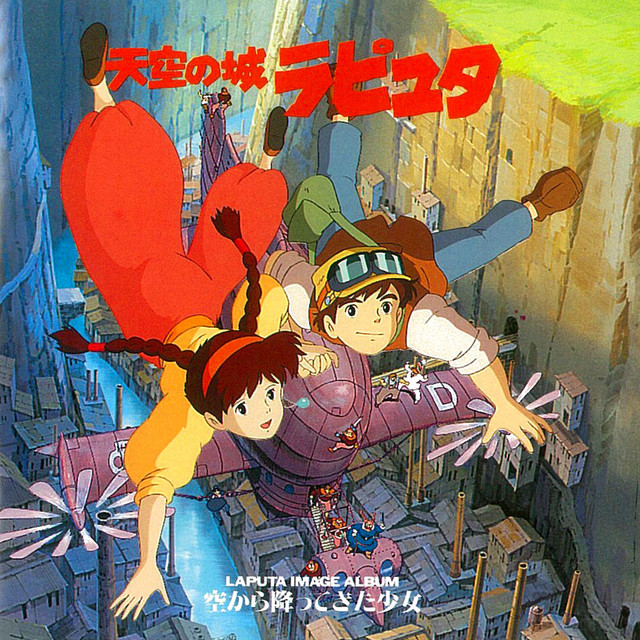
Album: 天空の城ラピュタ イメージアルバム ~空から降ってきた少女~
Standing in London’s legendary Air Studios in March 1986, Joe Hisaishi faced a peculiar challenge. The Japanese composer was putting the finishing touches on an image album for a film that existed only in Hayao Miyazaki’s imagination – Castle in the Sky. Among the pieces he was perfecting was “Taiju” (The Great Tree), a composition that would become one of his most profound musical statements about legacy, nature, and the weight of creative responsibility.
The song emerged from an unusual creative process. Rather than scoring to completed footage, Hisaishi was working from Miyazaki’s written meditations – poetic fragments that captured the director’s vision for each scene. For “Taiju,” Miyazaki had provided an evocative note about “Great Legend”: vast expanses, the tree of life, distant time, and sunlight. These weren’t musical instructions but emotional coordinates, challenging Hisaishi to translate abstract concepts into melody.
What makes “Taiju” particularly fascinating is how it revealed Hisaishi’s own musical DNA. The composer has often spoken about his melodic sensibilities being rooted in Scottish and Irish folk traditions – an unexpected influence for a Japanese musician, yet one that permeates his most memorable work. In “Taiju,” this Celtic thread weaves through the composition’s DNA, creating melodies that feel both ancient and immediate.
The piece unfolds in D major, a key that naturally lends itself to brightness and openness, perfectly suited to Miyazaki’s vision of sunlight and vast spaces. Hisaishi’s arrangement builds gradually, beginning with simple piano statements before introducing strings that seem to stretch toward the horizon. The melody itself follows patterns reminiscent of traditional Irish airs – long, breathing phrases that rise and fall like natural speech, carrying emotional weight through their very contours rather than through harmonic complexity.
But “Taiju” was born under intense pressure. Hisaishi has described feeling an overwhelming responsibility during the album’s creation. Having reconnected with Miyazaki and Isao Takahata on Nausicaä, he knew this project could define his career trajectory. The unspoken demand was clear: create something extraordinary. This pressure manifested daily during recording sessions at Wonder Station and Nikkatsu Studio Center, where Hisaishi grappled with translating Miyazaki’s philosophical concepts into musical reality.
The thematic weight was equally daunting. Miyazaki and Takahata had framed the entire project around a profound question: “What must adults leave behind for children today?” This wasn’t just about entertainment but about cultural inheritance and moral responsibility. “Taiju” embodies this philosophy through its very structure – it’s music that suggests continuity, growth, and the patient accumulation of wisdom over time.
Hisaishi’s musical background proved crucial to meeting this challenge. His university experience conducting baroque ensembles had given him an understanding of how Renaissance and baroque composers created music of spiritual elevation and architectural grandeur. This knowledge surfaces in “Taiju’s” careful construction, where each melodic phrase builds upon the previous one like branches growing from a central trunk.
The London finishing process, handled with mixing engineers Steve Jackson and Masayoshi Ohkawa, transformed these recordings into something Hisaishi described as “bright and vivid.” Air Studios, with its legendary acoustics and heritage of hosting classical and film score recordings, provided the sonic environment where “Taiju” could fully bloom. The mixing process enhanced the piece’s sense of space and light, crucial elements in Miyazaki’s original vision.
What emerges in “Taiju” is music that functions on multiple levels simultaneously. On the surface, it’s a beautiful instrumental piece that captures the wonder of discovering an ancient, magical tree. But deeper listening reveals its true subject: the relationship between past and future, the way wisdom and beauty persist across generations, and the responsibility each generation bears to preserve what’s valuable for those who follow.
The piece also represents a moment of artistic homecoming for Hisaishi. He’s spoken about how Laputa allowed him to work “in a place close to the music I originally possessed.” In “Taiju,” we hear a composer who has found his authentic voice – one that could bridge the gap between his classical training, his love of folk traditions, and the demands of cinematic storytelling.
Listening to “Taiju” today, more than three decades after its creation, the piece continues to fulfill Miyazaki’s original mandate about what adults should leave for children. It’s music that speaks to something eternal in human experience – our connection to nature, our responsibility to preserve beauty, and our capacity to create art that transcends its immediate circumstances. In just a few minutes of instrumental music, Hisaishi captured not just the image of a great tree, but the entire philosophy that would guide Studio Ghibli’s greatest works.
- 天空の城ラピュタRead Review
- ハトと少年Read Review
- 鉱夫Read Review
- 飛行石Read Review
- ドーラRead Review
- シータとパズーRead Review
- 大樹Now Playing
- フラップターRead Review
- 竜の穴Read Review
- ティディスの要塞Read Review
- シータとパズーRead Review
- 失われた楽園Read Review