
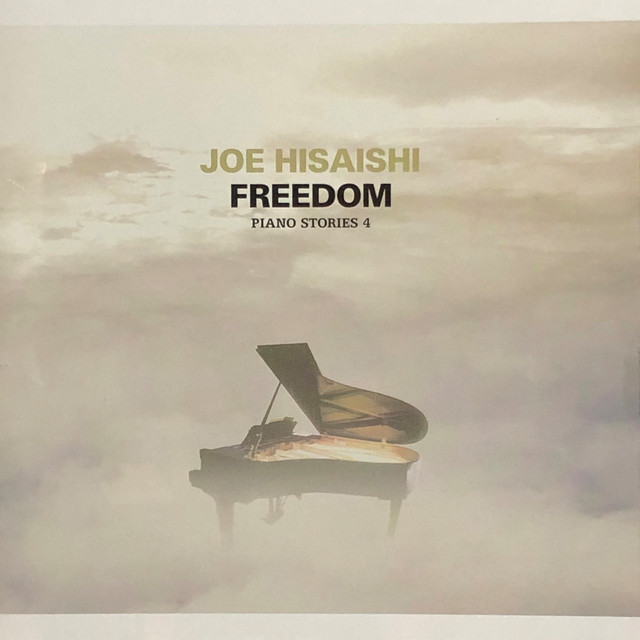
Album: Freedom – Piano Stories IV –

A Television in Hawaii
Joe Hisaishi had just finished composing Howl’s Moving Castle. He was on holiday in Hawaii — the kind of complete break that only makes sense after the sustained intensity of a Miyazaki collaboration — when he turned on the television and saw something that stopped him. A string ensemble was performing. The players were standing. And the music they were making had a physical energy, a bodily presence, that you simply do not get from musicians seated in the conventional orchestral arrangement.
The ensemble was Angèle Dubeau & La Piétà — a Canadian chamber group led by violinist Angèle Dubeau, known for programmes that cross freely between the classical repertoire and contemporary composition. Hisaishi watched them play and made a decision. He wanted to work with them. He wanted that sound, that standing energy, for his next album.
The Collaboration That Almost Came Apart
What followed, as Hisaishi recounts in 35mm Nikki (Takarajimasha, 2007), was a process considerably more difficult than the initial vision had suggested. A Japanese tour with Dubeau and La Piétà was planned — and around it, an album. Hisaishi began composing the new material. And then the schedule began to press.
The compositions were late. The recording that should have happened before the tour did not happen. There was no pre-recorded reference for the ensemble to work from, no shared version of the music that everyone could study in advance. When Dubeau and La Piétà arrived in Japan, the tour rehearsals were the first time any of them had played the pieces together.
This alone would have been challenging. But Hisaishi encountered a further difficulty he had not fully anticipated. What he needed from Dubeau and La Piétà was not the expressive freedom of classical performance — it was the opposite. His music required a tight, steady rhythmic pulse: the precise, metronomic groove of pop and contemporary music, where the beat does not bend to follow the emotion. Classical musicians, however accomplished, are trained to let the tempo breathe — to push and pull slightly with the phrase, to allow feeling to colour the time. Much of the early rehearsal time was spent correcting exactly this: pulling the ensemble away from their instincts and toward the locked, unwavering rhythm the music demanded.
How a Tour Becomes a Recording
But something shifted as the tour progressed. Night after night, performance after performance, the ensemble found its way into the music. The classical precision that had initially created friction became an asset — the intonation tightened, the ensemble playing grew more instinctive, and the expressive freedom Hisaishi needed began to emerge naturally from within the rigour rather than in spite of it.
The album was recorded during the tour itself — not as a live recording, but in studio sessions scheduled into the gaps between performances. What might have seemed like a logistical compromise turned out to produce exactly the quality the music needed. By the time they entered the studio, the ensemble had been shaped by weeks of playing the pieces on stage, night after night, in front of audiences. That accumulated experience came with them into the recording. The result, Hisaishi felt, was the best possible version of what he had imagined in that hotel room in Hawaii.
The Swan on the Surface
Freedom – Piano Stories IV – presents a surface of considerable beauty. The melodies — including a new recording of “The Merry-Go-Round of Life” from Howl’s Moving Castle — are clean, singable, accessible. The album sits comfortably in what might be called the popular classical space: music that asks nothing demanding of its listener, that rewards the kind of attention you give it on a quiet evening rather than the concentrated study a Beethoven quartet might require.
But underneath that surface, the ensemble writing is anything but simple. The rhythmic structures are complex — metres that shift and subdivide in ways that keep the players constantly alert. The harmonies are layered with a density that belies the apparent ease of the melodic lines above them. Like a swan moving across still water, the music looks effortless from above while something far more intricate is happening beneath.
This tension between accessibility and complexity is not accidental. It reflects a sustained interest in Hisaishi’s work that would become increasingly explicit in the years that followed: the influence of minimalist composition. The techniques audible in Freedom — repetitive rhythmic cells, gradual harmonic accumulation, structures that build through small variations rather than dramatic development — connect directly to the minimalist music Hisaishi has explored more openly in his concert work and recent recordings. In retrospect, Freedom can be heard as an important moment in that evolution: popular in form, but quietly radical in its underlying language.
It is worth noting that several tracks on the album had already reached Japanese audiences in a different context entirely. Many of the pieces had been written as television commercial music — a significant part of Hisaishi’s output throughout his career, and a field in which the demands of accessibility and immediate emotional impact are especially acute. Track five, “Oriental Wind,” is perhaps the clearest example: it became the theme of a widely broadcast green tea commercial in Japan, one that ran for years and became closely identified with the brand it advertised. The success of that campaign owed something, without question, to the quiet authority of the music beneath it. Heard on the album, freed from its commercial context, “Oriental Wind” reveals the same qualities that made it work on screen: a melody that settles into the memory almost without effort, and an arrangement that feels both simple and complete.
It is an album that repays closer listening. The more you hear beneath the surface, the more there is to find.
Source: Joe Hisaishi, 35mm Nikki (Takarajimasha, 2007)
Listen to the album below.