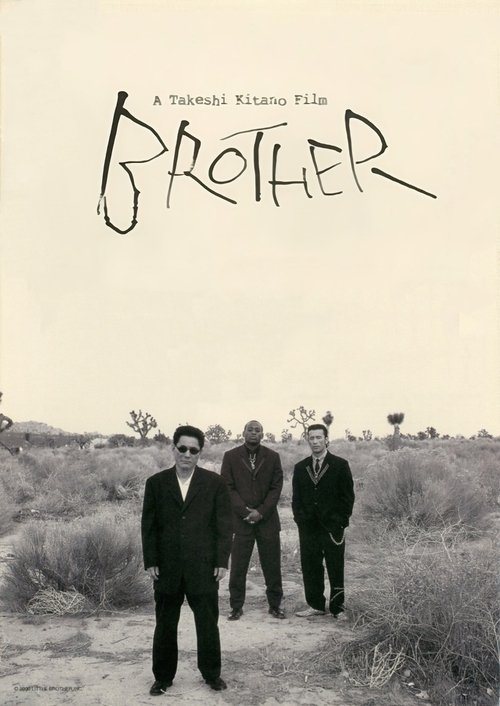
Takeshi Kitano’s 2000 film ‘Brother’ stands as a unique entry in both yakuza cinema and international action filmmaking. The narrative follows a hardened Japanese gangster who, after his violent exploits in Tokyo become too troublesome, finds himself exiled to Los Angeles where his estranged younger brother runs a small gang. This fish-out-of-water premise, set against the backdrop of organized crime, becomes a meditation on loyalty, displacement, and cultural collision. The film’s relatively straightforward plot serves as a canvas for Kitano’s distinctive directorial vision—one marked by sudden violence, dark humor, and quiet moments of reflection that have become his hallmark.
Upon its release, ‘Brother’ generated significant international attention, marking Kitano’s first major foray into English-language cinema and broader Western audiences. While critical reception proved mixed, with some praising its bold cultural cross-pollination and others finding it uneven, the film undeniably positioned Kitano as a serious auteur capable of working across different film traditions. The movie’s willingness to blur the boundaries between Japanese and American crime narratives was itself groundbreaking for the era, and it has since developed a devoted cult following among cinephiles who appreciate its refusal to conform to genre expectations.
Joe Hisaishi’s contribution to ‘Brother’ represents one of his most intellectually intriguing scores, as he faced the challenge of accompanying Kitano’s exploration of cultural displacement through purely musical means. Rather than creating a traditional yakuza film score, Hisaishi crafted something far more complex—a work that mirrors the protagonist’s own sense of alienation and dislocation. The composer employs a fascinating blend of traditional Japanese instrumental textures alongside Western orchestral elements, creating a sonic landscape that embodies the film’s central theme of existing between two worlds.
At its core, Hisaishi’s approach emphasizes minimalism and restraint, qualities that perfectly complement Kitano’s visual style. Long stretches of the film contain sparse instrumentation, allowing the audience to sit uncomfortably in silence before sudden bursts of violence. The score features recurring motifs built around simple, haunting melodies that convey the protagonist’s sense of isolation rather than triumph. Hisaishi avoids conventional heroic themes, instead opting for ambiguous, melancholic passages that suggest moral ambiguity and psychological distance. When Japanese instruments such as the shamisen or taiko drums appear, they’re often deployed in unconventional ways, stripped of their traditional context to emphasize the film’s atmosphere of dislocation.
The music’s relationship to the narrative proves remarkably subtle. Rather than underlining dramatic moments with bombastic orchestration, Hisaishi frequently undercuts them, creating a counterpoint between image and sound that forces viewers to examine their own emotional responses. A violent scene might be accompanied by delicate piano work, creating cognitive dissonance that enhances the film’s unsettling power. This compositional strategy reflects Hisaishi’s mature artistry—his willingness to trust silence and simplicity rather than relying on emotional manipulation through music.
Throughout ‘Brother,’ Hisaishi demonstrates why he remains one of cinema’s most essential composers, capable of creating scores that elevate their source material while maintaining artistic integrity. His work here stands as a fascinating document of East-West cultural exchange, proving that the most profound film music doesn’t necessarily announce itself loudly, but rather whispers truths beneath the surface of the narrative.