
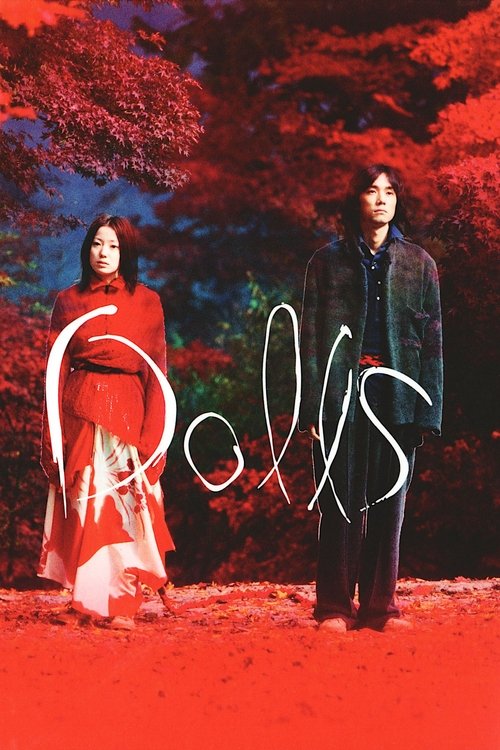
Takeshi Kitano’s 2002 film ‘Dolls’ stands as one of cinema’s most visually stunning meditations on love, duty, and human agency. The narrative weaves together multiple interconnected stories bound by a central metaphor: the relationship between puppeteers and their marionettes. At the heart of the film lies the tragic romance between Matsumoto and Sawako, a couple whose love is threatened by familial obligation when Matsumoto’s parents demand he submit to an arranged marriage with his boss’s daughter. This conflict between personal desire and societal expectation forms the emotional core around which Kitano constructs his baroque, painterly vision.
When ‘Dolls’ premiered at international film festivals, it garnered considerable critical acclaim for its audacious visual language and philosophical depth. European audiences particularly responded to Kitano’s departure from his typical genre work, recognizing in ‘Dolls’ a filmmaker operating at the height of his artistic ambitions. The film’s aesthetic—featuring vibrant costumes, theatrical staging, and meticulously composed frames—established it as a masterpiece of contemporary Japanese cinema. While not achieving mainstream commercial success, ‘Dolls’ has endured as a film of considerable cultural significance, regularly cited by critics and filmmakers as a defining work of early 2000s art cinema.
Yet the film’s visual splendor would remain incomplete without the contribution of Joe Hisaishi, whose score proves instrumental in elevating Kitano’s already ambitious vision. Hisaishi’s approach to ‘Dolls’ represents a masterclass in how film music can intensify thematic resonance. Rather than overwhelming Kitano’s meticulous visual compositions, the composer creates a soundscape that mirrors the puppet motif itself—beautiful, yet tinged with an underlying melancholy that speaks to the characters’ lack of control over their destinies.
The score’s primary thematic material centers on a haunting, yearning melody that recurs throughout the film, particularly during scenes emphasizing the lovers’ separation. This theme employs traditional Japanese instrumental textures—notably the shakuhachi flute—blended seamlessly with Western orchestral arrangements. This fusion reflects the film’s own cultural hybridity and the tension between tradition and modernity that drives the narrative. Hisaishi’s compositional approach privileges restraint and emotional clarity; rather than pursuing grandiose orchestration, he allows silences and sparse arrangements to carry profound weight.
Particularly remarkable is how Hisaishi’s music complements the film’s visual puppetry sequences. When Kitano presents stylized theatrical interludes featuring elaborate dolls performing their own tragic narratives, Hisaishi’s score becomes virtually choreographic, its rhythms and phrasing dancing in perfect synchronization with the marionettes’ movements. This creates a profound artistic synergy: the music doesn’t merely accompany the visuals but becomes their emotional equivalent, translating the mechanical movements of puppets into something deeply human and affecting.
The score’s minor-key harmonic language and use of sustained, mournful strings create an atmosphere of romantic tragedy that never tips into sentimentality. Instead, Hisaishi crafts something more sophisticated—music that acknowledges both the beauty and futility of the characters’ struggle against forces beyond their control. In this way, his composition becomes the perfect sonic manifestation of Kitano’s thematic preoccupation: we are all, to some extent, puppets dancing on invisible strings, yet our desires and loves remain genuinely felt, genuinely tragic.
For European listeners encountering ‘Dolls’ for the first time, Hisaishi’s score serves as an essential gateway into the film’s emotional universe. It is music that lingers long after the credits roll, a testament to the enduring power of his collaboration with Kitano.