
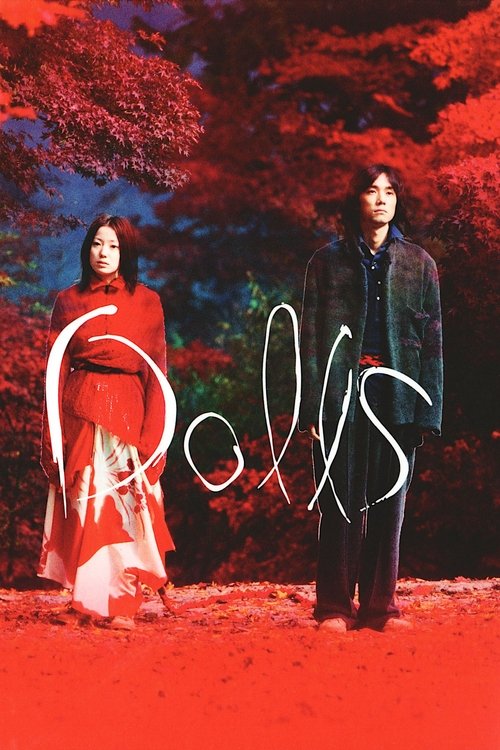
Takeshi Kitano’s 2002 film ‘Dolls’ stands as one of cinema’s most visually poetic and emotionally devastating meditations on love and fate. The narrative weaves together multiple stories of separated lovers, with the central tale following Matsumoto and Sawako, a young couple torn apart by the inexorable demands of traditional Japanese society. When Matsumoto’s parents arrange for him to marry his boss’s daughter, the couple faces an impossible choice between love and familial duty. This exploration of human agency and predetermined paths—symbolized throughout by the ancient art of Bunraku puppeteering—finds its perfect sonic counterpart in Joe Hisaishi’s extraordinary musical score.
Upon its release, ‘Dolls’ received considerable acclaim from critics who recognized Kitano’s artistic ambition and the film’s stunning visual composition. While perhaps less commercially successful than some of the director’s earlier works, the film has developed a devoted following among cinephiles and stands as a testament to Kitano’s willingness to pursue deeply personal, challenging artistic visions. The film’s deliberate pacing and painterly aesthetic attracted audiences willing to engage with its complex emotional landscape, and many viewers identified Hisaishi’s score as integral to the film’s profound impact.
Hisaishi’s contribution to ‘Dolls’ represents some of his most sophisticated and introspective work to date. Rather than employing the lush orchestration that characterizes much of his film music, the composer crafted a score that operates with remarkable restraint and emotional precision. The music frequently features solo piano passages combined with sparse orchestral textures, creating a soundscape that mirrors the film’s visual aesthetic of space, stillness, and carefully composed frames. This compositional approach reflects the puppetry motif central to Kitano’s narrative—just as the puppeteers control their wooden figures through invisible strings, Hisaishi’s delicate musical phrases seem to pull at the heartstrings of the film’s characters.
The thematic architecture of the score revolves around a series of haunting melodies that recur throughout the film, each iteration subtly transforming to reflect the emotional progression of the characters’ journeys. The main theme, introduced early through solo piano, carries a bittersweet quality that perfectly encapsulates the film’s central tragedy: love constrained by social obligation. As the narrative unfolds across its interconnected stories, Hisaishi gradually introduces additional instrumental voices—a mournful violin here, gentle woodwinds there—building emotional complexity without ever overwhelming the intimate quality of the piece.
What makes Hisaishi’s score particularly remarkable is his masterful understanding of silence. In ‘Dolls,’ the composer demonstrates that what remains unplayed can be as emotionally powerful as what is performed. Extended silences punctuate the score, allowing viewers to absorb the film’s stunning visuals and contemplate the profound themes at hand. When music does emerge from these silences, its impact is magnified tremendously. This sophisticated use of space and restraint elevates the score beyond mere accompaniment, transforming it into an active participant in storytelling.
The relationship between Hisaishi’s music and Kitano’s visuals achieves a remarkable synchronicity throughout ‘Dolls.’ The composer’s decision to embrace minimalism and emotional directness mirrors the director’s painterly approach to cinematography. Together, they create a work that operates on a heightened emotional register, where every image, every note, and every silence carries weight and meaning. For European audiences discovering this masterwork, Hisaishi’s score serves as an ideal entry point into both Kitano’s artistic vision and the composer’s remarkable range as a film musician.