
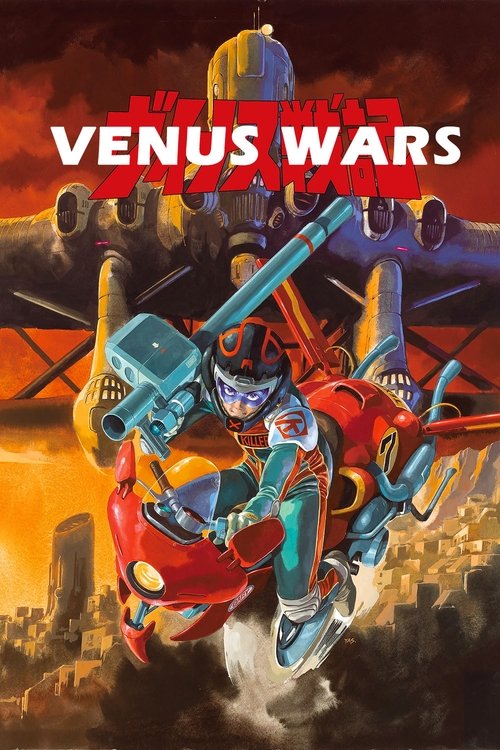
Venus Wars, released in 1989 and directed by Yoshikazu Yasuhiko, presents a unique vision of humanity’s colonised future. The film transports viewers to a dystopian Venus, where the peaceful settlement of Aphrodia faces invasion from the militaristic nation of Ishtar. When American reporter Susan Sommers arrives in the capital, she becomes entangled with a group of fearless teenagers who pilot mono-cycles in a high-octane sport reminiscent of roller derby. As conflict engulfs the nation, these young riders—particularly the gifted Hiro—find themselves thrust into an unexpected role as freedom fighters, their racing machines repurposed as weapons of resistance against overwhelming odds.
Although Venus Wars arrived during the tail end of the 1980s anime boom, it has maintained a devoted cult following among fans who appreciate its blend of science fiction worldbuilding and intimate human drama. The film’s reception was notably strong in Japan, where audiences embraced its unique aesthetic and action sequences. In Europe, while it achieved less mainstream recognition than some contemporaries, the film has gradually earned appreciation among anime enthusiasts and science fiction devotees who value its thematic depth and visual ambition. Critics have consistently praised Yasuhiko’s direction and the film’s commitment to exploring themes of civilian resistance and the cost of war, establishing Venus Wars as a respectable entry in 1980s anime cinema.
Central to the film’s emotional and kinetic power is Joe Hisaishi’s masterful score, a composition that stands as one of his most innovative and propulsive works from this period. Hisaishi, already celebrated for his collaborations with Hayao Miyazaki, approached Venus Wars with a distinctive compositional philosophy tailored to the film’s unique blend of sport, action, and human conflict. The score balances orchestral grandeur with synth-driven intensity, reflecting both the futuristic setting and the urgency of the narrative.
The composer’s approach centres on creating musical themes that embody character and situation rather than merely accompanying visual events. The mono-cycle races pulse with synthesiser-driven rhythms and driving string sections, capturing the adrenaline and liberation the riders experience. These sequences showcase Hisaishi’s talent for synchronising music with dynamic action, where percussion patterns mirror the mechanical whir of engines and the rhythmic pounding of competition. Yet Hisaishi never allows the score to overwhelm the spectacle; instead, the music enhances our investment in these characters’ physical exploits.
Beyond the action sequences, Hisaishi weaves quieter thematic material that underscores the film’s emotional core. Poignant melodies emerge when the story explores the teenagers’ forced transition from carefree athletes to reluctant soldiers. The composer employs solo instruments—delicate piano passages and tender woodwind arrangements—to capture intimate moments, preventing the constant warfare from consuming the human relationships at the story’s heart. This dynamic range demonstrates Hisaishi’s sophisticated understanding of narrative cinema.
The score’s orchestration reveals Hisaishi’s willingness to experiment with unconventional instrumental combinations. Traditional orchestral instruments blend seamlessly with synthesisers, creating a soundscape that feels simultaneously retro-futuristic and timeless. This tonal palette perfectly complements Venus Wars’ visual design, enhancing the film’s distinct aesthetic identity. The main theme itself—bold, heroic, and tinged with melancholy—encapsulates the film’s central tension between youthful optimism and wartime tragedy.
For European listeners discovering Hisaishi’s work, Venus Wars represents an essential listen, showcasing a composer operating at the peak of his creative powers, crafting music that transforms anime action into genuine cinematic art.