
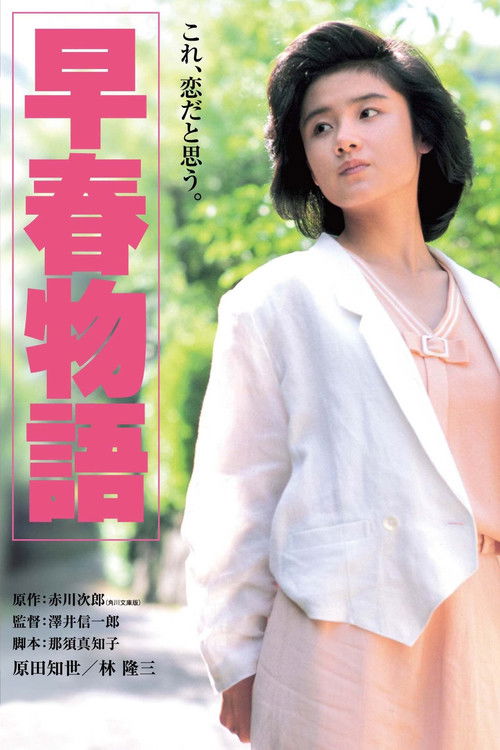
Shinichiro Sawai’s ‘Early Spring Story’ (1985) stands as a poignant meditation on youth, memory, and the search for identity. The film follows a passionate high school photographer as she navigates the complexities of first love while grappling with the unresolved legacy of her deceased mother. Through the lens of her camera, the protagonist discovers not only romance but also a deeper understanding of the choices that shaped her family’s past. This intimate coming-of-age narrative captures the bittersweet essence of adolescence with remarkable tenderness, presenting photography as both a literal and metaphorical tool for understanding oneself and others.
While ‘Early Spring Story’ remains somewhat lesser-known compared to other 1980s Japanese cinema, the film achieved meaningful recognition within domestic and international arthouse circles. Its exploration of maternal absence and romantic awakening resonated with audiences seeking authentic, character-driven storytelling. The film’s influence, though subtle, contributed to broader conversations about how Japanese cinema approached female perspectives and introspection during this period. For those familiar with Sawai’s work, the film exemplifies his commitment to nuanced emotional storytelling.
Yet the true revelation of ‘Early Spring Story’ lies in Joe Hisaishi’s extraordinary musical accompaniment. Hisaishi, already celebrated for his collaborations with Studio Ghibli and Akira Kurosawa, crafted a score that perfectly captures the film’s delicate emotional landscape. His compositional approach demonstrates remarkable restraint and sensitivity, eschewing melodrama in favor of subtle emotional resonance. The music functions not as decoration but as an essential narrative voice, often communicating what words and images alone cannot express.
Hisaishi’s thematic material weaves through the score like threads connecting the protagonist’s present discovery to her mother’s hidden past. The primary motif appears in gentle, understated piano passages that evolve throughout the film, mirroring the character’s psychological journey. Rather than employing obvious leitmotifs, Hisaishi creates an impressionistic soundscape where small melodic fragments accumulate meaning through repetition and subtle variation. This approach mirrors the protagonist’s photographic process—capturing fleeting moments that collectively reveal deeper truths.
The instrumentation choices particularly deserve praise. Hisaishi employs intimate chamber arrangements featuring piano, strings, and sparse woodwinds, creating an atmosphere of quiet vulnerability. The delicate string textures underscore moments of romantic connection, while minimalist piano passages accompany introspective scenes of photographic discovery. The orchestration never overwhelms the film’s visual poetry; instead, it exists in conversation with the cinematography, enhancing without dominating.
Where Hisaishi’s genius truly shines is in how the score navigates the emotional terrain between past and present. As the protagonist uncovers truths about her mother, the music subtly shifts, introducing darker harmonic colors and more complex arrangements. Yet these moments never descend into sentimentality. Instead, Hisaishi maintains his signature balance between accessibility and compositional sophistication, creating music that feels both emotionally immediate and structurally intricate.
For European fans discovering Hisaishi’s work, ‘Early Spring Story’ represents a masterclass in how film music can serve emotional authenticity. The score demonstrates why Hisaishi remains one of cinema’s most essential composers—his ability to translate human experience into musical language with such profound sensitivity and restraint.