
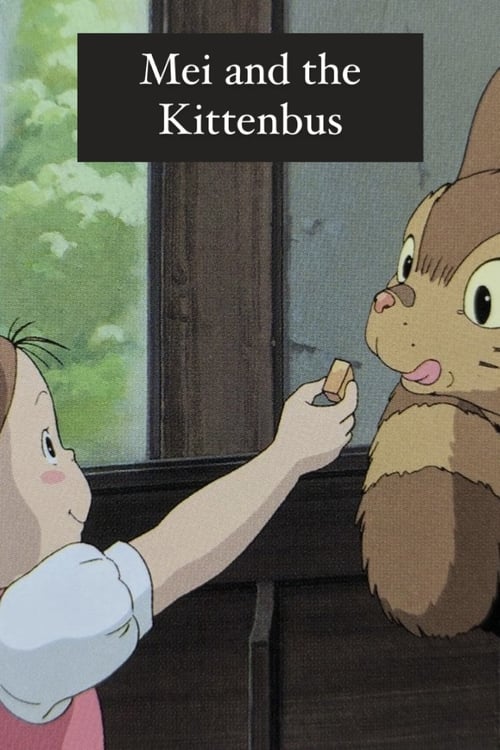
In 2002, Studio Ghibli released a delightful short film that would become a beloved companion piece to Hayao Miyazaki’s beloved feature “My Neighbor Totoro.” “Mei and the Kittenbus” tells the charming story of a young girl named Mei who encounters a magical baby cat bus on a windy day. When a whirlwind mysteriously chases her, Mei discovers that it is actually a friendly kitten-sized version of the famous Catbus. After sharing a caramel with her new friend, the two form an instant bond. That night, the baby cat bus visits Mei’s home, and together they embark on a wondrous journey skyward, traveling to a midnight forest populated by ghosts where larger cat buses have mysteriously gathered. It is a brief but enchanting narrative, lasting only fourteen minutes, yet it manages to capture the whimsical spirit that makes Studio Ghibli’s work so universally cherished.
Upon its release, “Mei and the Kittenbus” was initially distributed as a bonus feature accompanying the theatrical re-release of “My Neighbor Totoro,” and European audiences embraced it warmly. The film’s reception demonstrated that even a brief interlude from Miyazaki could resonate deeply with viewers. Critics and fans alike praised the film’s visual charm and its ability to evoke the same sense of wonder that defined its predecessor. Over the years, the film has gained significant recognition in its own right, cementing its place as an essential entry in the Ghibli canon. Its cultural impact, though sometimes overshadowed by the studio’s feature-length films, remains substantial among devoted followers of Japanese animation and Studio Ghibli enthusiasts across Europe.
Central to the film’s emotional resonance is the exquisite musical score composed by Joe Hisaishi, the legendary composer whose work has become inseparable from Studio Ghibli’s identity. Hisaishi’s approach to “Mei and the Kittenbus” exemplifies his masterful ability to distill complex emotional narratives into concise, memorable compositions. The score employs a delicate balance of whimsical orchestration and ethereal instrumentation that perfectly complements Miyazaki’s visual storytelling. Hisaishi utilizes warm, inviting melodies featuring gentle strings and woodwinds that immediately establish the film’s fantastical yet intimate atmosphere, drawing viewers into Mei’s magical world from the opening moments.
The composer’s thematic work reveals particular sophistication in how music underscores the unlikely friendship between Mei and the Kittenbus. The main theme features a playful, almost childlike melody that evolves throughout the film, gaining depth and richness as the bond between girl and cat bus deepens. When Mei offers her caramel to the mysterious whirlwind, Hisaishi’s score shifts subtly, introducing warmer harmonic textures that suggest recognition and connection. The music becomes more adventurous as the narrative progresses toward the nocturnal forest sequence, with the composer introducing mysterious, slightly unsettling elements through minor key modulations and unconventional instrumental combinations.
What makes Hisaishi’s work particularly noteworthy is his compositional restraint. Rather than overwhelming the intimate moments with elaborate orchestration, he allows silence and space to carry emotional weight. This approach demonstrates profound understanding of how music should serve the narrative. During the journey to the midnight forest, the score builds gradually, layering folkloric elements and ghostly textures while maintaining the underlying sense of safety and wonder that characterizes Mei’s experience. The gathering of cat buses is accompanied by swelling, majestic orchestration that transforms the fantastical into the magnificent, allowing viewers to appreciate the scale and magic of this hidden world.
Ultimately, Joe Hisaishi’s score for “Mei and the Kittenbus” represents some of his finest work, proving that even short-form animation deserves compositions of remarkable depth and artistry. The music elevates every frame, creating an immersive experience that lingers long after the credits roll.