
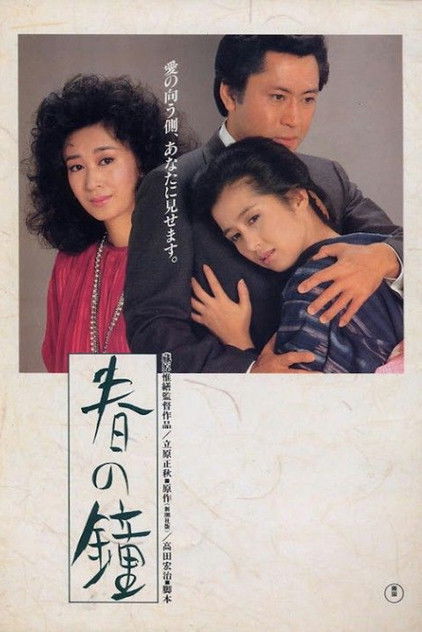
Koreyoshi Kurahara’s 1985 film “Spring Bell” presents a melancholic meditation on marriage, separation, and the gulfs that can form between two people bound by love and obligation. The narrative centers on Rokuheita Narumi, a museum director in Nara devoted to oriental art, whose marriage to Noriko exists primarily in name only. While he remains in the cultural heart of Nara, pursuing his professional passion, Noriko remains tethered to Tokyo, where she seeks solace in a hollow affair with a physician. When Rokuheita discovers her infidelity, he faces an impossible choice between personal happiness and familial duty—a distinctly Japanese dilemma that gives the film its emotional weight. Rather than pursue divorce, he channels his pain into his work, allowing the distance between husband and wife to grow ever wider.
Upon its release, “Spring Bell” found appreciation among discerning audiences and critics who recognized Kurahara’s sophisticated handling of emotional restraint and the film’s nuanced exploration of modern Japanese relationships. The picture exemplified a particular strand of 1980s Japanese cinema that favored psychological complexity over melodramatic excess. While not achieving blockbuster status, the film cultivated a devoted following among those drawn to its contemplative atmosphere and refined artistic sensibilities. The film’s modest success demonstrated that there remained an audience for intimate, character-driven narratives that examined the fractures in seemingly stable relationships.
Central to the film’s emotional resonance is Joe Hisaishi’s carefully crafted musical score, which serves as the film’s emotional backbone. Hisaishi, already establishing himself as one of Japan’s most sophisticated film composers, brings his characteristic elegance and restraint to “Spring Bell.” The score operates on a principle of minimalism, avoiding the sweeping romanticism that lesser composers might have employed. Instead, Hisaishi opts for delicate orchestrations that privilege space and silence, allowing moments of quiet reflection to breathe within the narrative.
The composer employs a refined palette of traditional and contemporary instruments, creating a sound world that mirrors the film’s thematic preoccupation with East-West cultural tension and the collision between tradition and modernity. Piano passages emerge as particularly significant, their crystalline tones evoking both the austere beauty of Nara’s cultural institutions and the emotional fragility of the characters. Where the narrative dwells in moments of profound loneliness—Noriko’s urban alienation or Rokuheita’s quiet desperation—Hisaishi’s music withdraws into intimate chamber arrangements that feel almost chamber-like in their delicacy.
Hisaishi demonstrates remarkable sensitivity in how his compositions respond to the visual language of Kurahara’s direction. When the camera contemplates the architectural spaces of the art museum or Japan’s natural landscapes, the music adopts an almost impressionistic quality, emphasizing texture and atmosphere rather than memorable melody. Conversely, when examining the psychological turbulence of the characters’ inner lives, the score becomes more harmonically adventurous, employing unexpected chord progressions that subtly suggest emotional disturbance and unresolved tension.
The score never overwhelms the intimate domestic scenes; instead, it provides subtle emotional scaffolding that supports the actors’ nuanced performances. This restraint represents Hisaishi’s artistic maturity—his understanding that sometimes what is left unsaid, what remains suspended in musical space, carries more power than explicit emotional declaration. For European audiences encountering “Spring Bell,” Hisaishi’s score serves as an eloquent gateway into the film’s contemplative world, offering a masterclass in how music can express the ineffable loneliness and dignity of individuals navigating impossible emotional circumstances.