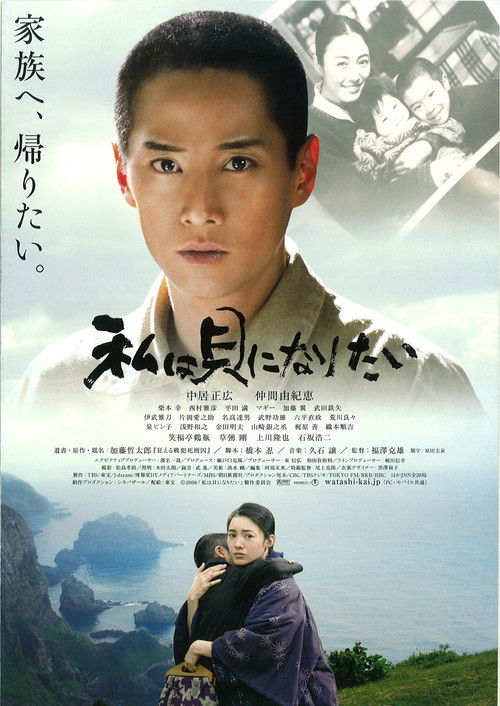
Katsuo Fukuzawa’s 2008 film “I Want to Be a Shellfish” stands as a profound meditation on the injustices of war and the fragility of human morality. The narrative follows Toyomatsu Shimizu, an ordinary barber conscripted during the final year of World War II, whose life takes an irreversible turn when he is ordered to execute a captured American soldier. In a moment that defines the entire film’s moral quandary, Toyomatsu’s inability to complete the deed—wounding rather than killing his prisoner—results in his own arrest and trial as a war criminal. Facing execution for a crime born from his own humanity, Shimizu becomes an unwilling symbol of war’s fundamental absurdity, where mercy itself becomes criminal and survival becomes impossible.
The film achieved significant recognition upon its release, earning critical acclaim for its unflinching examination of post-war justice and the Tokyo Trials. European audiences particularly responded to its philosophical depth and refusal to simplify its central ethical questions. Rather than presenting clear villains and heroes, Fukuzawa crafted a narrative that challenges viewers to confront uncomfortable truths about culpability, redemption, and the arbitrary nature of wartime morality. The film’s Japanese title, “Kaitai suru” (literally “to become a shellfish”), derives from a Buddhist parable about reincarnation and karma, lending the work a spiritual dimension that resonated across cultural boundaries. It became one of the most respected Japanese films dealing with the war’s aftermath and continues to spark meaningful discourse about accountability and human dignity.
At the heart of this powerful narrative lies Joe Hisaishi’s extraordinary musical score, a work that elevates the film from tragedy to something approaching the tragic sublime. Hisaishi’s approach to “I Want to Be a Shellfish” demonstrates his masterful understanding of how music can articulate emotions that dialogue cannot express. The composer employs a deceptively simple yet profoundly effective strategy: he grounds the score in the ordinariness of Toyomatsu’s pre-war life through gentle, folkish melodies that evoke the modest beauty of rural Japan. These early themes possess an almost wistful quality, establishing the character’s fundamental humanity and the peaceful existence that war will strip away.
As the narrative progresses toward its moral crisis, Hisaishi’s orchestration becomes increasingly sparse and unsettling. Traditional instruments fade, replaced by minimal piano passages and dissonant string work that mirrors Toyomatsu’s internal anguish. The composer avoids melodrama; instead, he opts for restraint, allowing silence and tension to speak volumes. This compositional choice proves devastatingly effective during the film’s trial sequences, where Hisaishi’s score becomes almost skeletal—a few notes on piano, the whisper of strings—creating an atmosphere of inexorable doom that no aggressive orchestration could achieve.
What distinguishes Hisaishi’s work here is his refusal to provide emotional catharsis through his music. While many composers might underscore climactic moments with swelling orchestrations, Hisaishi maintains an almost Buddhist acceptance of suffering. His themes repeatedly circle back on themselves without resolution, musically embodying Toyomatsu’s entrapment. The recurring motif—a simple, haunting melody—becomes increasingly fragmented as the film progresses, fragmenting much like the protagonist’s hopes for justice and redemption.
The final scenes showcase Hisaishi at his most poignant, pairing minimal instrumentation with the film’s devastating conclusion. Here, his music achieves a kind of tragic poetry, transforming Toyomatsu’s fate into something universal about human suffering and the price of conscience. For European listeners unfamiliar with Hisaishi’s broader filmography, “I Want to Be a Shellfish” offers an essential introduction to a composer who understands that the most powerful film music often whispers rather than shouts.