
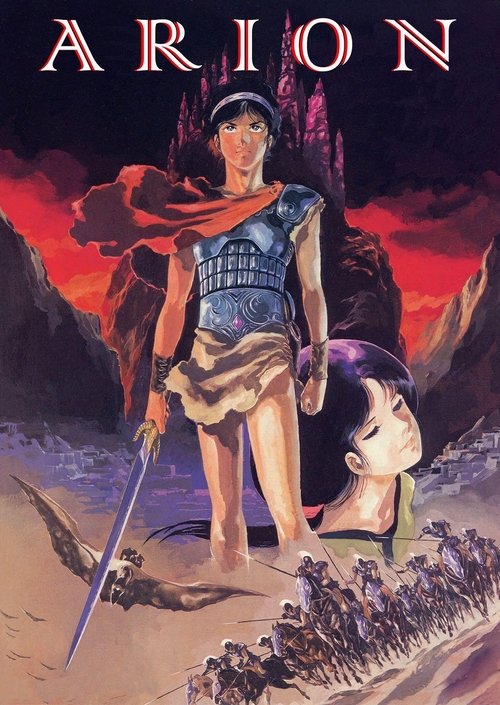
Yoshikazu Yasuhiko’s 1986 animated film ‘Arion’ stands as a visually stunning yet often overlooked gem in the pantheon of mythologically-inspired cinema. The narrative follows its titular protagonist, a young man raised in the underworld by Hades himself, who has been deceived into believing that Zeus blinded his mother and that only the god’s death can restore her sight. This dark twist on classical mythology creates a compelling moral journey as Arion discovers the truth behind his upbringing and must confront his adopted father in an attempt to save Olympus from destruction. The film’s ambitious scope—combining intricate hand-drawn animation with philosophical depth—establishes it as a work of considerable ambition that dared to reimagine ancient legends for contemporary audiences.
Upon its theatrical release, ‘Arion’ garnered significant attention within Japanese animation circles, praised for Yasuhiko’s direction and the film’s willingness to explore morally complex themes rather than simply adapting Greek mythology wholesale. European audiences, in particular, found themselves captivated by the film’s visual poetry and its earnest engagement with classical source material. While it never achieved mainstream recognition comparable to later Studio Ghibli productions, the film developed a devoted cult following among European fans who appreciated its artistic ambitions and thematic richness. The work demonstrated that anime could tackle sophisticated narrative concepts while maintaining visual splendor, influencing subsequent creators who sought to blend high art with animation.
Yet what truly elevates ‘Arion’ into the realm of the unforgettable is Joe Hisaishi’s extraordinary musical score—a towering achievement that fundamentally shapes the film’s emotional resonance. Hisaishi approaches the material with compositional sophistication rarely seen in animated features, crafting themes that are simultaneously grand and intimate, ancient and contemporary. His primary motif for Arion himself begins as a hesitant, searching melody, reflecting the protagonist’s confused identity and internal conflict. This theme gradually transforms throughout the narrative, gaining strength and clarity as Arion matures and discovers his true purpose, creating a musical parallel to his psychological journey.
The score’s handling of the divine realm deserves particular attention. Rather than relying on bombastic orchestration alone, Hisaishi employs layered orchestration featuring prominent strings, woodwinds, and carefully deployed brass sections that evoke mythological grandeur without descending into cliché. The music for Olympus itself shimmers with ethereal qualities—think shimmering harps and delicate string passages—that suggest both beauty and moral complexity. Conversely, the underworld theme employs darker tonal palettes with deeper brass and percussion that ground the music in earthiness and gravity.
Hisaishi’s compositional approach brilliantly mirrors the film’s visual narrative, with music serving not merely as accompaniment but as emotional interpreter. During moments of revelation, his orchestration expands to match Arion’s expanding consciousness. Quieter scenes of introspection receive intimate chamber arrangements that allow viewers to sit with characters’ emotional turmoil. The climactic confrontation between Arion and Hades features some of Hisaishi’s most daring work—dissonant passages that reflect spiritual and moral collision, juxtaposed with moments of painful tenderness that acknowledge the complicated bond between adoptive father and son.
For European listeners discovering ‘Arion’ through modern streaming platforms, Hisaishi’s score remains thoroughly transportive, standing as a testament to animation’s capacity to inspire symphonic-level composition. This film remains essential listening for anyone seeking to understand how profoundly music can elevate cinematic storytelling.