
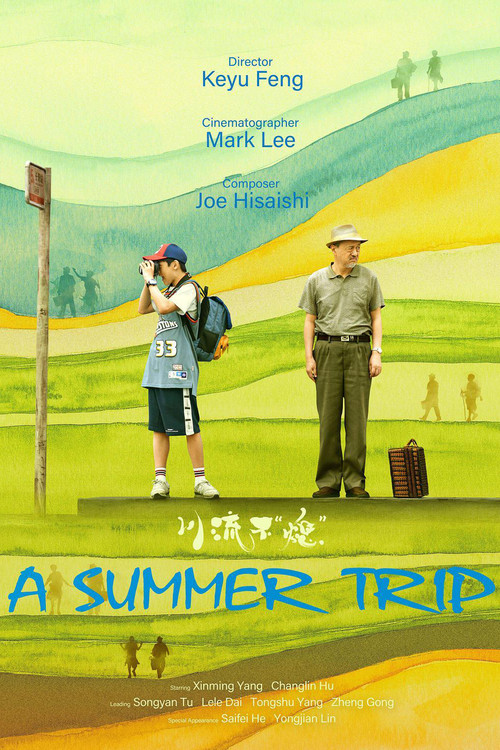
Feng Keyu’s 2021 film ‘A Summer Trip’ is a touching exploration of intergenerational connection set against the backdrop of China’s rapid modernization. The narrative follows Zhang Dachuan, a Korean War veteran grappling with memory and displacement in a small southern Chinese town, and his estranged grandson Xiaosong, a digitally-native teenager disconnected from traditional values. When Dachuan embarks on a secret journey to Beijing for a comrade’s funeral, Xiaosong tags along to escape his studies, setting the stage for an unlikely road trip. Through a series of humorous and poignant encounters, the film charts how these two characters—separated by decades and worldviews—gradually discover common ground amidst China’s stunning landscapes. Their adventure becomes a meditation on filial piety, loyalty, and the timeless human need for connection, wrapped in a package that manages to be both entertaining and deeply moving.
Since its release, ‘A Summer Trip’ has resonated strongly with audiences across East Asia and beyond. The film’s sensitive portrayal of aging, generational divide, and cultural transition struck a chord with viewers navigating similar shifts in their own societies. European audiences, in particular, have responded warmly to its universal themes and gentle humanism, recognizing parallels to their own evolving relationships with tradition and modernity. The film achieved considerable critical success, with many praising its balance of comedy and tenderness, and its refusal to condescend to either its elderly or young protagonist.
Central to the film’s emotional resonance is Joe Hisaishi’s exquisite musical score, which functions as far more than mere accompaniment. Hisaishi, renowned for his collaborations with Hayao Miyazaki and his ability to capture the ineffable essence of human experience, brings his signature sensibility to this Chinese production. His compositional approach here emphasizes simplicity and authenticity—qualities that mirror the film’s thematic preoccupations. Rather than overwhelming the narrative with orchestral grandeur, Hisaishi employs sparse, deliberate instrumentation that creates space for reflection and emotional depth.
The score’s primary thematic material centers on a gentle, lyrical melody that embodies the film’s exploration of connection across time. This motif recurs throughout, evolving subtly to reflect the characters’ emotional journey. Early iterations present the theme in minor keys, tinged with melancholy and nostalgia, reflecting Dachuan’s burden of memory. As the film progresses and the relationship between grandfather and grandson deepens, Hisaishi gradually shifts the theme toward major tonalities, introducing brighter orchestration that suggests hope and reconciliation without sacrificing emotional authenticity.
Hisaishi’s use of traditional Chinese instruments proves particularly masterful. Rather than employing them as mere ‘local color,’ he integrates them organically with Western orchestration, creating a hybrid sound world that mirrors the film’s central tensions. The erhu’s mournful tones evoke Dachuan’s past, while subtle piano passages suggest Xiaosong’s modern consciousness. During the film’s numerous travel sequences, Hisaishi employs gentle rhythmic patterns and flowing melodic lines that complement the cinematography, allowing landscapes to breathe while deepening our emotional connection to the characters moving through them.
What makes this score particularly remarkable is its restraint. Hisaishi resists the temptation to manipulate emotions through musical sentimentality; instead, he trusts the story and characters, providing a delicate harmonic foundation upon which their experiences can unfold naturally. In moments of quiet intimacy—when Dachuan and Xiaosong simply sit together, watching the landscape pass—the music withdraws almost entirely, replaced by ambient sound and silence. This compositional confidence transforms these moments into profound emotional beats.
For European listeners unfamiliar with Hisaishi’s work, ‘A Summer Trip’ offers an ideal introduction. The score demonstrates why he remains one of cinema’s most vital composers, capable of creating music that honors both intellectual rigor and profound emotional truth.