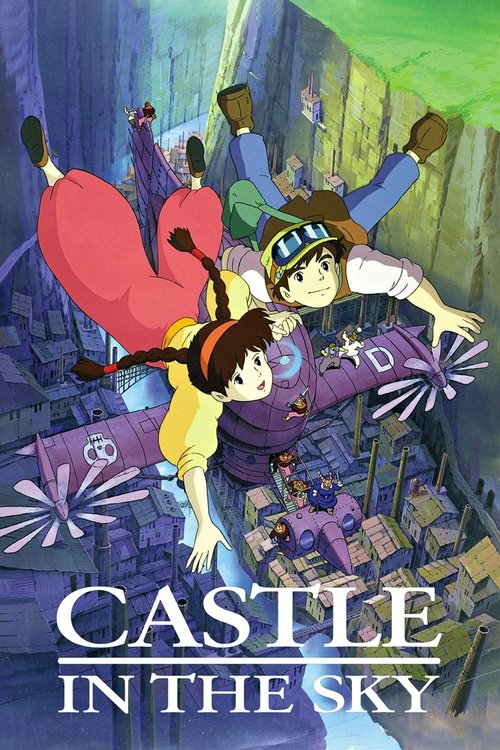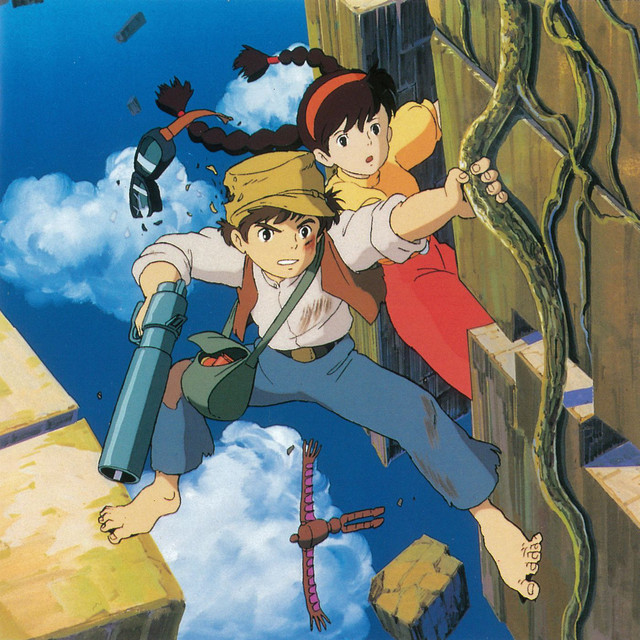
Album: 天空の城ラピュタ サウンドトラック ~飛行石の謎~
In the summer of 1986, something extraordinary was happening in a cramped Tokyo studio. Joe Hisaishi sat hunched over a Fairlight III sampler, watching grainy rushes of an animated film frame by frame, counting seconds with scientific precision. This wasn’t typical film scoring – this was musical archaeology, digging for the perfect moment where sound and image would fuse into something greater than their parts.
The track that emerged from this meticulous process, “Sheeta’s Determination” (Shīta no Ketsui), represents one of the most sophisticated examples of synchronous film scoring ever achieved. Yet its creation story reveals a composer wrestling with the fundamental challenge of animated film music: how do you make audiences feel the inner life of a drawing?
Hisaishi had established a radical working principle for Castle in the Sky’s soundtrack: “complete unity between the movement of the pictures and the flow of music.” This wasn’t merely about hitting action cues or matching tempo to chase scenes. It was about microsecond-level synchronization, where every gesture of Sheeta’s animated hand would correspond to a specific musical phrase, every shift in her expression matched by harmonic movement.
The technical setup was revolutionary for its time. After receiving the nearly complete rush film on June 20th, Hisaishi began programming rhythmic foundations into his Fairlight III, using the sampler not just for sounds but as a precision timing device. He would mark exact timecodes for visual beats – a character’s step, a glance, the flutter of clothing in wind – then construct musical frameworks that would lock onto these moments with clockwork accuracy.
But “Sheeta’s Determination” also emerged from an even more unusual creative process. Months earlier, Hisaishi had composed an entire “image album” called “The Girl Who Fell from the Sky,” creating musical sketches for a film that didn’t yet exist in its final form. This two-stage approach meant that by the time the serious soundtrack discussions began in a coffee shop near Studio Ghibli on June 23rd, all three collaborators – Hisaishi, director Hayao Miyazaki, and producer Isao Takahata – had the same melodies playing in their heads.
“Probably nobody else is doing anything like this,” Hisaishi reflected on the process. The image album served as a musical vocabulary, allowing incredibly specific conversations: “In this scene, use that theme from track seven, but develop the harmonic progression we discussed for the character’s emotional arc.”
For “Sheeta’s Determination,” this meant drawing from themes already associated with the young protagonist’s journey while crafting new orchestral colors that would reflect her growing resolve. The track showcases Hisaishi’s decision to center the entire Laputa score around “simple acoustic sounds” – a deliberate contrast to his previous work on Arion, which had featured extensive electronic sampling.
The orchestration, recorded with nearly fifty musicians at Nikkatsu Studio on July 8th, builds around warm string sections and woodwind chorales, with brass entering only at crucial emotional peaks. The piece moves in a moderate 4/4 tempo that allows space for both intimate solo passages and full orchestral statements, reflecting Sheeta’s internal journey from uncertainty to courage.
Hisaishi’s basic philosophy for the score centered on “melodies that convey love, dreams, and adventure,” music that would “warm children’s hearts when they hear it.” This wasn’t sentimentality but a conscious artistic choice to privilege emotional directness over sophisticated harmonic complexity. “Sheeta’s Determination” exemplifies this approach – its melodic lines are immediately memorable, built on stepwise motion and gentle leaps that feel natural to hum, yet sophisticated enough to support the dramatic weight of the character’s pivotal moment.
The recording schedule was punishing: just eighteen days from the final story meetings to completed soundtrack. Yet this intensity served the music well. Working at breakneck speed with such precise visual references, Hisaishi couldn’t second-guess his instincts. The result has a spontaneous quality that belies its technical sophistication.
When you listen to “Sheeta’s Determination” today, you’re hearing the fruit of this unique creative laboratory – music that functions both as masterful orchestral writing and as precisely engineered emotional machinery. Every phrase serves the story, yet the piece works equally well as pure musical experience.
This dual success suggests something profound about Hisaishi’s approach to film music. Rather than seeing narrative function as a constraint on musical creativity, he discovered that extreme precision in serving the image could actually liberate musical expression. When every note has a specific dramatic purpose, composition becomes less about abstract musical development and more about translating human emotion into sound.
The legacy of this approach extends far beyond anime scoring. “Sheeta’s Determination” proved that popular film music didn’t need to choose between accessibility and sophistication, between serving the story and standing as independent art. In just under four minutes, it demonstrates how technical precision, collaborative creativity, and uncompromising emotional honesty can create music that touches listeners across cultures and generations.
- 空から降ってきた少女Read Review
- スラッグ溪谷の朝Read Review
- 愉快なケンカ(~追跡)Read Review
- ゴンドアの思い出Read Review
- 失意のパズーRead Review
- ロボット兵(復活~救出)Read Review
- 合唱 君をのせてRead Review
- シータの決意Now Playing
- タイガーモス号にてRead Review
- 破滅への予兆Read Review
- 月光の雲海Read Review
- 天空の城ラピュタRead Review
- ラピュタの崩壊Read Review
- 君をのせてRead Review