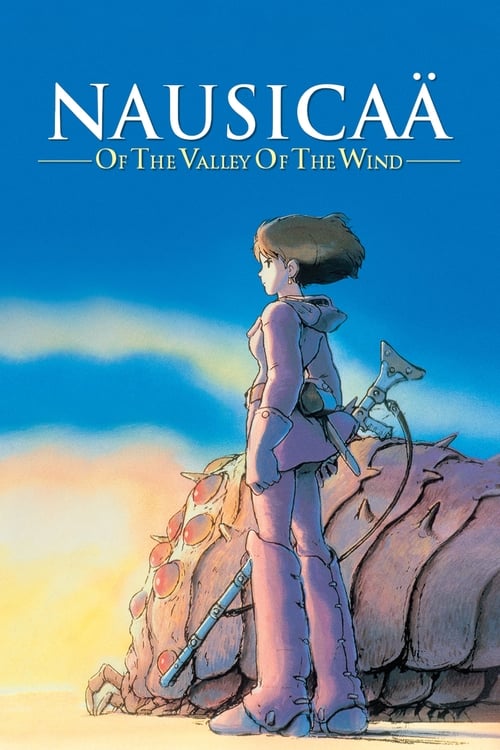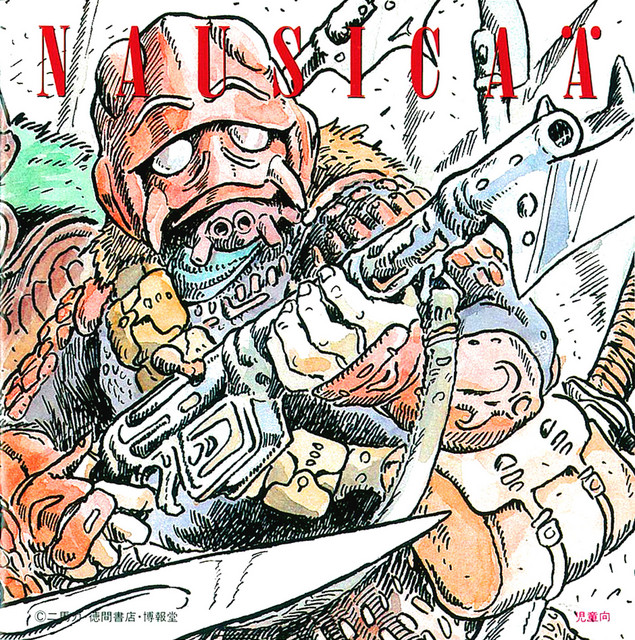
Album: 風の谷のナウシカ イメージアルバム 鳥の人…
The opening brass fanfare of “Doki-gun no Gyakushū” (The Dorok Army’s Counterattack) crashes through speakers like an avalanche of sound, immediately establishing the militaristic presence of Nausicaä’s antagonistic forces. But beneath this powerful orchestral statement lies a compositional philosophy that would reshape how audiences experience animated cinema forever.
Joe Hisaishi’s work on Nausicaä of the Valley of the Wind represents more than just another film score—it marks the birth of a unique approach to musical storytelling that prioritizes environmental immersion over emotional manipulation. “Doki-gun no Gyakushū,” composed for the original image album “Bird People,” exemplifies this revolutionary method through its relentless percussion and ominous low brass, creating not just music about an army, but music that embodies the very essence of mechanical warfare encroaching upon a natural world.
What makes Hisaishi’s approach so distinctive becomes clear when examining his core philosophy: music should reflect situation rather than emotion. “I don’t score to emotional peaks,” Hisaishi explained during production. “Instead, I compose for situational elements, seeing the world through Nausicaä’s eyes—not her feelings, but what she observes and experiences.” This subtle but profound shift transforms how music functions within narrative cinema.
In “Doki-gun no Gyakushū,” this philosophy manifests through stark orchestral contrasts. The piece opens with militant percussion—military snare patterns that suggest marching formations—while dark brass harmonies in D minor create an atmosphere of impending doom. Rather than building toward emotional climaxes, the music maintains its threatening posture throughout, mirroring how an occupying army doesn’t fluctuate emotionally but remains a constant, oppressive presence.
The creation of this musical language emerged from an unlikely collaboration. Initially hired only for the image album, Hisaishi found himself working with director Hayao Miyazaki and producer Isao Takahata through marathon creative sessions that regularly exceeded ten hours. These weren’t casual meetings—they were intensive workshops where every musical decision faced scrutiny from two men Hisaishi describes as having “abnormally good ears.”
Takahata’s attention to detail bordered on the obsessive. During one session, he identified the latter half of the “Toxic Jungle” theme as distinctly Debussy-influenced—the kind of observation that reveals both his classical knowledge and his commitment to musical authenticity. For Hisaishi, these collaborations represented “the most detailed discussions I’d ever experienced” in his career.
This meticulous approach shaped every aspect of “Doki-gun no Gyakushū.” The piece’s orchestration deliberately avoids the warm string sections that characterize Nausicaä’s themes, instead emphasizing brass and percussion to create sonic distance between the army and the valley’s inhabitants. The rhythmic structure—built on relentless quarter-note patterns—suggests mechanical movement rather than organic flow, reinforcing the fundamental conflict between technology and nature that drives the film’s narrative.
Interestingly, Hisaishi’s broader musical vocabulary for Nausicaä drew heavily from Celtic traditions. He consciously incorporated elements from Irish and Scottish folk melodies, believing their “simple, somehow nostalgic feeling” would resonate with Japanese audiences familiar with these melodic patterns through educational songs. This cultural bridge-building extends to “Doki-gun no Gyakushū,” where the absence of folk elements becomes as meaningful as their presence elsewhere in the score.
The relationship between Miyazaki and Hisaishi proved crucial to this musical evolution. Miyazaki listened to the image album repeatedly while creating storyboards, allowing Hisaishi’s existing compositions to influence the film’s visual development. When it came time to score the actual movie, Miyazaki advocated strongly for Hisaishi’s continued involvement. Takahata’s support came from practical considerations: “We need someone with classical training to understand our detailed musical requirements.”
This collaborative process transformed how animated films approached musical storytelling. “Doki-gun no Gyakushū” demonstrates music’s power to establish environmental context rather than simply underscore dramatic moments. The piece doesn’t tell listeners how to feel about the Dorok army—instead, it places them within the sonic landscape these forces create.
Hisaishi’s first impression of Miyazaki as possessing “simple, handmade humanity” proved prophetic. Their partnership would produce some of cinema’s most beloved scores, but it began with this fundamental understanding: music could serve story by creating worlds rather than highlighting emotions. “Doki-gun no Gyakushū” stands as an early example of this philosophy in action, where orchestral forces become geological phenomena, and melodies transform into landscapes we inhabit rather than feelings we experience.
Decades later, this approach continues influencing composers worldwide, proving that sometimes the most revolutionary changes come not from what music adds to a story, but from how it chooses to tell that story in the first place.
- 風の伝説Read Review
- はるかな地へ…(~ナウシカのテーマ~)Read Review
- メーヴェRead Review
- 巨神兵~トルメキア軍~クシャナ殿下Read Review
- 腐海Read Review
- 王蟲Read Review
- 土鬼軍の逆襲Now Playing
- 戦闘Read Review
- 谷への道Read Review
- 遠い日々(~ナウシカのテーマ~)Read Review
- 鳥の人(~ナウシカのテーマ~)Read Review