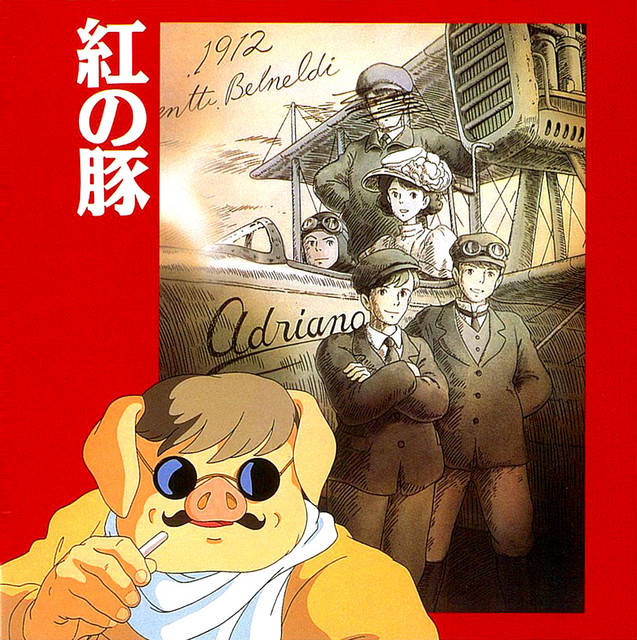
Album: 紅の豚 イメージアルバム
What happens when two creative minds unknowingly orbit the same artistic vision? In 1992, something extraordinary occurred that would forever change how we think about animation scores. Joe Hisaishi was deep in composition for his personal project ‘My Lost City,’ a jazz-influenced album inspired by F. Scott Fitzgerald’s writing and the intoxicating spirit of the 1920s. Meanwhile, across town, Hayao Miyazaki was sketching out ideas for ‘Porco Rosso,’ setting his story of a pig pilot in that very same decade.
Neither knew what the other was creating, yet when their paths crossed, Hisaishi felt what he described as something ‘deeply fateful’ about their synchronicity. This cosmic alignment would birth one of animation’s most sophisticated soundscapes, with ‘Savoia Over the Sea of Clouds’ serving as a perfect crystallization of their shared vision.
The track emerges from Hisaishi’s image album for ‘Porco Rosso,’ a collection that would prove crucial in shaping the film’s eventual score. Unlike typical film music written after animation is complete, these image album pieces served as musical blueprints, capturing the emotional DNA of characters and themes before cameras rolled. ‘Savoia Over the Sea of Clouds’ embodies this experimental approach, blending Hisaishi’s newfound jazz sensibilities with his signature melodic craft.
Listening to the piece, one immediately notices how Hisaishi weaves together two distinct musical languages. The composition moves between contemplative passages that echo his classical training and more rhythmically complex sections that betray his deep dive into 1920s jazz idioms. Written in a flowing 4/4 time signature, the piece uses brass and woodwind arrangements that feel both nostalgic and forward-looking, much like the film’s protagonist caught between his human past and pig-cursed present.
The creative process behind this music reveals Hisaishi at his most collaborative. Miyazaki, seeking to share his cinematic vision with his composer, handed over six carefully crafted poems as musical inspiration: ‘Flying Boatmen’s Tango,’ ‘Ascension,’ ‘Twilight Adriatic Sea,’ ‘Night Flight,’ ‘Secret Garden,’ and ‘Merry-Go-Round.’ These weren’t mere suggestions but emotional roadmaps, guiding Hisaishi toward the psychological landscape of seaplane pilots, Mediterranean sunsets, and the melancholy romance of an era defined by both celebration and loss.
‘Savoia Over the Sea of Clouds’ responds to these poetic prompts with remarkable sophistication. The composition captures the dual nature of flight itself—both the mechanical precision required to navigate aircraft through dangerous skies and the almost spiritual transcendence that comes from soaring above earthbound concerns. Hisaishi achieves this through careful orchestration that alternates between grounded, rhythmic bass lines and soaring melodic phrases that seem to lift off the staff.
The image album served as a crucial bridge between Hisaishi’s personal artistic exploration and the demands of film scoring. Three major themes from this collection—the prototypes for ‘Days Gone By,’ ‘Flying Boatmen,’ and ‘The Women of Piccolo’—would eventually migrate into the final film score, but not unchanged. ‘Savoia Over the Sea of Clouds’ demonstrates this evolutionary process, existing as both a complete artistic statement and a musical sketch awaiting further development.
What makes this composition particularly fascinating is how it embodies Hisaishi’s growing confidence in blending genres. The piece refuses to be categorized simply as either orchestral film music or jazz composition. Instead, it creates its own hybrid language, one that speaks to both the period setting of Porco’s world and the timeless themes of adventure, loss, and redemption that drive the narrative.
When Miyazaki finally heard the completed ‘My Lost City’ album, his reaction was immediate and telling: he wanted everything for his film. This wasn’t mere enthusiasm but recognition of a kindred artistic spirit. Hisaishi had somehow captured not just the sound of the 1920s, but the feeling of that decade as it lived in Miyazaki’s imagination—glamorous yet melancholic, adventurous yet tinged with inevitable loss.
‘Savoia Over the Sea of Clouds’ stands as perhaps the purest expression of this meeting of minds. Free from the specific timing constraints that would later shape the film score, the piece stretches out languidly, allowing each musical idea to breathe and develop. The result feels less like background music and more like a meditation on flight itself—the physics and poetry of leaving the ground behind.
This convergence of jazz elements and Hisaishi’s evolving compositional voice would prove transformative for both artists. It elevated ‘Porco Rosso’ beyond simple adventure storytelling, infusing it with the sophisticated emotional palette that jazz uniquely provides. More importantly, it demonstrated how true collaboration requires not just communication between artists, but a deeper alignment of vision and values.
‘Savoia Over the Sea of Clouds’ reminds us that the best film music often emerges not from calculation but from genuine artistic passion, when composers follow their instincts toward sounds that move them personally, trusting that authenticity will serve the larger artistic vision.
- アドリア海の青い空Read Review
- 冒険飛行家の時代Read Review
- 真紅の翼Read Review
- 雲海のサボイアNow Playing
- ピッコロ社Read Review
- 戦争ゴッコRead Review
- ダボハゼRead Review
- アドリアーノの窓Read Review
- 世界恐慌Read Review
- マルコとジーナのテーマRead Review