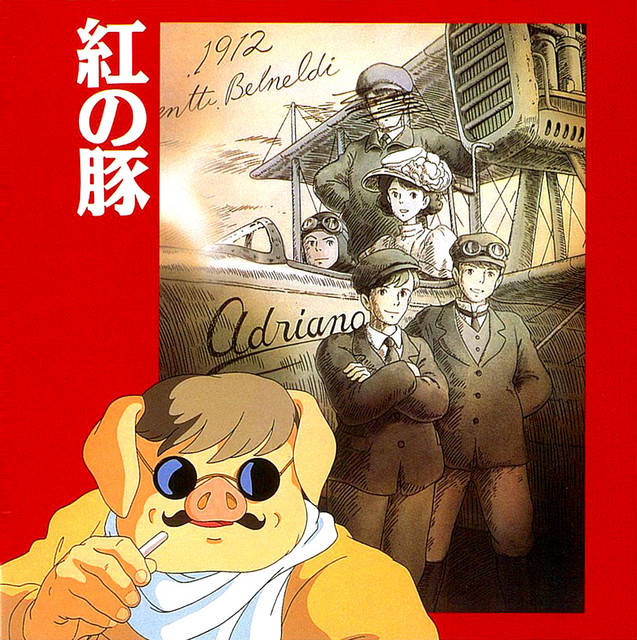
Album: 紅の豚 イメージアルバム
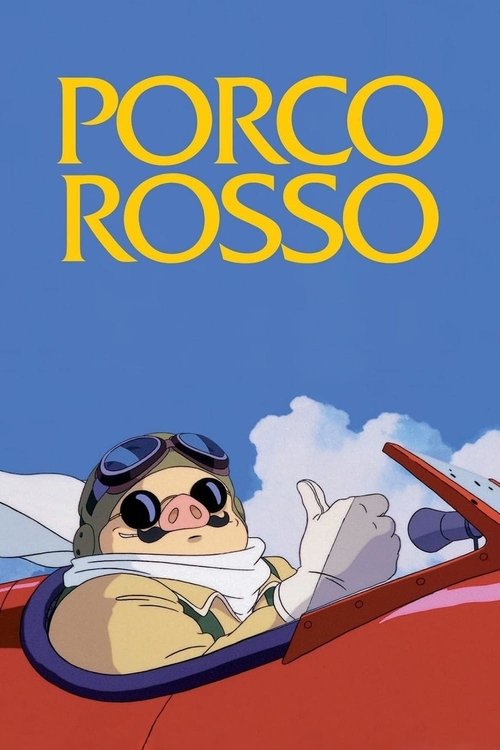
In the spring of 1992, Hayao Miyazaki handed Joe Hisaishi six handwritten poems. These weren’t lyrics to be set to music, but something far more intriguing—emotional blueprints for what would become one of Studio Ghibli’s most sophisticated soundtracks. Among the verses titled ‘Flying Boatman’s Tango,’ ‘Ascent,’ ‘Adriatic Sea at Twilight,’ ‘Night Flight,’ ‘Secret Garden,’ and ‘Merry-Go-Round’ lay the seeds for a musical revolution that would transform how we think about animation scoring.
The film was Porco Rosso, and tucked within its image album was a track called ‘Piccolo-sha’ (The Piccolo Company)—a piece that would evolve into ‘Piccolo no Onnatachi’ (The Women of Piccolo) in the final film. This seemingly simple transformation reveals the meticulous creative process that made Porco Rosso’s soundtrack unlike anything Hisaishi had composed before.
What made this project revolutionary wasn’t just its subject matter—a world-weary pig pilot in 1930s Italy—but Hisaishi’s bold decision to weave jazz idioms into his orchestral palette. For most audiences, Hisaishi was the minimalist maestro behind Castle in the Sky’s soaring themes and My Neighbor Totoro’s pastoral melodies. Few knew that this seemingly classical composer had spent his student years immersed in the smoky world of Miles Davis, John Coltrane, and particularly Mal Waldron, whose piano style left an indelible mark on his musical consciousness.
‘Piccolo-sha’ emerged from this fusion of influences, serving as a perfect case study in how Hisaishi translated Miyazaki’s poetic vision into sound. The track captures the bustling energy of the seaplane repair shop run by the film’s female mechanics, but it does so through a distinctly jazzy lens that feels both nostalgic and immediate. The melody, written in a warm G major, carries the conversational quality of jazz piano while maintaining the structural clarity that makes Hisaishi’s themes so memorable.
The instrumentation choices reveal Hisaishi’s deep understanding of both worlds he was bridging. While maintaining his signature orchestral approach—this entire soundtrack was recorded with a full 70-piece orchestra at Aoi Studio during May and June 1992—he introduced subtle jazz harmonies and rhythmic patterns that give ‘Piccolo-sha’ its distinctive character. The brass sections carry hints of big band swagger, while the woodwinds provide the kind of intimate commentary that Waldron might have offered on piano.
This musical bilingualism wasn’t accidental. Hisaishi drew from his own solo album ‘My Lost City,’ incorporating elements that had been gestating in his personal work into the Ghibli universe. The result was a soundtrack that could support both thrilling aerial dogfights and quiet moments of human connection—exactly what Porco Rosso needed to transcend its action-adventure surface and become something deeper.
The evolution from ‘Piccolo-sha’ to ‘Piccolo no Onnatachi’ demonstrates Hisaishi’s collaborative process with Miyazaki. The image album version served as a rough sketch, capturing the essential emotional core while leaving room for refinement once the visual elements were finalized. This working method, refined over their previous four collaborations, allowed both artists to discover the story through music and image simultaneously.
What makes tracks like ‘Piccolo-sha’ particularly fascinating is how they represent Hisaishi’s musical philosophy in microcosm. He understood that animation music couldn’t simply underscore action—it needed to create emotional geography. The jazz elements weren’t just period-appropriate decoration for a 1930s setting; they represented a more mature emotional vocabulary that matched the film’s themes of loss, nostalgia, and the weight of experience.
The acoustic emphasis that Hisaishi insisted upon for this project further enhanced the music’s emotional impact. In an era when electronic enhancement was becoming standard, his decision to rely on the natural resonance of traditional instruments gave tracks like ‘Piccolo-sha’ an organic warmth that perfectly complemented Miyazaki’s hand-drawn animation.
Listening to ‘Piccolo-sha’ today, it’s remarkable how effectively it captures the essence of characters and locations that were still being developed when Hisaishi composed it. The track pulses with the determined energy of women keeping a business running in a man’s world, while the underlying jazz harmonies suggest the broader cultural sophistication of interwar Europe.
This sophisticated approach to animation scoring—treating animated characters as complex individuals deserving of equally complex musical portraits—would influence not just future Ghibli productions but animation music globally. By taking seriously both Miyazaki’s poetic inspirations and his own jazz background, Hisaishi created a template for how animated film music could mature alongside its medium.
‘Piccolo-sha’ stands as proof that the most powerful film music often emerges not from obvious sources, but from the unexpected collision of diverse influences guided by a clear artistic vision.
- アドリア海の青い空Read Review
- 冒険飛行家の時代Read Review
- 真紅の翼Read Review
- 雲海のサボイアRead Review
- ピッコロ社Now Playing
- 戦争ゴッコRead Review
- ダボハゼRead Review
- アドリアーノの窓Read Review
- 世界恐慌Read Review
- マルコとジーナのテーマRead Review