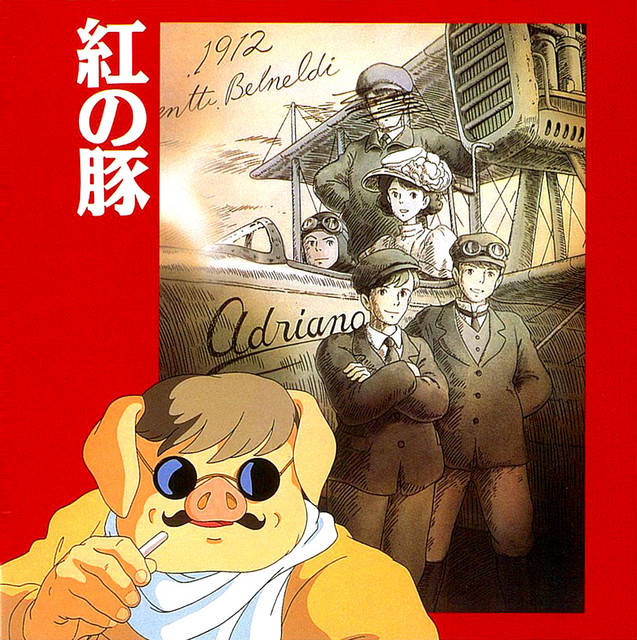
Album: 紅の豚 イメージアルバム
In the summer of 1992, Joe Hisaishi found himself facing an unusual creative challenge. Hayao Miyazaki had just handed him six poems, not a script or storyboards, but poetry. Among these verses was ‘Tasogare no Adoria-kai’ (Twilight Over the Adriatic Sea), which would become the foundation for one of Hisaishi’s most evocative compositions from the Porco Rosso Image Album.
The song ‘Adoria-kai no Aoi Sora’ (Blue Sky Over the Adriatic Sea) emerged from this unconventional collaboration, representing a fascinating intersection of literary inspiration and musical interpretation. For Miyazaki, these poems served as primary materials to share the film’s emotional landscape with his longtime collaborator. Rather than describing specific scenes, the verses captured moods, atmospheres, and the romantic melancholy that would define Porco Rosso.
Hisaishi’s approach to this particular piece reveals his deep understanding of how music can translate abstract emotions into tangible sound. The composer, known for his meticulous attention to acoustic authenticity, insisted on recording with a full seventy-piece orchestra at Aoi Studio during May and June of 1992. This decision wasn’t merely about grandeur; it reflected his belief that the warmth and imperfection of human performance could capture nuances that electronic instruments simply couldn’t convey.
The influence of jazz permeates ‘Blue Sky Over the Adriatic Sea’ in subtle but significant ways. Hisaishi’s longtime admiration for Miles Davis, John Coltrane, and particularly Mal Waldron shaped his harmonic vocabulary throughout the piece. The piano passages echo Waldron’s introspective style, with their contemplative phrasing and sophisticated chord voicings in B-flat major. This jazz sensibility might surprise those who know Hisaishi primarily as an orchestral composer and minimalist, but it demonstrates the breadth of his musical influences.
What makes this composition particularly intriguing is how it functions within the larger Image Album framework. Unlike the final film score, which underwent significant revision, the Image Album captured Hisaishi’s initial emotional response to Miyazaki’s vision. Three themes from this collection would eventually evolve into major musical motifs for the finished film: the prototype of ‘Days Gone By’ emerged from ‘Marco and Gina’s Theme,’ ‘Flying Boatmen’ developed from ‘Bully Fish,’ and ‘The Women of Piccolo’ originated from ‘Piccolo Company.’ However, ‘Blue Sky Over the Adriatic Sea’ remained unique to the Image Album, serving as a pure distillation of the film’s nostalgic atmosphere.
Miyazaki’s creative brief for the entire project was characteristically direct yet paradoxical: ‘Please make embarrassing music and get us excited.’ This seemingly contradictory instruction perfectly encapsulates the emotional complexity Miyazaki sought. He wanted music that would embrace sentimentality without cynicism, that could be both deeply moving and unabashedly romantic. When Hisaishi delivered the completed pieces, Miyazaki’s delighted reaction confirmed that the composer had successfully navigated this delicate balance.
The orchestration of ‘Blue Sky Over the Adriatic Sea’ reveals Hisaishi’s sophisticated understanding of color and texture. Strings provide the emotional foundation, their sustained passages evoking the endless horizon of the Mediterranean. Woodwinds dance above this backdrop like seabirds catching thermal currents, while the brass section adds warmth reminiscent of Italian sunshine. The piece unfolds at a moderate tempo, allowing each instrumental voice to breathe and develop its melodic line naturally.
This commitment to acoustic recording also reflects a philosophical stance about the relationship between technology and artistry. While many film composers in the early 1990s were embracing digital synthesizers and sampling technology, Hisaishi deliberately chose the path of human expression. The slight imperfections in intonation, the natural decay of acoustic instruments, and the subtle variations in timing that occur when musicians play together—these elements create an emotional authenticity that perfectly serves Miyazaki’s nostalgic vision.
The poetry that inspired ‘Blue Sky Over the Adriatic Sea’ functions as more than mere program notes; it represents a shared language between director and composer. By providing verses rather than specific musical instructions, Miyazaki allowed Hisaishi’s own artistic sensibilities to flourish while ensuring their visions remained aligned. This collaborative approach would become a hallmark of their partnership, with each artist trusting the other’s expertise while maintaining clear communication about emotional intent.
Listening to ‘Blue Sky Over the Adriatic Sea’ today, one can hear the seeds of countless future collaborations between Miyazaki and Hisaishi. The piece embodies their shared belief in music’s power to transcend language and speak directly to the heart. It stands as evidence that sometimes the most profound artistic statements emerge not from complex instructions, but from simple poetry and the trust between creative partners.
- アドリア海の青い空Now Playing
- 冒険飛行家の時代Read Review
- 真紅の翼Read Review
- 雲海のサボイアRead Review
- ピッコロ社Read Review
- 戦争ゴッコRead Review
- ダボハゼRead Review
- アドリアーノの窓Read Review
- 世界恐慌Read Review
- マルコとジーナのテーマRead Review