
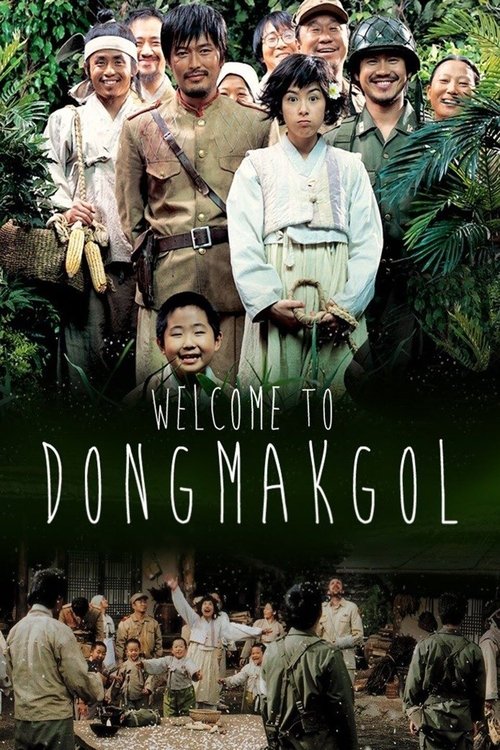
Bae Jong’s 2005 film ‘Welcome to Dongmakgol’ stands as a remarkable achievement in Korean cinema, adapting Jang Jin’s successful theatrical play into a poignant wartime drama. Set during the Korean War in 1950, the narrative follows soldiers from both North and South Korea, alongside an American pilot, who stumble upon an isolated village seemingly untouched by the ravages of conflict. The residents of Dongmakgol exist in blissful ignorance of the world beyond their boundaries, creating a striking contrast between the chaos of war and the village’s naive idealism. This premise forms the emotional and thematic foundation upon which the entire film is constructed.
Upon its release, ‘Welcome to Dongmakgol’ achieved considerable critical and commercial success throughout Korea and beyond. The film resonated deeply with audiences who appreciated its unique blend of war drama, comedy, and profound humanism. Its examination of how ordinary people become entangled in larger conflicts, while maintaining hope and compassion, struck a chord particularly strong in East Asia, where the legacy of division and war remains culturally significant. The film’s gentle critique of militarism and its celebration of human connection transcended typical war film conventions, attracting viewers seeking more nuanced explorations of conflict.
Central to the film’s emotional power is Joe Hisaishi’s sublime musical score, which deserves recognition alongside the finest achievements in contemporary film composition. Hisaishi, already renowned for his prolific collaborations with director Hayao Miyazaki and his vast body of original work, brings his characteristic sensitivity and sophistication to Dongmakgol’s narrative landscape. His compositional approach reflects a deep understanding of the film’s dual nature—balancing the severity of war with the transcendent innocence of the village.
The score’s primary strength lies in Hisaishi’s masterful use of thematic material to underscore the film’s central conflict. Where one might expect militaristic or discordant music to represent the soldiers and war, Hisaishi instead crafts surprisingly tender melodies that humanize every character. This artistic choice proves remarkably effective, suggesting that even in the midst of warfare, the soldiers remain fundamentally human—capable of warmth, humor, and connection. The composer employs gentle orchestration, featuring prominent woodwinds and strings that evoke a sense of longing and melancholy rather than aggression.
The Dongmakgol village itself receives musical treatment that perfectly captures its otherworldly quality. Hisaishi constructs ethereal, almost spiritual passages that seem to exist outside conventional time, using simple folk-inspired melodies and delicate instrumentation to suggest the village’s isolation from modern conflict. These sections feel almost dreamlike, reinforcing the film’s exploration of an alternate reality where war doesn’t intrude. The juxtaposition between the soldiers’ themes and the village’s music creates a profound commentary on the collision between two worlds.
Throughout the film, Hisaishi demonstrates remarkable restraint—a hallmark of his finest work. Rather than overwhelming scenes with orchestral bombast, he allows silence and minimalist passages to carry equal weight. This compositional philosophy perfectly complements Dongmakgol’s narrative rhythm, particularly in moments emphasizing human connection and unexpected friendship. The score ultimately becomes inseparable from the film’s meditation on peace, compassion, and the possibility of transcendence even amid humanity’s darkest impulses.