
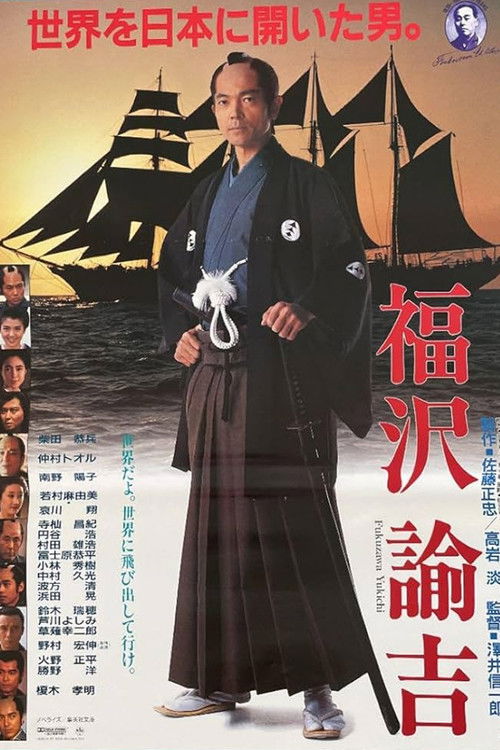
Director Shinichiro Sawai’s 1991 film “Fukuzawa Yukichi” tells the compelling true story of one man’s educational vision that would fundamentally reshape Japan’s relationship with the wider world. The narrative follows Fukuzawa as he establishes a school dedicated to teaching samurai the Dutch language, recognizing it as essential for international commerce and cultural exchange. However, his journey takes a decisive turn when he encounters English during his time in Yokohama, realizing its greater global significance. What begins as a linguistic pursuit evolves into something far more profound—a philosophical battle against deeply entrenched patriarchal traditions that threaten to stifle Japan’s modernization. Through persistence and progressive thinking, Fukuzawa’s humble institution eventually becomes one of Japan’s most prestigious universities, a testament to the transformative power of education and cross-cultural understanding.
The film resonated strongly with Japanese audiences upon its release, earning appreciation for its thoughtful examination of the Meiji period and the tensions between tradition and modernization. Among Japanese cinema enthusiasts and historians, it gained recognition as a meaningful biographical drama that transcends simple hagiography, presenting Fukuzawa as a complex figure grappling with genuine obstacles. While perhaps not achieving the widespread international recognition of some of its contemporaries, the film has maintained a respectable reputation within circles of serious cinema and cultural studies, particularly among those interested in Japanese history and education.
Yet it is Joe Hisaishi’s magnificent musical accompaniment that truly elevates “Fukuzawa Yukichi” into something extraordinary. Hisaishi, already renowned for his collaborations with Hayao Miyazaki and his distinctive compositional voice, crafts a score that functions as nothing less than an active participant in the film’s thematic exploration. His music becomes the emotional and intellectual bridge between East and West, mirroring Fukuzawa’s own journey of discovery and synthesis.
The score ingeniously weaves traditional Japanese instrumental textures with Western classical harmonic structures. Hisaishi employs shamisen and shakuhachi alongside strings and brass, creating a sonic landscape that embodies the cultural collision at the film’s heart. Rather than simply layering these elements superficially, he synthesizes them into a cohesive musical language that suggests genuine dialogue rather than conflict. This compositional approach perfectly complements the narrative’s central thesis—that cultural exchange enriches rather than diminishes national identity.
When depicting Fukuzawa’s moments of intellectual revelation and growing conviction, Hisaishi deploys sweeping orchestral passages that surge with optimistic momentum. These themes carry subtle melodic hints of both European and Japanese musical traditions, suggesting that Fukuzawa’s enlightenment stems not from abandoning his heritage but from embracing expansion. Conversely, when portraying the resistance Fukuzawa faces from traditionalists, Hisaishi’s music becomes more austere and discordant, using minor keys and sparse instrumentation to convey the weight of entrenched opposition.
The composer’s sensitivity to dramatic pacing ensures that the score never overwhelms the narrative, yet it consistently enriches our understanding of Fukuzawa’s internal struggles and victories. In quieter scenes, Hisaishi employs delicate piano passages and solo woodwind lines that convey intellectual yearning and personal doubt—the human dimensions beneath the historical drama. These moments showcase his maturity as a film composer, demonstrating that profound emotional truth often requires restraint rather than grandiosity.
Ultimately, Hisaishi’s score for “Fukuzawa Yukichi” stands as a masterclass in how music can crystallize a film’s deepest themes, transforming a historical biography into a meditation on progress, cultural identity, and the courage required to imagine a different future.