
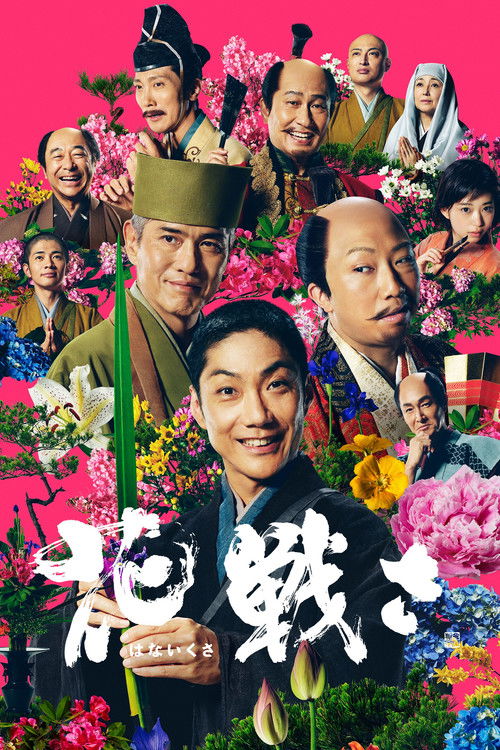
Tetsuo Shinohara’s 2017 film ‘Flower and Sword’ stands as a contemplative meditation on art, power, and spiritual resistance during Japan’s transformative late 16th century. Set in the aftermath of Nobunaga Oda’s death, the narrative follows two remarkable figures: Senko Ikenobo, a master of ikebana whose delicate flower arrangements become vessels of hope, and Rikyu, a tea ceremony sage whose friendship with Ikenobo unites them in their pursuit of peace. As Hideyoshi Toyotomi’s increasingly authoritarian rule threatens to crush individual expression, both men face their ultimate test of conviction. The film culminates in Rikyu’s tragic forced suicide and Ikenobo’s courageous challenge to the warlord’s tyranny, embodying the eternal tension between artistic freedom and political oppression.
Upon its release, ‘Flower and Sword’ received considerable acclaim within Japanese cinema circles and among international film festivals. The film resonated particularly strongly with audiences who appreciated its philosophical depth and refusal to present history as mere spectacle. Critics praised Shinohara’s visual restraint and his focus on intimate character moments rather than battlefield grandeur. This deliberate pacing and emotional subtlety created the perfect canvas for a composer of extraordinary sensitivity, allowing Joe Hisaishi’s score to emerge as a crucial narrative voice rather than mere accompaniment.
Joe Hisaishi’s compositional approach to ‘Flower and Sword’ represents a masterclass in thematic subtlety and emotional sophistication. Rather than employing grand orchestral gestures, Hisaishi crafted a score that mirrors the film’s own aesthetic philosophy: one of restraint, elegance, and profound spiritual depth. The music frequently employs traditional Japanese instruments—koto, shakuhachi, and taiko—alongside Western orchestral elements, creating a sonic landscape that reflects the cultural tensions underlying the narrative. This instrumental synthesis becomes a metaphor for the collision between traditional artistic values and modernizing political power.
The score’s central thematic material revolves around motifs of beauty, fragility, and quiet defiance. Hisaishi develops these themes with remarkable economy, allowing single melodic phrases to carry enormous emotional weight. When Ikenobo arranges flowers, the music becomes almost transparent, with delicate strings and gentle woodwind passages that seem to breathe alongside the visual composition of blooms and branches. These sequences showcase Hisaishi’s understanding that music need not compete with visual beauty; instead, it can enhance and deepen our emotional receptivity to what we observe.
The film’s tragic centerpiece—Rikyu’s forced harakiri—demanded from Hisaishi a score of devastating emotional honesty. Rather than resorting to melodrama, the composer strips away almost all orchestration, leaving only sparse string phrases and the haunting timbre of shakuhachi flute. This minimalist approach transforms a moment of violence into one of profound spiritual dignity, suggesting that true power lies not in domination but in the quiet integrity of one’s convictions. The music’s refusal to sentimentalize or aggrandize suffering becomes its own form of resistance.
Throughout ‘Flower and Sword,’ Hisaishi’s score demonstrates his conviction that beauty itself can be a revolutionary act. By refusing bombast and embracing subtlety, the composer creates a musical world where ikebana and tea ceremony become not quaint pastimes but essential expressions of human freedom. The final confrontation between Ikenobo and Hideyoshi resonates with such power precisely because Hisaishi has spent the entire film establishing that art’s quiet persistence constitutes an unshakeable defiance against tyranny. In this masterful score, music and meaning become indistinguishable.