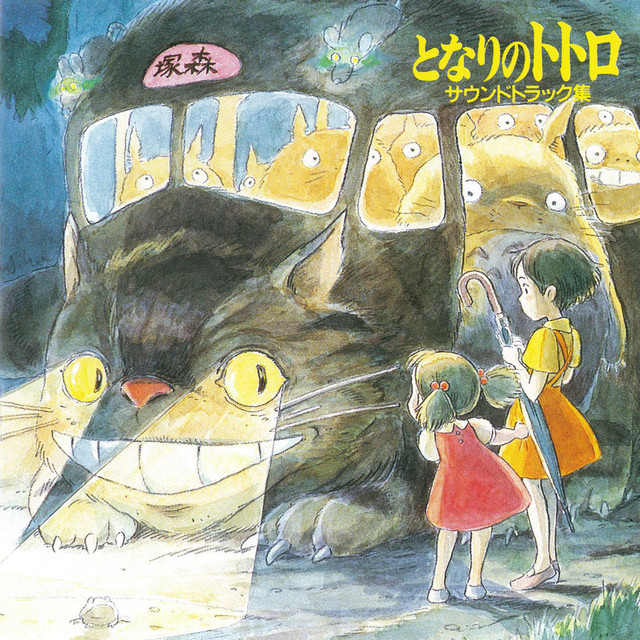
Album: となりのトトロ サウンドトラック集
Picture this: one of Japan’s most celebrated composers sitting behind a tabla, carefully recording his own percussion tracks to avoid what he feared most—creating “just another ordinary children’s movie.” This is the story of how Joe Hisaishi’s approach to “Sanpo (with Chorus)” and the My Neighbor Totoro soundtrack revolutionized animated film music by refusing to play by conventional rules.
The challenge facing Hisaishi was deceptively simple yet profound. As he explains, writing purely orchestral music for Totoro would have resulted in something disappointingly predictable. The solution? A bold fusion that had been brewing in his mind since Nausicaä of the Valley of the Wind—the marriage of ethnic musical elements with traditional orchestration. This wasn’t just an aesthetic choice; it was a philosophical statement about what children’s cinema could become.
“Sanpo” serves as the perfect microcosm of this revolutionary approach. While the song appears straightforward—a cheerful walking song that opens the film—its underlying structure reveals Hisaishi’s sophisticated musical thinking. The composer deliberately infused the piece with minimalist elements and ethnic atmospheres, creating what he termed a “slightly ethnic feel” that would distinguish it from standard orchestral fare.
The recording process itself tells a fascinating story of artistic dedication. Hisaishi didn’t simply hire session musicians to handle the ethnic percussion; he personally performed the tabla parts, sampling his own playing to ensure authenticity. This hands-on approach reflects his deep commitment to the fusion concept—every ethnic element had to feel genuine, not borrowed or superficial.
What makes the Totoro soundtrack particularly significant in Hisaishi’s career is the collaborative dynamic that emerged. For the first time, director Hayao Miyazaki took the lead in musical discussions, playfully complaining that producer Isao Takahata had been “cheating” by dominating previous musical collaborations. This shift in creative control led to a more integrated approach where “Sanpo” and the main Totoro theme formed the melodic backbone, while “Path of the Wind”—what Hisaishi called the “hidden theme”—provided emotional depth during pivotal forest scenes.
The technical composition of the soundtrack reveals another layer of Hisaishi’s evolving artistry. Originally planned with a heavier synthesizer presence, illness during recording forced a dramatic rebalancing. The final mix featured approximately sixty percent orchestra to forty percent synthesizer—the reverse of his initial intention. Rather than viewing this as a setback, Hisaishi recognized that the increased orchestral presence actually made the music more accessible while maintaining its innovative edge.
“Sanpo” benefits enormously from this orchestral emphasis. The song’s buoyant 4/4 rhythm and major key tonality gain richness from the full orchestral arrangement, while subtle ethnic percussion adds textural complexity without overwhelming the melody’s inherent simplicity. The choral arrangement further emphasizes the communal spirit that defines both the song and the film itself.
For Hisaishi, working on Miyazaki’s films represents more than professional collaboration—it’s a form of artistic discipline. He describes these projects as both trials and training grounds where he can confirm his musical identity. This relationship pushes him beyond comfortable creative territories, forcing him to solve complex problems like balancing accessibility with innovation, or maintaining childlike wonder without sacrificing musical sophistication.
The structural success of the Totoro soundtrack lies in its three-tiered approach: main themes like “Sanpo” provide immediate emotional connection, ethnic elements prevent the music from becoming generic, and hidden themes like “Path of the Wind” offer deeper narrative support. This architecture creates a listening experience that works simultaneously for children experiencing their first film score and adults appreciating nuanced compositional craft.
“Sanpo” embodies this multilayered approach perfectly. Children hear an irresistibly catchy walking song that makes them want to march along with Satsuki and Mei. Adult listeners discover a miniature study in East-West musical fusion, where pentatonic melodies dance over Western harmonic progressions while ethnic percussion provides rhythmic complexity.
The song’s enduring popularity stems from this careful balance. Unlike purely orchestral children’s music that can feel condescending or overly simplified, “Sanpo” treats young listeners as capable of appreciating musical sophistication. The ethnic elements don’t exoticize Japanese culture but instead create a unique sonic landscape that feels both familiar and mysterious.
Looking back, “Sanpo” represents a pivotal moment in animated film music. Hisaishi’s refusal to accept conventional approaches to children’s cinema opened new possibilities for how family films could sound. By personally performing tabla parts and insisting on ethnic-orchestral fusion, he created a template that influenced countless composers while remaining uniquely his own.
The true genius of “Sanpo” lies not in its individual elements but in how they serve the larger artistic vision. Every musical choice—from the ethnic percussion to the choral arrangements—supports Hisaishi’s fundamental belief that children deserve music as complex and beautiful as any audience. In doing so, he didn’t just avoid creating another ordinary children’s film; he helped define what extraordinary children’s cinema could become.
- さんぽ-オープニング主題歌-Read Review
- 五月の村Read Review
- オバケやしき!Read Review
- メイとすすわたりRead Review
- 夕暮れの風Read Review
- こわくないRead Review
- おみまいにいこうRead Review
- おかあさんRead Review
- 小さなオバケRead Review
- トトロRead Review
- 塚森の大樹Read Review
- まいごRead Review
- 風のとおり道(インストゥルメンタンル)Read Review
- ずぶぬれオバケRead Review
- 月夜の飛行Read Review
- メイがいないRead Review
- ねこバスRead Review
- よかったねRead Review
- となりのトトロ-エンディング主題歌-Read Review
- さんぽ(合唱つき)Now Playing