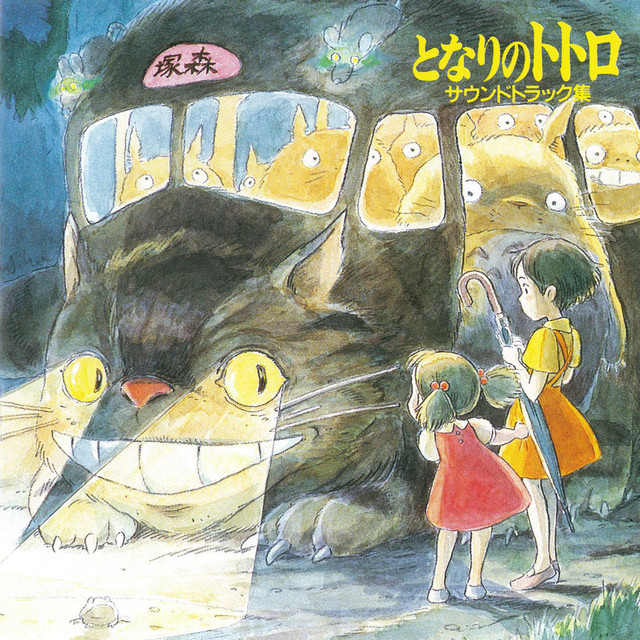
Album: となりのトトロ サウンドトラック集
Picture a giant cat with glowing eyes racing through the night forest, its hollow belly serving as a mystical passenger compartment. This is the Cat Bus from My Neighbor Totoro, one of Studio Ghibli’s most beloved creatures, and Joe Hisaishi faced a unique challenge when scoring its magical appearances. How do you create music that captures wonder without falling into saccharine territory? The answer lies in ‘Neko Bus’ (Cat Bus), a track that reveals Hisaishi’s sophisticated approach to children’s cinema.
The challenge began with Totoro itself. Unlike traditional animated films with clear dramatic arcs, Miyazaki’s story focused on daily life moments – two sisters moving to the countryside, discovering forest spirits, waiting for their mother’s recovery. ‘The story sequences were very everyday,’ Hisaishi reflected, recognizing that conventional orchestral scoring might reduce the film to ‘an ordinary children’s movie.’
This realization shaped his entire approach to the Totoro soundtrack. Rather than relying solely on traditional orchestration, Hisaishi deliberately introduced what he called ‘ethnic elements’ alongside conventional orchestral pieces. The strategy wasn’t new for him – he’d been balancing these contrasting musical worlds since his work on Nausicaä. But Totoro demanded something more nuanced.
‘If I wrote only normal orchestral music, it would become a very ordinary children’s film,’ Hisaishi explained. The Cat Bus theme embodies this philosophy perfectly. Built on minimalist music principles, the track avoids predictable melodic development in favor of rhythmic patterns and timbral exploration. The ethnic percussion elements – including tabla rhythms that Hisaishi performed himself – create an otherworldly atmosphere that matches the supernatural nature of the Cat Bus without overwhelming the screen.
Hisaishi’s hands-on approach extended beyond composition to performance. When creating the ethnic percussion sounds for tracks like ‘Neko Bus,’ he personally played the tabla parts, sampling his own performances rather than relying on session musicians or preset sounds. This attention to authentic detail reflects his understanding that children’s ears are remarkably sensitive to artifice.
The composer’s restraint proved crucial throughout the project. ‘Strong music would seem to float away from the screen,’ he noted, recognizing that Totoro’s gentle storytelling required musical support rather than musical dominance. The Cat Bus sequences presented particular challenges – how do you score a creature that’s simultaneously cute and mysterious, familiar yet supernatural?
Hisaishi’s solution involves careful textural layering. The ‘Neko Bus’ track opens with subtle string figures that suggest movement without overwhelming energy. Ethnic percussion enters gradually, building atmosphere through repetitive patterns rather than dramatic crescendos. The melody itself remains purposefully simple, avoiding the ornate development that might suit adult dramas but would feel excessive in Totoro’s world.
This philosophy extended to the album’s overall structure. Hisaishi organized the soundtrack around three main musical ideas: the walking song ‘Sanpo,’ the title theme ‘Totoro,’ and what he called the ‘hidden theme’ – ‘Path of the Wind,’ used during the tree-growing sequence. Each served different dramatic functions while maintaining stylistic consistency.
The ethnic elements weren’t exotic decoration but essential ingredients in Hisaishi’s recipe for avoiding what he feared most: accidentally creating nursery rhyme music. ‘One step wrong and it could become a children’s song world,’ he admitted. The tabla rhythms, minimal music structures, and carefully controlled orchestration provided sophistication without pretension.
Interestingly, Hisaishi initially planned more vocal pieces for the soundtrack. He created an image album featuring songs rather than instrumental tracks, believing that ‘songs would make the scene images clearer’ given Totoro’s focus on daily life rather than dramatic action. However, the final instrumental approach proved more effective, allowing the ethnic-orchestral hybrid to support rather than compete with the visuals.
The Cat Bus theme demonstrates how thoughtful composers can create music that speaks to children without condescending to them. By incorporating minimalist techniques and world music elements, Hisaishi crafted something genuinely unique – a lullaby with teeth, comfort music with mystery intact.
Thirty-five years later, ‘Neko Bus’ remains a perfect example of how sophisticated musical thinking can enhance rather than overwhelm intimate storytelling. Hisaishi’s careful balance of ethnic and orchestral elements created a sonic landscape where magical cats feel believable and wonder never transforms into mere whimsy. Sometimes the most profound musical statements whisper rather than shout.
- さんぽ-オープニング主題歌-Read Review
- 五月の村Read Review
- オバケやしき!Read Review
- メイとすすわたりRead Review
- 夕暮れの風Read Review
- こわくないRead Review
- おみまいにいこうRead Review
- おかあさんRead Review
- 小さなオバケRead Review
- トトロRead Review
- 塚森の大樹Read Review
- まいごRead Review
- 風のとおり道(インストゥルメンタンル)Read Review
- ずぶぬれオバケRead Review
- 月夜の飛行Read Review
- メイがいないRead Review
- ねこバスNow Playing
- よかったねRead Review
- となりのトトロ-エンディング主題歌-Read Review
- さんぽ(合唱つき)Read Review