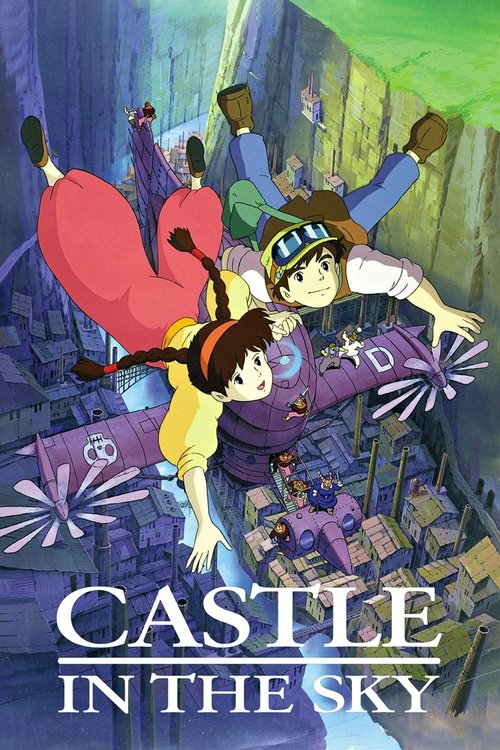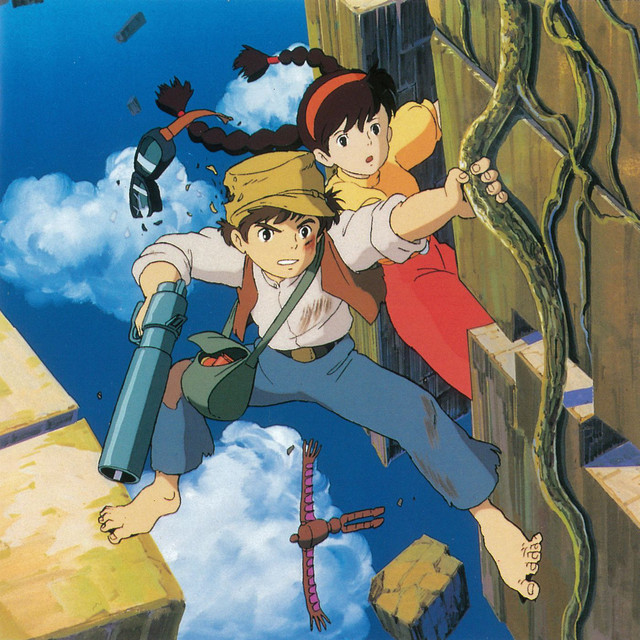
Album: 天空の城ラピュタ サウンドトラック ~飛行石の謎~
In the summer of 1986, something extraordinary was happening in Japanese recording studios. Joe Hisaishi wasn’t just composing music for Hayao Miyazaki’s Castle in the Sky—he was engineering a revolutionary approach to film scoring that would synchronize every musical beat with animated movement down to the exact second.
“Robot Soldiers (Revival~Rescue)” from the Castle in the Sky soundtrack exemplifies this meticulous process. The track captures one of the film’s most emotionally charged sequences, where dormant mechanical guardians awaken to protect the floating castle. But behind its sweeping orchestral arrangements lies a fascinating story of creative collaboration and technical innovation.
The genesis of this precision began in June 1986, when Miyazaki, producer Isao Takahata, and Hisaishi gathered in a small coffee shop near Studio Ghibli. With the film’s rush footage nearly complete, they spent hours discussing how music could enhance the animated sequences. Hisaishi had established a clear philosophy for the project: create melodies that children could embrace, music that would warm hearts while maintaining acoustic simplicity.
This represented a deliberate departure from his previous work on Arion, where complex sound sampling dominated. For Castle in the Sky, Hisaishi committed to straightforward acoustic instruments, believing that love, dreams, and adventure required honest, unembellished musical expression.
“Robot Soldiers (Revival~Rescue)” demonstrates this philosophy perfectly. Built around a haunting melody in D minor, the piece begins with solo piano before gradually introducing strings and brass. The tempo shifts from a contemplative andante to an urgent allegro as the mechanical beings stir to life, mirroring the visual progression frame by frame.
Hisaishi’s technical process was groundbreaking for its time. After studying rush film footage on video, he meticulously catalogued the timing of every significant visual movement. Using a Fairlight III synthesizer, he constructed rhythmic foundations that matched these precise moments. This wasn’t approximate synchronization—it was mathematical precision applied to emotional storytelling.
Miyazaki provided Hisaishi with detailed conceptual notes that would influence the entire score. For the castle itself, he described “shining cloud peaks beyond, yearning, lost paradise, darkness containing both evil and beautiful things, mystery.” These poetic fragments shaped how Hisaishi approached the robot soldiers’ music, balancing their mechanical nature with the profound sadness of their duty.
The actual recording sessions revealed the ambitious scope of this synchronization project. On June 24th, Hisaishi began laying down tracks at Wonder Station, building those crucial rhythmic foundations on the Fairlight III. Two weeks later, nearly fifty orchestra musicians gathered at Nikkatsu Studio to record the full orchestral arrangements.
“Robot Soldiers (Revival~Rescue)” required careful orchestration to convey both mechanical precision and emotional depth. The piece features distinctive brass fanfares that herald the robots’ awakening, while underlying string tremolo creates an atmosphere of ancient power stirring after centuries of sleep. Hisaishi employed traditional orchestration techniques—no synthesized shortcuts—to ensure the music felt as timeless as the story itself.
The track’s structure mirrors the visual narrative perfectly. As stone guardians crack open their eyes, low brass instruments rumble to life. When they begin moving with purpose, the full orchestra joins in triumphant harmony. Every musical accent corresponds to specific animated gestures, creating an unprecedented unity between sound and image.
This meticulous approach extended beyond individual cues to the entire soundtrack’s emotional arc. Hisaishi understood that children in the audience needed music they could internalize and remember, melodies that would stay with them long after leaving the theater. “Robot Soldiers (Revival~Rescue)” achieves this through its memorable central theme, which returns throughout the film in various arrangements.
The recording process concluded on July 12th with final track mixing, but the impact of Hisaishi’s precision-timing approach would influence film scoring for decades. By treating animated sequences as musical scores themselves—where visual rhythms determined musical rhythms—he created a new standard for animation soundtracks.
“Robot Soldiers (Revival~Rescue)” stands as a perfect example of this innovation. When listeners hear those opening piano notes building toward orchestral grandeur, they’re experiencing not just beautiful music, but a revolutionary approach to cinematic storytelling. Hisaishi proved that when composers truly understand visual narrative, music becomes more than accompaniment—it becomes an integral part of the story itself.
This track, lasting just over three minutes, represents countless hours of frame-by-frame analysis, collaborative discussion, and musical craftsmanship. It embodies Hisaishi’s belief that animated films deserve the same musical sophistication as any dramatic production, and that children’s entertainment should never compromise artistic integrity.
- 空から降ってきた少女Read Review
- スラッグ溪谷の朝Read Review
- 愉快なケンカ(~追跡)Read Review
- ゴンドアの思い出Read Review
- 失意のパズーRead Review
- ロボット兵(復活~救出)Now Playing
- 合唱 君をのせてRead Review
- シータの決意Read Review
- タイガーモス号にてRead Review
- 破滅への予兆Read Review
- 月光の雲海Read Review
- 天空の城ラピュタRead Review
- ラピュタの崩壊Read Review
- 君をのせてRead Review