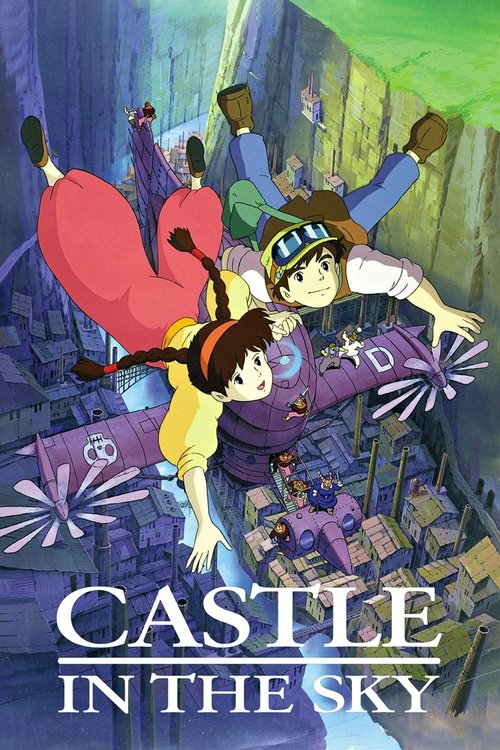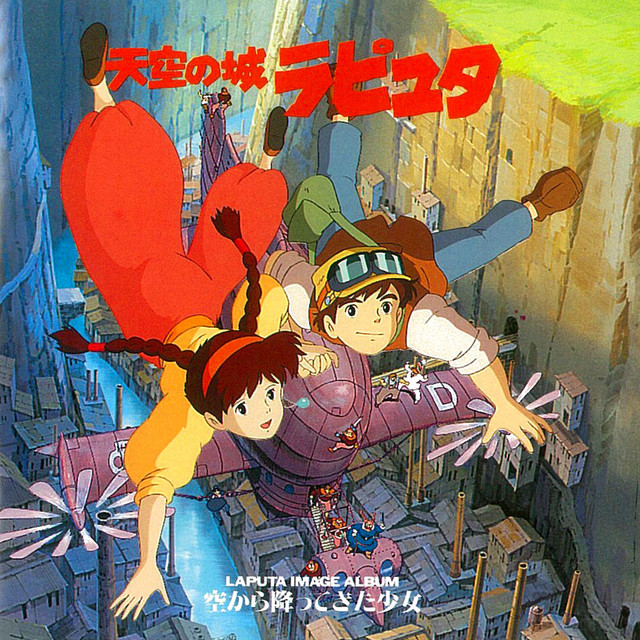
Album: 天空の城ラピュタ イメージアルバム ~空から降ってきた少女~
In the sprawling landscape of animated film music, few composers have mastered the delicate balance between wonder and gravitas quite like Joe Hisaishi. His track “Fortress of Tedis” from the Castle in the Sky Image Album stands as a compelling example of how creative pressure and artistic vision can transform simple musical ideas into something extraordinary.
The year was 1986, and Hisaishi found himself in a peculiar position. Having already collaborated with Hayao Miyazaki and Isao Takahata on Nausicaä, he was tasked with creating an image album that would capture the essence of their upcoming film before a single frame was animated. The concept they presented was both simple and profound: “What must adults leave for children now?” This philosophical foundation would guide every musical decision that followed.
Recorded at Wonder Station and Nikkatsu Studio Center, the initial sessions for “Fortress of Tedis” reflected Hisaishi’s commitment to acoustic simplicity. Unlike his previous work on Arion, which had featured extensive sound sampling, he deliberately chose to center the Laputa music around organic, acoustic instruments. The piece itself unfolds in a minor key, with brass instruments carrying the primary melodic weight, creating an atmosphere that feels both majestic and slightly ominous—perfectly capturing the dual nature of the floating fortress itself.
But the real magic happened during the final mixing phase at London’s legendary Air Studios. Working alongside mix engineers Steve Jackson and Masayoshi Ohkawa, Hisaishi transformed what could have been a straightforward orchestral piece into something that sparkled with life. He later described how this London finishing process made each track “bright and lively,” and “Fortress of Tedis” exemplifies this transformation beautifully. The careful balance of reverb and spatial positioning gives the impression of music echoing through vast stone corridors while maintaining an intimate, human quality.
What makes this track particularly fascinating is how it demonstrates the creative tensions Hisaishi faced throughout the project. Every day during recording, he felt the weight of expectation—the unspoken pressure to create something worthy of his collaborators’ vision. This anxiety, rather than paralyzing his creativity, seemed to fuel a deeper commitment to his core musical philosophy: creating melodies that children could embrace with warm hearts while still honoring the complexity of the story being told.
The composition itself reflects this duality perfectly. The main theme opens with a stately, almost ceremonial quality that speaks to the ancient power of the fortress, but as it develops, subtle harmonic shifts introduce moments of uncertainty and even vulnerability. This wasn’t accidental—Hisaishi understood that Laputa itself represented both technological marvel and cautionary tale, and the music needed to hold both truths simultaneously.
Interestingly, this image album approach allowed Hisaishi creative freedoms that wouldn’t survive the transition to film. While “Fortress of Tedis” maintains its mysterious, contemplative character in both versions, other tracks like the flaptter theme underwent dramatic changes. The original album version captured the whimsical, fluttering nature of flight, but when the actual film scenes demanded tension and danger, that musical approach had to evolve. This creative flexibility—the willingness to serve the story above all else—became a hallmark of Hisaishi’s film scoring philosophy.
There’s something particularly moving about imagining Hisaishi in those London studio sessions, fine-tuning the orchestral balance that would bring Tedis fortress to life. The careful layering of strings against brass, the precise placement of woodwind accents, the decision to let certain phrases breathe while driving others forward with rhythmic urgency—these weren’t just technical choices but emotional ones, guided by Miyazaki’s evocative scene descriptions of boys on rooftops and morning light cutting through mist.
The track stands as more than just background music; it’s architectural in its own right, building sonic spaces that feel as real and navigable as any animated environment. When those opening brass notes announce the fortress theme, listeners don’t just hear music—they experience the weight of ancient stones, the echo of empty halls, and the lingering presence of a civilization that reached too far toward the sky.
Today, “Fortress of Tedis” endures because it captures something essential about the creative process itself: the way artistic pressure can crystallize into clarity, how collaborative vision can elevate individual effort, and why sometimes the most powerful music emerges from the simplest acoustic foundations. In just a few minutes of orchestral storytelling, Hisaishi created not just a soundtrack to adventure, but a meditation on what we build, what we preserve, and what we ultimately leave behind.
- 天空の城ラピュタRead Review
- ハトと少年Read Review
- 鉱夫Read Review
- 飛行石Read Review
- ドーラRead Review
- シータとパズーRead Review
- 大樹Read Review
- フラップターRead Review
- 竜の穴Read Review
- ティディスの要塞Now Playing
- シータとパズーRead Review
- 失われた楽園Read Review