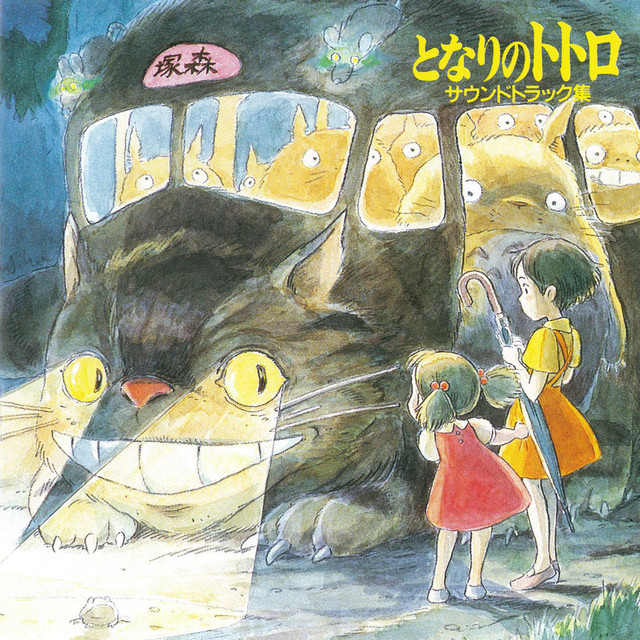
Album: となりのトトロ サウンドトラック集
When Joe Hisaishi sat down to compose the soundtrack for ‘My Neighbor Totoro’, he faced an unusual creative challenge. Unlike action-packed adventures or dramatic narratives, this Miyazaki film centered on quiet domestic moments and the gentle wonder of childhood discovery. How do you score the mundane without losing the magic? Hisaishi’s solution lay in a delicate balance that would define one of Studio Ghibli’s most beloved soundscapes.
‘The Great Tree of Tsukamori Forest’ emerges from this philosophy of musical restraint, serving as a perfect example of Hisaishi’s approach to the entire Totoro soundtrack. Rather than overwhelming the pastoral scenes with bombastic orchestration, the composer chose to weave ethnic textures into traditional Western arrangements, creating something both familiar and mysteriously otherworldly.
The decision wasn’t arbitrary. Hisaishi had been developing this hybrid approach since his work on ‘Nausicaä of the Valley of the Wind’, recognizing that purely orchestral scores risked reducing animated films to simple children’s entertainment. For Totoro, this concern felt even more pressing. The story’s episodic nature and focus on everyday life threatened to dissolve into forgettable background music if handled conventionally.
‘I realized that using only standard orchestral music would turn this into an ordinary children’s movie,’ Hisaishi reflected on his compositional strategy. ‘That’s why I gave the Totoro theme a minimalist, slightly ethnic atmosphere.’ This philosophy permeates ‘The Great Tree of Tsukamori Forest’, where gentle percussion and modal harmonies create an ancient, sacred feeling without ever becoming intrusive.
The ethnic elements weren’t mere decorative flourishes. Hisaishi personally performed many of the percussion parts, including tabla drums that he recorded himself for sampling. This hands-on approach allowed him to control the exact timbral qualities he wanted, ensuring that every exotic texture served the film’s emotional geography rather than simply adding surface color.
Structurally, the Totoro soundtrack operates on multiple thematic levels. While ‘Stroll’ and ‘My Neighbor Totoro’ function as primary themes, Hisaishi developed what he called a ‘hidden theme’ in ‘The Path of the Wind’, which appears prominently in scenes featuring the forest’s ancient trees. ‘The Great Tree of Tsukamori Forest’ draws from this same musical DNA, its contemplative melody moving in measured phrases that mirror the patient growth of centuries-old camphor trees.
The composer’s restraint becomes most apparent when considering what he chose not to include. Strong, dramatic music would have detached the score from the images, he believed, yet overly simplistic melodies risked sliding into nursery rhyme territory. Instead, tracks like ‘The Great Tree of Tsukamori Forest’ inhabit a middle ground—sophisticated enough for adult ears, gentle enough for children, and rooted enough in folk traditions to feel timeless.
This balancing act reflected broader questions about how to musically represent childhood wonder. Hisaishi initially considered creating an image album focused on songs rather than instrumental pieces, believing that lyrics would better capture the film’s episodic, slice-of-life moments. The challenge lay in strengthening the story’s weaker narrative elements without overwhelming its delicate emotional fabric.
In ‘The Great Tree of Tsukamori Forest’, these concerns crystallize into a piece that feels both ancient and immediate. The track unfolds in the gentle 4/4 time signature that characterizes much of the Totoro score, with woodwinds carrying the primary melody over sustained string harmonies and subtle ethnic percussion. The music breathes with the natural rhythms of forest life, never rushing, never forcing emotional climaxes that the visuals cannot support.
The success of this approach extends far beyond the film itself. Hisaishi’s fusion of minimalist techniques with ethnic instrumentation and Western orchestral tradition created a template that influenced countless subsequent anime soundtracks. More importantly, it demonstrated how restraint could become a form of artistic courage—choosing not to overwhelm delicate moments with unnecessary musical drama.
‘The Great Tree of Tsukamori Forest’ stands as a quiet monument to this philosophy. In its gentle progressions and carefully chosen textures, we hear not just the sound of an enchanted forest, but the sound of a composer discovering how less can indeed become more. The track invites listeners into a space where magic exists not through overwhelming spectacle, but through patient attention to the sacred qualities of ordinary moments.
In the end, Hisaishi’s greatest achievement with the Totoro soundtrack may be its proof that children’s music need not be childish music. By treating his young audience with sophisticated musical respect while maintaining accessibility and wonder, he created scores that grow with their listeners—much like the ancient trees that inspired them.
- さんぽ-オープニング主題歌-Read Review
- 五月の村Read Review
- オバケやしき!Read Review
- メイとすすわたりRead Review
- 夕暮れの風Read Review
- こわくないRead Review
- おみまいにいこうRead Review
- おかあさんRead Review
- 小さなオバケRead Review
- トトロRead Review
- 塚森の大樹Now Playing
- まいごRead Review
- 風のとおり道(インストゥルメンタンル)Read Review
- ずぶぬれオバケRead Review
- 月夜の飛行Read Review
- メイがいないRead Review
- ねこバスRead Review
- よかったねRead Review
- となりのトトロ-エンディング主題歌-Read Review
- さんぽ(合唱つき)Read Review