
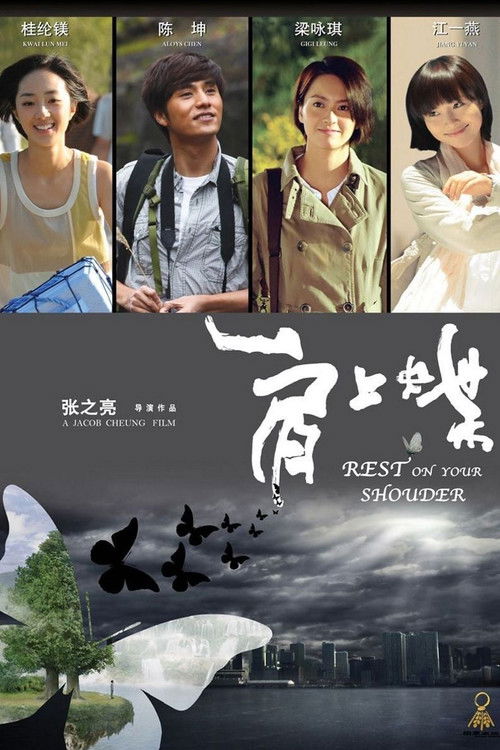
Jacob Cheung Chi-Leung’s 2011 film ‘Rest on Your Shoulder’ presents a haunting exploration of love, sacrifice, and supernatural intervention set against the backdrop of a mysterious epidemic. The narrative centers on botanist Yan Guo and his fiancée Baobao, who journey to Moon Island, a nature reserve shrouded in myth and wonder, to research the medicinal properties of rare plants. Their arrival at this isolated sanctuary becomes a turning point when they participate in an ancient ritual at the legendary Eros Tree. What begins as a romantic gesture to strengthen their bond transforms into a devastating trial: Baobao must remain invisible to Yan for three years to save his life. This fantastical premise serves as the emotional foundation for an extraordinary cinematic experience, one that demanded a composer of exceptional sensitivity and imagination.
Upon its release, ‘Rest on Your Shoulder’ garnered significant attention within East Asian cinema circles, appreciated for its lyrical approach to science fiction and its willingness to blend contemporary concerns with timeless romantic mythology. The film’s meditation on the nature of sacrifice and the possibility of unseen presence resonated particularly with audiences who found depth in its unconventional narrative structure. While not achieving mainstream commercial success across all markets, the film cultivated a devoted following among cinephiles and enthusiasts of arthouse cinema, who recognized Cheung’s ambitious vision and the film’s thematic richness.
Yet it is Joe Hisaishi’s magnificent musical score that truly elevates ‘Rest on Your Shoulder’ into the realm of artistic transcendence. The renowned Japanese composer, celebrated for his prolific work with Studio Ghibli and his distinctive fusion of Western orchestral tradition with Japanese sensibility, approached this project with remarkable sensitivity to its unique emotional architecture. Hisaishi’s score becomes less a mere accompaniment and more a narrative voice itself, often articulating the film’s deeper emotional truths with clarity that surpasses dialogue.
The compositional approach throughout the score reflects the film’s central paradox: the simultaneous presence and absence of Baobao. Hisaishi employs delicate orchestration, frequently highlighting solo instruments that seem to call across an unbridgeable distance. Strings shimmer with an almost ethereal quality, suggesting both hope and melancholy, while subtle use of traditional and contemporary instruments creates a soundscape that mirrors the film’s blend of ancient ritual and modern sensibility. The main theme carries a bittersweet melodic line that captures the essence of love persisting despite separation, building emotional resonance through repetition and subtle harmonic variations.
What distinguishes Hisaishi’s work here is how thoroughly the music becomes intertwined with the film’s visual language. When Yan moves through Moon Island, seemingly alone yet accompanied by his unseen beloved, the score provides emotional continuity that visual cinema alone cannot achieve. Gentle piano passages accompany intimate moments charged with poignancy, knowing that physical touch remains forbidden. The orchestration swells during moments of crisis or emotional breakthrough, validating the intensity of feelings that cannot be externally expressed.
Hisaishi’s mastery of dynamic restraint proves equally significant. Rather than overwhelming audiences with grandiose declarations, the composer trusts in subtlety, allowing quiet moments of trembling strings and sparse piano notes to communicate profound longing. This restraint transforms the score into a meditation on absence itself—how love can persist and even strengthen when stripped of physical confirmation.
For European audiences unfamiliar with Hisaishi’s extensive catalogue, ‘Rest on Your Shoulder’ presents an accessible entry point into his sophisticated compositional world. The score demonstrates why he remains one of cinema’s most treasured composers, capable of creating music that transcends cultural boundaries to touch the universal human experience of love, loss, and hope.