
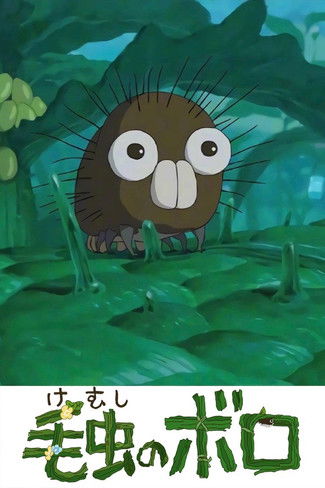
In 2018, legendary animator Hayao Miyazaki returned to directing with a deceptively simple yet profoundly moving short film titled ‘Boro the Caterpillar.’ The film follows a newly hatched caterpillar as it experiences the world for the first time, discovering both the wonders and dangers of its natural habitat. Just before dawn, Boro emerges from his egg among scrub grass, encountering the brilliance of the morning sun and the mysterious deliciousness in the air. As he descends from the groundsel and takes his first tentative steps, he enters a world of infinite possibility—and infinite threat. In merely twelve minutes, Miyazaki crafts a meditation on life’s fragility, wonder, and the perpetual cycle of survival and transformation that defines existence itself.
Despite its modest runtime and limited theatrical release, ‘Boro the Caterpillar’ captured the hearts of critics and audiences worldwide, particularly resonating with long-time Studio Ghibli admirers. The film’s reception demonstrated that Miyazaki’s artistic sensibilities remained as sharp as ever, capable of conveying profound emotional and philosophical truths through the simplest narrative frameworks. The film’s quiet contemplation of life and death, predator and prey, struck a chord with viewers seeking meaning beyond conventional storytelling. Its success vindicated the director’s decision to create something deliberately paced and introspective—a far cry from the sweeping adventures that characterized much of his earlier work.
Central to the film’s emotional resonance is Joe Hisaishi’s exquisite musical score, which elevates ‘Boro the Caterpillar’ from a charming nature study into something approaching the poetic and transcendent. Rather than employing his typical lush orchestrations, Hisaishi adopts a minimalist approach that mirrors the film’s visual simplicity and philosophical depth. The composer understands intuitively that Miyazaki’s painterly animation demands restraint; each note must carry weight, each silence must speak volumes.
The score’s central theme—a hauntingly beautiful piano melody—captures Boro’s innocent wonder at the world. Hisaishi constructs this motif with delicate precision, allowing it to breathe and expand gradually as the caterpillar’s awareness grows. The composer employs sparse instrumentation, layering solo piano against subtle string arrangements and occasional woodwind flourishes that evoke the natural world without ever becoming overly pastoral or sentimental. This restraint proves crucial; lesser composers might have indulged in saccharine sentimentality, but Hisaishi maintains artistic integrity throughout.
What makes Hisaishi’s approach particularly masterful is how the music responds to narrative tension. As Boro encounters predators and understands mortality, the score subtly darkens. Dissonant harmonies creep in beneath the main theme, creating unease without abandoning the piece’s fundamental beauty. The composer refuses to heighten drama artificially; instead, he allows small musical shifts to register profound psychological changes. When Boro finally confronts his impending metamorphosis, Hisaishi’s music achieves something remarkable—simultaneously conveying loss, hope, and the bittersweet acceptance of transformation.
For European listeners accustomed to the grand romantic traditions of classical music, Hisaishi’s work on ‘Boro the Caterpillar’ offers something simultaneously familiar and revelatory. His compositional restraint recalls minimalist composers like Philip Glass and John Adams, yet the score remains distinctly Japanese in its sensibility, emphasizing space, silence, and subtle gradation over dramatic gesture. In just twelve minutes, Joe Hisaishi creates a complete musical world—one that justifies his position among cinema’s greatest living composers.