
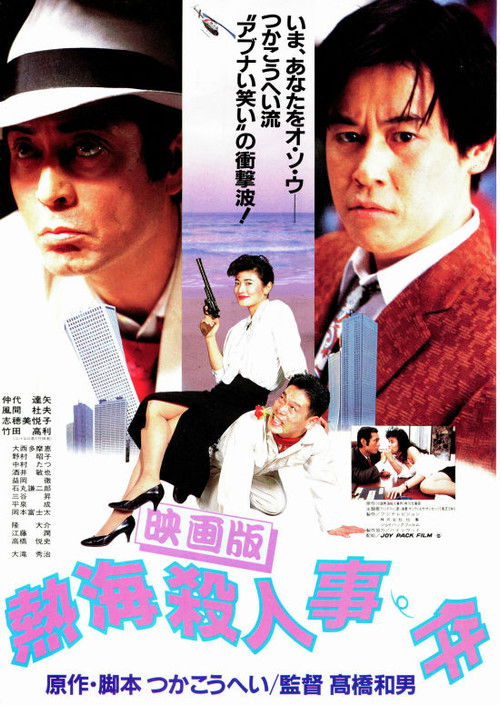
Kazuo Takahashi’s 1986 film ‘Atami Murder Case’ presents a fascinating exploration of detective work and criminal psychology during Japan’s bubble economy era. The narrative follows the legendary Chief Detective Kimura Denbei, affectionately known as ‘Smoky Denbei’ throughout the Metropolitan Police Department, as he navigates the complexities of modern crime alongside Detective Kumada Tomekichi, a newcomer transferred from Toyama Prefectural Police. What makes this crime drama particularly intriguing is Denbei’s controversial philosophy: that contemporary murderers no longer require logical, comprehensible motives. Kumada’s gradual acceptance of these unconventional investigative methods forms the emotional core of the film, creating tension between traditional detective work and the murky reality of contemporary criminal behaviour. This thematic tension between order and chaos, between understanding and acceptance of the inexplicable, permeates every aspect of the film, nowhere more effectively than in its remarkable musical accompaniment.
Upon its release, ‘Atami Murder Case’ garnered significant critical appreciation within Japanese cinema circles, establishing itself as a thoughtful entry in the detective genre that transcended typical crime narrative conventions. The film’s willingness to challenge audiences’ expectations regarding motive and logic resonated with viewers seeking something beyond formulaic mystery plotting. While perhaps not achieving the mainstream commercial heights of some contemporaneous releases, the film developed a respectable following among critics and cinema enthusiasts who appreciated its philosophical approach to criminology and human psychology. The film’s reputation has endured among devoted fans of Japanese cinema, particularly those interested in how the medium handled contemporary social anxieties during Japan’s economic boom.
Central to the film’s atmospheric power is Joe Hisaishi’s exceptional score, which serves as far more than mere background accompaniment. Hisaishi’s compositional approach demonstrates his characteristic sophistication and emotional intelligence, crafting music that actively enhances the film’s exploration of psychological ambiguity. Rather than employing traditional dramatic scoring techniques that might resolve tensions or provide emotional certainty, Hisaishi constructs a soundscape that mirrors Denbei’s worldview—one where clarity and conventional understanding cannot be relied upon.
The score employs subtle instrumental textures, combining traditional Japanese elements with contemporary orchestral arrangements. This fusion reflects the film’s own thematic concerns with the collision between traditional investigative methods and modern criminal realities. String arrangements carry a restless quality, frequently unresolved and meandering, suggesting the circular nature of criminal investigation when traditional motives no longer apply. Woodwind instrumentation adds moments of introspection, particularly during sequences where Kumada grapples with his mentor’s philosophies.
Hisaishi’s musical themes develop organically alongside character development, with Denbei’s motif possessing a weathered, experienced quality—economical in its expression yet profound in its implications. The composer avoids grandiose gestures, instead favouring intimate orchestration that draws listeners into the psychological landscape of criminal investigation. This restraint proves exceptionally effective during investigation sequences, where the music’s ambiguity mirrors the detectives’ struggle to comprehend motiveless crimes.
The score’s relationship with visual storytelling demonstrates Hisaishi’s mastery of cinematic composition. Rather than competing with dialogue or action, the music creates psychological space, allowing viewers to inhabit the detectives’ uncertainty. This sophisticated approach to film scoring showcases why Hisaishi became such a sought-after composer—his ability to translate abstract emotional and philosophical concepts into compelling musical language remains unparalleled in Japanese cinema.