
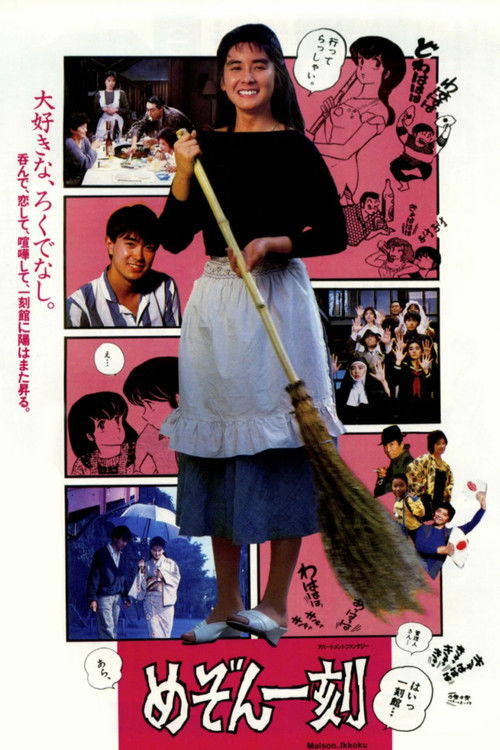
Maison Ikkoku: Apartment Fantasy, released in 1986 and directed by Shinichiro Sawai, invites viewers into one of anime’s most charmingly chaotic settings—a Japanese apartment building teeming with unforgettable characters. The film follows the everyday adventures of its volatile inhabitants: Kyoko, the enigmatic and beautiful new apartment manager; Yusaku, a perpetually stressed college student drowning in exam preparations; Mrs. Ichinose, a gossipy woman with a fondness for alcohol; her mischievous son Kentaro; Akemi, a bar hostess with equally questionable sobriety; and Mr. Yotsuya, the building’s resident freeloader and unwelcome observer. Through their interactions and misadventures, the film captures the essence of communal living in Japan with both humor and heart.
Upon its release, Maison Ikkoku: Apartment Fantasy achieved considerable success within Japan’s anime community and helped cement the franchise’s popularity throughout the 1980s. The film’s adaptation of the beloved manga and television series resonated with audiences who appreciated its balance of comedy, romance, and relatable domestic chaos. European fans discovered the film somewhat later, but it has since become a cherished entry in the anime canon, celebrated for its faithful representation of the source material’s spirit and its vibrant characterization.
However, the true magic of Maison Ikkoku: Apartment Fantasy lies in Joe Hisaishi’s extraordinary musical composition. Hisaishi, already renowned for his collaborative work with Hayao Miyazaki, demonstrates in this score why he stands among anime’s greatest composers. His approach to the film’s music is nothing short of revelatory, crafting a sonic landscape that perfectly encapsulates the film’s unique blend of comedy, warmth, and underlying melancholy.
Hisaishi’s compositional strategy employs a remarkably diverse palette of musical themes, each tailored to illuminate specific characters and situations. The score seamlessly transitions between whimsical, comedic passages—particularly during the apartment’s most absurd moments—and tender, romantic interludes that showcase the deeper emotional currents beneath the film’s humorous surface. His use of traditional Japanese instrumental textures combined with contemporary orchestral elements creates a distinctly hybrid sound that feels both authentically Japanese and cosmopolitan.
The opening theme sets the tone magnificently, establishing an infectious energy that mirrors the apartment’s bustling atmosphere. Hisaishi employs playful woodwind arrangements and bouncing rhythmic patterns that immediately endear listeners to the building’s eclectic residents. Yet beneath this cheerfulness lies sophisticated harmonic work that prevents the score from becoming merely frivolous.
Throughout the film, Hisaishi demonstrates remarkable sensitivity to visual storytelling. When the narrative focuses on Kyoko and Yusaku’s blossoming relationship, the music transforms into something more delicate and introspective, with elegant string arrangements and subtle piano melodies that capture the tentative hope of new romance. Conversely, scenes of domestic mayhem are accompanied by frantic, comedically timed orchestrations that enhance the visual gags without overwhelming them.
What ultimately distinguishes Hisaishi’s work here is his understanding that great film music must serve the story while maintaining its own artistic integrity. His score for Maison Ikkoku: Apartment Fantasy achieves this balance beautifully, elevating the film beyond mere entertainment into something genuinely memorable. For European fans discovering Hisaishi’s extensive catalogue, this 1986 gem represents an essential listen—a testament to his compositional genius and his ability to capture the human experience through music.