
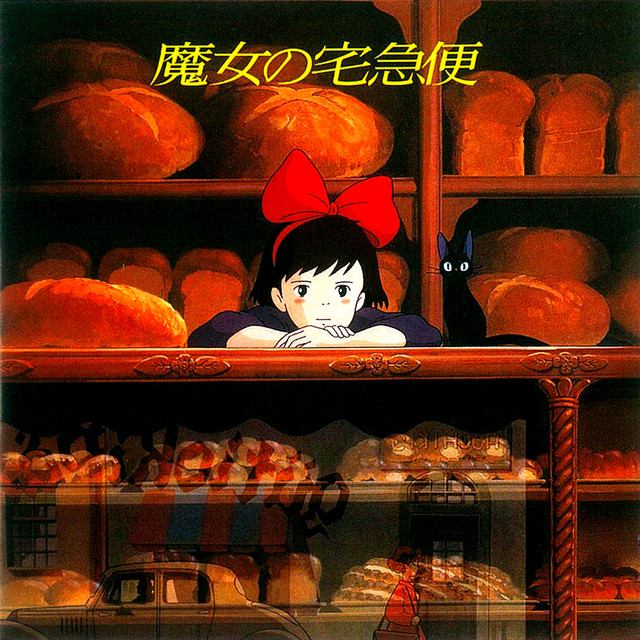
Album: 魔女の宅急便 イメージアルバム
When Joe Hisaishi first sat down to compose music for a young witch’s journey of independence, he wasn’t thinking about orchestral grandeur or polished film scores. Instead, he envisioned something more immediate and raw: musical sketches that would capture the essence of a story before the cameras even rolled.
The “Kiki’s Delivery Service Image Album” represents one of the most fascinating experiments in film music creation – a collection of synthesizer-based compositions that served as the creative blueprint for what would become one of Studio Ghibli’s most beloved soundtracks. Unlike traditional image albums that often bear little resemblance to their final film counterparts, Hisaishi’s preliminary work for Hayao Miyazaki’s 1989 animated feature demonstrates an almost telepathic understanding between director and composer.
This remarkable creative partnership becomes evident when examining how closely the image album tracks correspond to specific scenes in the final film. Of the twelve compositions on this album, only two – “Nagisa no Date” (Seaside Date) and “Toppuu” (Sudden Wind) – didn’t make it into the movie. This near-perfect translation rate suggests that Miyazaki and Hisaishi engaged in extensive discussions about the film’s emotional landscape long before animation began.
Hisaishi approached this project with a deliberately loose geographical concept in mind: “somewhere European, perhaps around the Mediterranean.” This vague but evocative inspiration allowed him to craft music that feels both specific and universal. Rather than getting bogged down in authentic folk traditions or precise cultural references, he created a sonic palette that suggests European charm without being tied to any particular nation’s musical heritage.
The album’s instrumentation reflects this approach perfectly. While synthesizers form the backbone of every track, Hisaishi weaves in violin melodies, guitar textures, and percussion patterns that evoke the cobblestone streets and seaside cafes of an idealized European town. It’s music that breathes with the same sense of possibility that drives young Kiki as she sets off to make her way in the world.
Take “Machi no Yoru” (Town at Night), one of the album’s most atmospheric pieces. Built around a simple synthesizer arrangement, the track captures the mystery and excitement of exploring a new place after dark. The melody moves with the curiosity of someone discovering hidden alleyways and lit windows, each phrase suggesting another corner to turn. There’s no dramatic orchestration here – just pure melodic expression that makes you feel like you’re floating through unfamiliar streets alongside our young protagonist.
Hisaishi’s philosophy for this project extended beyond mere musical sketching. He deliberately avoided what he calls emotional manipulation through music – the conventional approach of matching sad scenes with melancholy compositions or action sequences with bombastic scores. Instead, he aimed to create music that would make audiences feel comfortable and at ease, regardless of what was happening on screen. This counter-intuitive approach requires tremendous confidence in your melodic material, and Hisaishi’s themes prove more than capable of carrying this responsibility.
“Kaze no Oka” (Wind Hill) exemplifies this philosophy beautifully. The track feels like a gentle breeze made audible, with synthesized textures that seem to lift and carry you forward. There’s an inherent optimism in the melody that doesn’t force happiness but simply invites it. When this music eventually accompanied Kiki’s flying sequences in the film, it didn’t need to spell out the joy of flight – it embodied the sensation itself.
The concept of wind and breath permeates the entire album, though it’s more subtle here than in the final orchestrated score. Hisaishi understood that Kiki’s story was fundamentally about air and movement – a young witch whose power comes from the sky, living in a coastal town where sea breezes mix with urban energy. The synthesizer tones often mimic the quality of wind instruments, creating sustained notes that seem to float and drift like invisible currents.
“Genki ni Naresou” (I Feel Like I Can Get Better) demonstrates how effectively Hisaishi could convey complex emotions through simple electronic arrangements. The title itself suggests resilience and hope, and the music delivers on that promise without resorting to overly cheerful melodies. Instead, there’s a gentle determination in the way the synthesizer lines interweave, building confidence measure by measure. It’s the musical equivalent of taking a deep breath and deciding to try again.
What makes this album particularly valuable for understanding Hisaishi’s creative process is how it reveals the skeletal structure of his musical thinking. Without the lush orchestrations and careful production polish of the final soundtrack, we can hear the core melodic ideas in their purest form. These aren’t demo recordings or rough drafts – they’re complete musical statements that happen to use synthesizers as their primary voice.
The album’s rough-sketch quality doesn’t diminish its artistic value; rather, it enhances our appreciation for how strong melodies can communicate across different arrangements and instrumentations. Hisaishi’s themes are so fundamentally sound that they work just as well in simple electronic settings as they do with full orchestras.
This image album also reveals how deeply Hisaishi thinks about the relationship between music and storytelling. Rather than composing abstract pieces and hoping they might fit somewhere in the film, he created music that already understood its narrative purpose. Each track feels like it knows exactly what story it wants to tell, even in this preliminary form.
The collaboration between Hisaishi and Miyazaki represented here goes beyond typical director-composer relationships. It’s a meeting of minds that happened before storyboards were finalized or voice actors cast. The music didn’t need to react to completed visuals because it was already part of the storytelling process from the beginning.
Listening to “Kiki’s Delivery Service Image Album” today feels like discovering an alternate universe version of a familiar soundtrack – one where synthesizers reign supreme but the emotional core remains unchanged. It’s a reminder that great film music begins with great melodies, and everything else is simply a matter of arrangement and orchestration. In Hisaishi’s capable hands, even the simplest electronic textures can capture the wonder of a young witch learning to fly.
- かあさんのホウキRead Review
- ナンパ通りRead Review
- 町の夜Read Review
- 元気になれそうRead Review
- 渚のデイトRead Review
- 風の丘Read Review
- トンボさんRead Review
- リリーとジジRead Review
- 世界って広いわRead Review
- パン屋さんの窓Read Review
- 突風Read Review
- 木洩れ陽の路地Read Review

Sources
- Kiki’s Delivery Service Image Album – Liner Notes
- Kiki’s Delivery Service Soundtrack LP Liner Notes (2020)
- Kiki’s Delivery Service Roman Album