
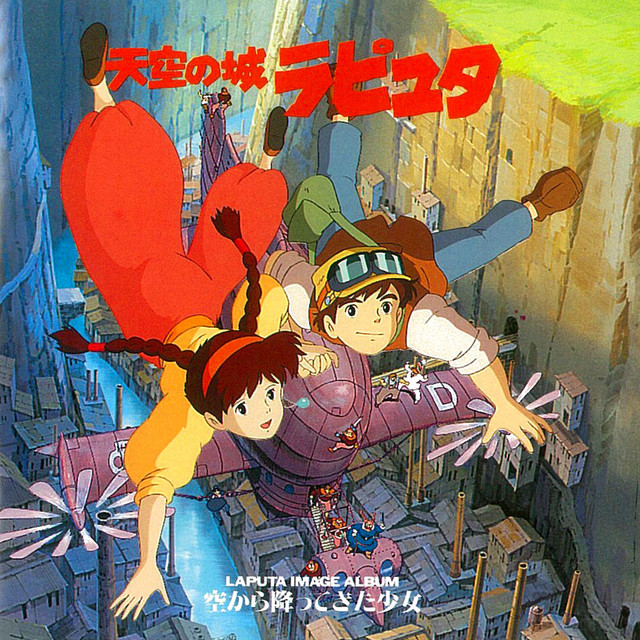
Album: 天空の城ラピュタ イメージアルバム ~空から降ってきた少女~
In March 1986, Joe Hisaishi found himself in London’s prestigious Air Studios, putting the finishing touches on one of his most ambitious projects yet. The album “Castle in the Sky Image Album: The Girl Who Fell from the Sky” wasn’t just another soundtrack—it was an experimental approach to film scoring that would revolutionize how animated features approached music composition.
What makes this album extraordinary isn’t just its beautiful melodies, but the radical two-stage creative process that brought it to life. Unlike traditional film scoring, where composers write music after seeing completed scenes, Hisaishi created this image album before Hayao Miyazaki’s “Castle in the Sky” was fully animated. This unconventional approach would prove to be a stroke of genius, allowing both director and composer to develop a shared musical vocabulary that would inform every scene of the finished film.
The pressure Hisaishi felt during this period was immense. Reuniting with Miyazaki and Isao Takahata after their successful collaboration on “Nausicaa of the Valley of the Wind,” he carried the weight of expectations on his shoulders. “I had to create something truly wonderful,” he later reflected, describing how this unspoken pressure haunted him daily during the recording sessions. The challenge wasn’t just musical—it was philosophical. Miyazaki and Takahata had posed a profound question that would guide the entire project: “What must adults leave for children today?”
This existential weight shaped every note of the album. Rather than creating typical adventure music filled with bombastic orchestrations, Hisaishi chose a deliberately simple, acoustic approach. This was a conscious departure from his previous work on “Arion,” which had featured complex sound sampling. For “Castle in the Sky,” he wanted something that would warm children’s hearts—music that could convey love, dreams, and adventure through clear, memorable melodies.
The opening track, “Castle in the Sky,” establishes this philosophy immediately. Built around a soaring main theme that would become one of Studio Ghibli’s most recognizable melodies, it captures the wonder of discovery and the promise of adventure. The acoustic instrumentation creates an intimate feeling despite the grand subject matter, reflecting Hisaishi’s belief that the most powerful emotions come from simplicity rather than complexity.
Perhaps no track better illustrates the collaborative process between Hisaishi and Miyazaki than “Dola.” For this piece, Miyazaki provided Hisaishi with detailed character notes that read like poetry: “Passion and pride, appetite and greed, overflowing love and hatred. The flag that flies has been passed down from generations before. If we don’t live now, when will we live? Children, follow me. I’ll teach you the joy of living.” These words guided Hisaishi in creating music that captures the air pirate leader’s fierce vitality and maternal strength. The resulting composition balances menace with warmth, perfectly embodying a character who terrorizes her enemies while nurturing her crew like a mother hen.
The album’s innovative production process extended beyond composition into its technical realization. Initial recordings took place at Wonder Station and Nikkatsu Studio Center in Japan, but the crucial final mixing happened at London’s Air Studios, with engineers Steve Jackson and Masayoshi Ohkawa bringing international expertise to the project. Hisaishi noted that this London finishing process gave each piece a “bright, lively quality” that elevated the entire album.
What emerged from this cross-cultural collaboration was something unprecedented in animation music. By creating the image album first, Hisaishi and the filmmakers could discuss specific scenes with remarkable precision. “In this scene, we’ll use that theme,” became the level of detail possible when everyone involved had the same musical references in their minds. As Hisaishi observed, “Probably nobody else is doing anything like this.”
The track “Sheeta and Pazu” demonstrates how this collaborative process enhanced the storytelling. Rather than generic “romantic” music, Hisaishi crafted something that speaks to the specific relationship between these characters—a friendship built on shared wonder and mutual protection. The music captures their childlike amazement at the world around them while hinting at the deeper bond that will sustain them through their adventures.
This image album approach had profound implications beyond just one film. It established a template for how music could be integrated into the storytelling process from the earliest stages, rather than being added as an afterthought. The success of this method would influence how Studio Ghibli approached subsequent projects and demonstrated that animated films could achieve the same level of musical sophistication as live-action cinema.
The album’s enduring appeal lies in its ability to function as both accompaniment to Miyazaki’s visuals and as standalone musical storytelling. Each track creates vivid imagery in the listener’s mind, whether they’ve seen the film or not. This dual nature reflects Hisaishi’s understanding that the best film music doesn’t just support what’s happening on screen—it creates its own emotional narrative that enhances and deepens the viewing experience.
Listening to “The Girl Who Fell from the Sky” today, more than three decades after its creation, its revolutionary approach remains evident. The album stands as proof that innovation in film music doesn’t require abandoning melody or emotional directness. Instead, it shows how rethinking the creative process itself can lead to art that transcends its original medium.
In an industry often focused on efficiency and established practices, Hisaishi’s willingness to experiment with this two-stage composition process created something genuinely new. The image album didn’t just provide music for an animated film—it helped define what animated film music could become when composers and directors truly collaborate from the beginning. The result is an album that captures the essence of childhood wonder while addressing the profound responsibility adults have to preserve that wonder for future generations.
- 天空の城ラピュタRead Review
- ハトと少年Read Review
- 鉱夫Read Review
- 飛行石Read Review
- ドーラRead Review
- シータとパズーRead Review
- 大樹Read Review
- フラップターRead Review
- 竜の穴Read Review
- ティディスの要塞Read Review
- シータとパズーRead Review
- 失われた楽園Read Review
Sources
- Castle in the Sky Image Album Liner Notes
- Castle in the Sky Roman Album
- Castle in the Sky Image Album (Miyazaki Memo)